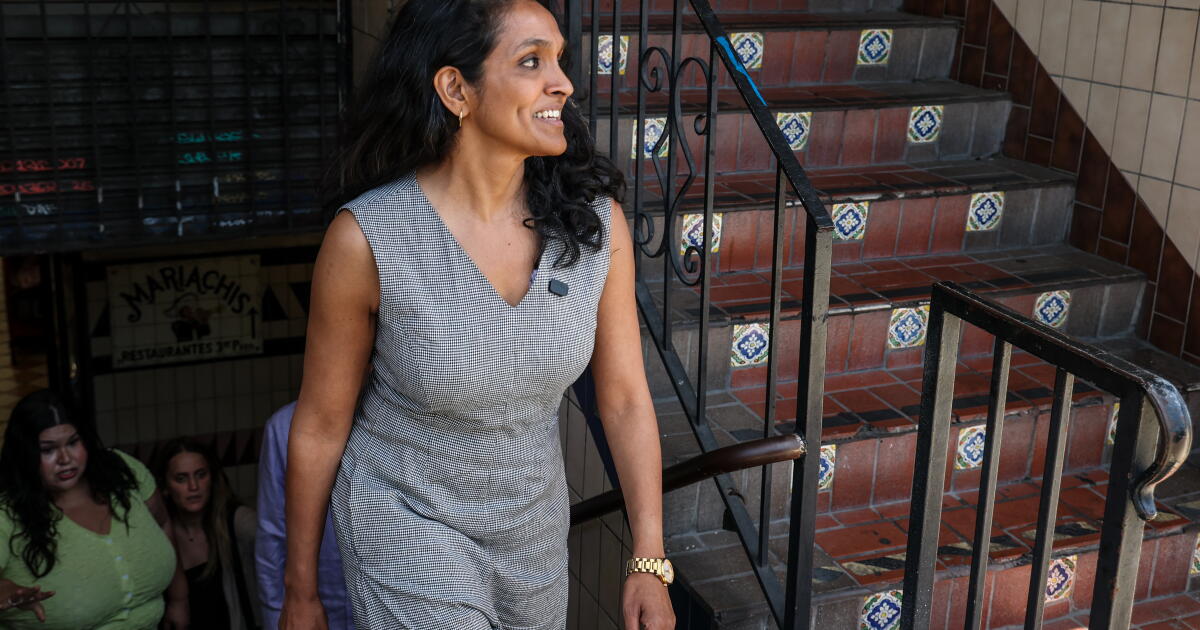
When voters chose Nithya Raman as the next mayor of Los Angeles, the outcome signaled far more than a change in leadership at City Hall.
It marked a definitive, and perhaps permanent, crack in the foundation of the city’s long-dominant Latino political establishment, the LA Times reported. For decades, this network—comprised of union activists, nonprofit leaders, and seasoned politicians—served as the primary gatekeeper for power in the nation’s largest Latino capital.
By betting heavily on the incumbent, Karen Bass, these power brokers found themselves on the outside looking in, watching a new generation of voters bypass the traditional playbook entirely.
The stakes were clear from the start. Mayor Bass entered the race with the full weight of the establishment behind her, securing endorsements from prominent figures who had once helped pioneer the political machinery that defined Southern California elections.
Yet, that institutional muscle failed to translate into the necessary support at the ballot box. While Bass leaned on a coalition of established political allies, Raman’s campaign focused on mobilizing a younger, more diverse demographic that was largely unmoored from the traditional machine.
A Failing Institutional Playbook
The disconnect between the political establishment and the electorate grew increasingly visible throughout the campaign. On October 24, at a rally in Panorama City—a hub for the San Fernando Valley’s influential political machine—elected officials gathered to frame the election as a critical moment for the city.
“You need to remind them Mayor Karen Bass is the right leader,” Representative Luz Rivas told a crowd that largely lacked the very Latino demographic the event was intended to reach. The enthusiasm was notably thin, contrasting sharply with the energy at a nearby canvasada hosted by the Raman campaign, where union members and students gathered to fuel their efforts with tacos and grassroots organizing.
“The mayor ran on a very institutional playbook of getting a bunch of Latino politicians together so they could tell Latinos how to vote. That doesn’t work anymore. Latinos want deeds,” said Marco Santana, a political consultant who supported Raman’s campaign.
This rejection of the “institutional playbook” did not happen in a vacuum. The establishment’s credibility has been eroding for years, battered by a series of scandals that left many voters disillusioned. The 2022 audio leak, which featured top city officials using racist language, turned once-powerful council members into pariahs.
That same year, the political landscape shifted further when democratic socialist candidates Hugo Soto-Martínez and Eunisses Hernandez secured City Council seats, despite skepticism from the old guard who dismissed their chances. By early 2024, the corruption conviction and 13-year prison sentence of former Councilmember Jose Huizar—once a rising star—further underscored the fragility of the status quo.
The New Generation of Leadership
The shift is also demographic and cultural. As the city evolves, the traditional methods of “caudillos y caudillas” (political bosses) are meeting resistance from younger leaders who prioritize policy and community engagement over patronage.
When Raman kicked off her remarks in Sylmar with an “¡Hola, Sylmar!” and acknowledged local landmarks, she was speaking to a community that felt ignored by the standard media outreach efforts. Her message, “La comunidad latina merece más” (The Latino community deserves more), resonated in ways that traditional, top-down endorsements did not.

The consequences of this election ripple through various sectors of the city, from labor unions to local school boards. The loss of influence among the traditional Latino political elite forces a re-evaluation of how power is brokered in Los Angeles. While the establishment may not disappear overnight, its ability to dictate the outcome of a municipal race has been severely compromised.
Even as Raman prepares to assume office, the reality of governing in a city with such deep-seated political divisions remains a challenge. During a recent news conference regarding federal immigration enforcement, Raman stood alongside state Senator Maria Elena Durazo and other leaders who had previously endorsed Bass. The event served as a reminder that while the guard has changed, the need for coalition-building remains.
For now, the city is left with the aftermath of a campaign that proved institutional backing is no longer a guaranteed path to victory. As Michael Trujillo, a longtime political consultant, noted, the reconstruction of the Latino political establishment will be a long process, if it happens at all.
The Raman era begins with a clear mandate from voters who are no longer willing to wait for the machine to catch up to their needs.
Keep reading

No. 9 Tennessee Faces Texas A&M in Crucial SEC Road Matchup
No. 9 Tennessee faces a critical road test against Texas A&M this Saturday at 3 p.m. Eastern Time....

Oregon Progressives Gain Power to Push Wealth Tax and Policy Shifts
Oregon progressives roughly doubled their presence in the House and Senate during last week's election as the Democratic...

Why Beating Michigan Is the Only Nonnegotiable Left for Ohio State
In a column for Land-Grant Holy Land, a contributor argues that while Ohio State has three games remaining...

Proposed SNAP Rule Changes Could Impact Nevada Families and Retailers
Federal regulators are moving to tighten how families qualify for food assistance, a decision that could strip nutrition...