| Date | Event |
|---|---|
| February 6, 2025 | Trump issues Executive Order 14,203 authorizing ICC sanctions |
| December 2025 | Russian court convicts eight ICC judges and the prosecutor in absentia |
| July 24, 2026 | Assembly removes Prosecutor Karim Khan for serious misconduct |
| July 13, 2026 | Rubio announces campaign to dismantle ICC “brick by brick” |
| October 9, 2026 | US sanctions the ICC as an institution |
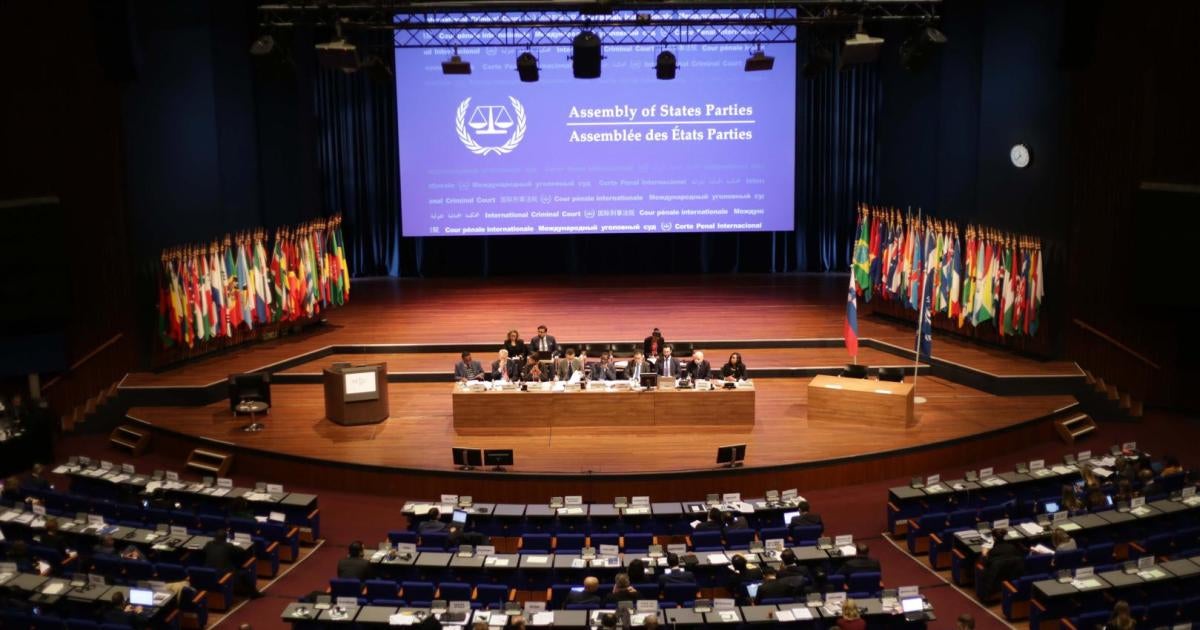
| November 30, 2026 | Duterte trial scheduled to begin; ASP session opens in The Hague |
Since February 2025, the US has used Executive Order 14,203 to sanction the former prosecutor and his deputies, a senior trial lawyer, nine judges including the ICC president, UN Special Rapporteur Francesca Albanese, and three Palestinian human rights organizations.
On October 9, the US sanctioned the court itself.
“The US government ‘structured this action to provide an opportunity for States Parties to negotiate and present a solution to address our concerns,’” Secretary of State Marco Rubio said in July, referring to a six-month general license expiring April 7, 2027. The State Department said the period is intended “to provide time for States Parties to demonstrate meaningful progress on diplomatic and legal resolutions.”
Seven lawsuits challenging the order are pending in US federal court. Human Rights Watch, the American Friends Service Committee, the Center for Constitutional Rights, and the Open Society Institute filed one on August 11, arguing the sanctions exceed presidential authority and violate First and Fifth Amendment rights.
The ICC has shifted its IT systems from Microsoft to a European provider, changed insurers, removed US-nexus transactions, and paid staff in advance. States parties have made early assessed contributions. The European Council on October 16 asked the Commission to protect the court and mitigate sanctions toward EU companies.
The Commission on October 23 urged EU operators to “continue providing services to the ICC as before, enabling the court to continue carrying out its mandate in full.”
Human Rights Watch said the EU must activate its Blocking Statute to give banks and service providers legal clarity beyond the six-month license. The statute prohibits EU entities from complying with listed extraterritorial sanctions, and the Commission can add the US ICC sanctions to its annex.
At its last session, the Assembly agreed any dialogue with non-states parties must take place “with full respect for the Rome Statute and the independence, impartiality and integrity of the Court.”
Human Rights Watch said engagement should not result in concessions that pressure judicial independence or hollow out the court’s mandate.
The trial of former Philippine President Rodrigo Duterte for crimes against humanity of murder and attempted murder is scheduled to open on November 30, the first day of the Assembly session.
Worth a look

Luxon Calls Putin a ‘Killer’ and Criticises Trump’s Remarks
New Zealand Prime Minister Christopher Luxon called Russian President Vladimir Putin "a killer" and sharply criticised US President...
IDFA Director Warns Against Overstating Documentary Revival
Three documentaries — Alex Gibney's four-hour Musk, the Guardian-produced NAZA, and Nathan Fielder and Lance Oppenheim's You Can...

ICC Upholds Jurisdiction Over Njeem, Defers Admissibility Ruling in Libya Case
Pre-Trial Chamber I of the International Criminal Court unanimously upheld its jurisdiction over Osama Almasri Njeem on November...
US Rep. Brendan Boyle Elected President of NATO Parliamentary Assembly
U.S. Rep. Brendan Boyle was elected president of the NATO Parliamentary Assembly on Monday in Berlin, a role...