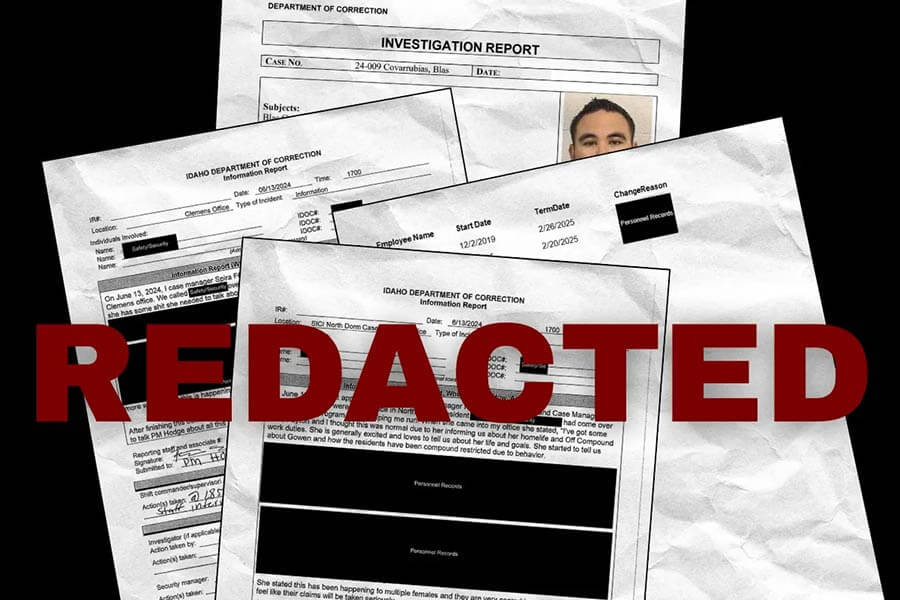
An Idaho judge ordered the release of police employment records on November 5 following a legal battle over whether state agencies could withhold officer separation details.
Ada County District Judge Patrick J. Miller ruled that the Idaho State Police and the Idaho Department of Correction must disclose information regarding why officers left their positions, including whether they were terminated, resigned, or retired.
The Bottom Line:
- Legal Precedent: The ruling establishes that “employment history” under the Idaho Public Records Act includes the nature of an employee’s departure, preventing agencies from using file location to shield data.
- Accountability Gap: The litigation stemmed from a 2025 investigation that revealed dozens of prison guards were permitted to resign without facing criminal prosecution or disciplinary action for alleged sexual misconduct.
- Systemic Friction: State agencies attempted to bypass disclosure by “disabling” internal search tools and claiming records were part of confidential decertification files.
The judicial mandate for transparency
The court’s decision directly addresses attempts by state agencies to restrict access to data that was previously available to news organizations. InvestigateWest and the Invisible Institute filed suit on June 16, alleging that the state agencies were concealing officer employment histories that had been disclosed in the past.
According to East Idaho News, the agencies had begun denying requests, stating they would no longer disclose whether an officer retired, resigned, or was fired.
Judge Miller rejected the argument that disclosing a reason for separation would improperly reveal confidential disciplinary details. The ruling said that the Idaho Public Records Act does not allow an agency to withhold nonexempt information simply because it is housed within an otherwise exempt file.
The judge specifically said that an officer’s employment history and dates of service do not lose their character as disclosable records just because they reside in the same file as confidential details.
Agency attempts to bypass disclosure
The litigation revealed specific tactical shifts by state leadership to limit data availability. A records clerk informed the Invisible Institute that Idaho State Police leadership decided to “disable” a tool used to search an internal employment database.
While the agency claimed the tool was no longer in use because it was “unreliable” and produced inconsistent results, Judge Miller found this defense insufficient. The court ruled that an agency cannot defeat statutory rights of access by choosing to maintain records in a system from which they claim they cannot retrieve them.
The Idaho State Police also claimed the requested information was contained in confidential decertification files, which they argued were exempt from disclosure. The agency stated it had no records in response to certain public records requests.
However, the judge pointed to a public-facing search tool on the state Peace Officer Standards and Training website as being “inconsistent” with the agency’s claim that it lacked the records. The court has since ordered the state police and the prison system to conduct a new search for the requested database records.
The institutional impact of misconduct concealment
The underlying driver for this legal action was an October 2025 series by InvestigateWest. That reporting used officer employment records to expose alleged sexual misconduct by dozens of Idaho prison guards.
The investigation highlighted a pattern where staff members were allowed to resign rather than face disciplinary or criminal consequences. This revelation prompted Idaho lawmakers to close a loophole in a sexual abuse law and order an independent review of the state’s women’s prison system.
“This ruling is a win for government transparency — and accountability — in Idaho,” said Jacob Fries, InvestigateWest’s executive director.
The disclosure mandate also includes the names of several state employees previously accused of misconduct, which the judge found had been improperly redacted. This includes information regarding two former prison guards accused of sexually assaulting an inmate, according to East Idaho News.
Impact on public oversight
For the American public, this ruling serves as a critical check on the ability of state institutions to manage their own liability by obscuring personnel history.
When agencies can selectively “disable” databases or reclassify employment status as confidential, the ability of taxpayers and regulators to monitor the use of public funds and the conduct of public servants is compromised. This creates a transparency deficit that can mask systemic risks in state-run institutions.
Institutional observers view this as a development in the tension between administrative privacy and public accountability. The ability of journalists to access the National Police Index, a database maintained by the Invisible Institute, relies on the integrity of these state-level data feeds. If agencies can effectively "deactivate" the paper trail of misconduct, oversight mechanisms become less effective.
“An agency may not defeat the public’s statutory right of access by choosing to maintain public records in a system from which the agency claims it cannot retrieve them,” Judge Miller wrote in the ruling.
The court’s order requires the Idaho State Police and the Department of Correction to proceed with the search for the requested records and to release the names and separation details of the officers in question.
Disclaimer: The information provided in this article is for educational and market analysis purposes only and does not constitute financial, investment, or legal advice. Always consult with a certified financial professional before making investment decisions.
Related reading

Little Rock Nonprofit Aims to Support Homeless Veterans
“I’m always that one call away,” said Latoria Lea Compton, founder and executive director of the Gentle Promise...

Wife of Former NFL QB Richard Todd Arrested After Pliers Attack
Debra Todd, the wife of former Alabama and New York Jets quarterback Richard Todd, was arrested and charged...

Trial Begins Over Alleged Abuse at Wyoming Boys’ School
“Instead of helping him manage his emotions, they locked him away,” said Ciara Boerman, an attorney representing Blaise...

Wisconsin Supreme Court to Hear Act 10 Constitutionality Appeal
Public employee collective bargaining rights face a high-stakes legal showdown as the Wisconsin Supreme Court prepares to hear...