The critical constraint driving this platform is the 30-second limit of terrestrial microgravity analogues — parabolic flights and drop towers — which is insufficient for thorough human-machine interaction studies.
The VR system bypasses that ceiling by embedding ISS-derived physics into a headset, allowing deorbit maneuvers, emergency responses, and robotic arm operations to run for minutes or hours rather than seconds.
The Bottom Line:
- Configurable VR spacecraft cockpit calibrated with actual ISS microgravity telemetry.
- Integrates 32-channel EEG, binocular eye-tracking, and NASA TLX/Cooper-Harper subjective scales into a single repeatable platform.
- Statistical validation at α = 0.05 across trained test pilots using Shapiro–Wilk normality checks and paired t-tests.
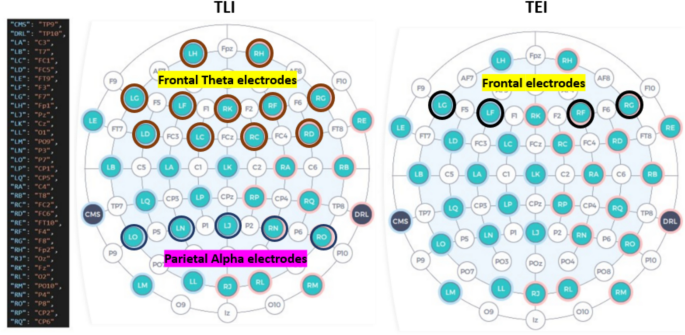
The rig centers on an HTC Vive Pro Eye headset with integrated gaze tracking, supplemented by Tobii Pro Glasses and an Emotiv EPOC Flex 32-channel EEG cap prepared in saline solution under the standard 10–20 montage.
Raw EEG feeds five bands — theta, alpha, beta-low, beta-high, gamma — into two indices: Task Load Index (frontal midline theta / parietal alpha) and Task Engagement Index (beta / (theta + alpha) at F3, F4, F7, F8). Ocular metrics use a 30°/sec velocity threshold (I-VT) to separate fixations from saccades, then compute fixation rate, mean duration, and saccade velocity. A Nearest Neighbor Index (NNI) quantifies gaze entropy across the area of interest.

Unlike commercial aviation, spacecraft operations are predominantly automated or ground-controlled. Yet NASA’s Human Rating requirements mandate manual control capability for contingency survival — Apollo 13 and Soyuz T-10-1 proved the point.
Current CAD/CAE tools paired with Digital Human Models lack the fidelity to stress-test cockpit layouts against real cognitive load in microgravity. The IISc platform closes that gap by letting designers swap panel geometries, control laws, and display symbology inside the same validated physics envelope.
Eight highly trained test pilots flew counterbalanced scenarios with enforced rest periods to mitigate order effects. Normality of paired differences passed Shapiro–Wilk; pairwise two-tailed t-tests at α = 0.05 with Cohen’s d effect sizes followed. Analysis ran in Excel Data Analysis Toolpak and IBM SPSS v24. Each pilot generated one physiological datapoint per condition, treated as independent observations.
A validated VR alternative that ports ISS physics into a headset-EEG bundle shifts the cost curve for early-phase cockpit optimization. Boeing, SpaceX, and NASA’s Orion program currently rely on hybrid physical mock-ups and parabolic campaigns; a software-defined platform that reproduces microgravity ergonomics on demand could compress design iteration cycles from quarters to weeks.
IISc, founded in 1909 in Bengaluru with support from Jamsetji Tata, was the first Indian institution to introduce master’s programs in engineering and later pioneered integrated doctoral programmes across natural sciences. Its campus originated on 371 acres donated by Maharaja Krishnaraja Wadiyar IV, and the institute was deemed a university in 1958.
The preprint does not report absolute TLI/TEI thresholds that correlate with mission-critical error rates, nor does it disclose the specific ISS telemetry datasets used for physics calibration.
Keep reading
Greene County Wildfire Grows to 500 Acres, Crosses into Hawkins County, Closes School
A wildfire burning on Caney Creek Lane in Greene County has exploded to roughly 500 acres in a...
Mississippi IHL Eliminates 15 Degree Programs, Suspends 4 in Productivity Review
The Mississippi Institutions of Higher Learning Board of Trustees voted Thursday to eliminate 15 academic degree programs across...

Georgia Southern Rallies Past Houston Christian 86-79 to End Huskies’ Win Streak
Houston Christian saw its season-opening four-game winning streak end Thursday night when Georgia Southern rallied late for an...
Single Interprofessional Workshop Boosts Medical and Pharmacy Student Collaboration at JayDoc Clinic
Twenty-seven students showed up, and the data shifted. Medical and pharmacy students at the University of Kansas School...