
Illinois rejected a Trump voucher program while unions demanded $7 billion in school funding.
“Public dollars belong in public schools,” said Stacy Davis Gates, president of the Chicago Teachers Union.
Gov. JB Pritzker announced Tuesday that Illinois will not opt into the Trump administration‘s Federal Scholarship Tax Credit voucher program, rejecting a plan educators argued would drain resources from the state’s 1.8 million public school students.
The decision follows a year of pressure from a statewide coalition. In January, IFT joined a coalition letter urging the governor to keep Illinois out. In April, the Chicago Board of Education passed a resolution demanding rejection. In June, Davis Gates joined union presidents nationwide calling on Democratic governors to refuse the program, IFT reported.
Gov. Pritzker’s office cited critical flaws identified in a review of Treasury and IRS guidance. Federal regulations prohibit states from setting stricter guidelines on scholarship-granting organizations, restrict the types of schools that can benefit, and prevent narrowing what scholarship funding covers, the governor’s office told m.edglentoday.com. The tax credit is estimated to divert $2.7 billion to $6.1 billion in federal revenue annually.
“Trump’s voucher scheme was built to pull money out of public education with zero oversight and zero educational benefit for students,” Davis Gates said. “Illinois’ 1.8 million public school students deserve better, and today they got it.”
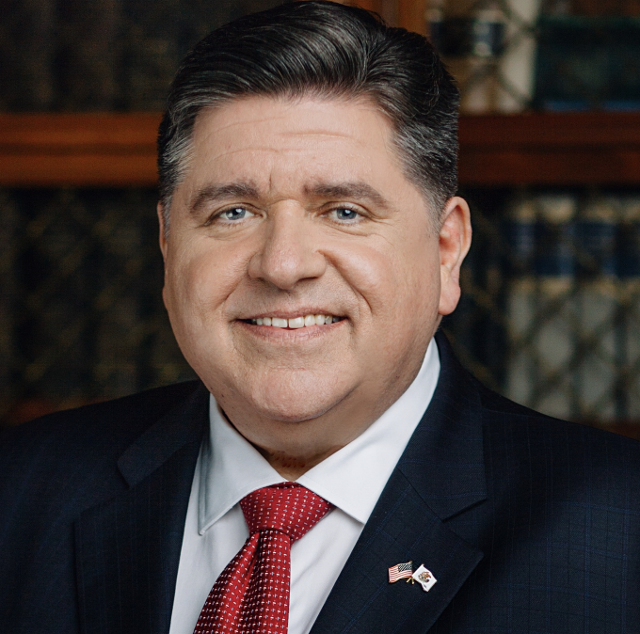
“Gov. Pritzker did the right thing in rejecting Trump’s voucher program,” Davis Gates said. “And to be clear, saying no to vouchers is the floor, not the ceiling.”
U.S. Sens. Dick Durbin and Tammy Duckworth backed the decision. “Now with the same legislation, a president known for his scams and failed businesses is trying to sell us on the idea of a voucher program that would gut resources from public schools,” Durbin said. “Illinois won’t fall for it,” Durbin said. “Our students deserve better than Trump’s unregulated, short-sighted voucher program.”
“The strength of our public education system helps determine the future of our children, our workforce, and our entire state,” Senator Duckworth said.

Mailee Smith, vice president of policy and litigation at the Illinois Policy Institute, criticized the move. She said the decision puts Illinois students at a “disadvantage” because they will not receive scholarship funds donated by Illinois taxpayers. “The scholarships could have made a major difference for families in paying for tutoring, test preparation and other academic support for students in public and private schools,” Smith said.
“In the same month that Pritzker embraced a Trump program that offers tax breaks to real estate investors, he opted Illinois out of another federal program that could help students from low-income families.” Kathy Hochul of New York. “Pritzker should re-evaluate this decision,” Smith said. “It’s not too late to support Illinois families.”
Davis Gates framed the rejection as a baseline. “Saying no to vouchers is the floor, not the ceiling,” she said. She pointed to Texas, where Gov.-elect Gina Hinojosa defeated Gov. Greg Abbott this month on a pledge to end that state’s $1 billion voucher program and fully fund public schools.
Illinois lawmakers ended the state’s own private school tax credit program, Invest in Kids, in 2023. The governor’s office highlighted more than $2.5 billion in evidence-based funding investments but acknowledged schools remain roughly $7 billion short of what the evidence-based funding formula mandates.
Davis Gates began her career teaching history at Englewood Technical Prep Academy in 2004, a public school on Chicago’s South Side whose 2008 closure under then-CPS CEO Arne Duncan she credits with radicalizing her.
She joined the Chicago Teachers Union staff as political director in 2011 and was chosen as vice president in 2018, a role in which she oversaw the 14-day 2019 strike and the union’s pandemic-era safety demands that led to a five-day work stoppage in January 2022.
Elected CTU president in May 2022 with 56% of the vote, Davis Gates took office in July 2022 and helped secure passage of HB 2908 in 2021, which established a fully elected Chicago Board of Education by 2027.
CTU members will board buses at 6:15 a.m. on Dec. 2 at 1901 W. Carroll Ave. to join IFT members at the Capitol for a veto session Lobby Day, with a press conference scheduled for 11 a.m. in the Blue Room.
“If the governor and the General Assembly can figure out how to benefit a billion-dollar sports corporation, they can figure out how to pay down their past-due balance to the state’s young people,” Davis Gates said. “Our students are the home team.”

Broncos Signed Khalen Saunders to Practice Squad on Wednesday
Defensive line injuries pushed the Denver Broncos to add veteran depth before their Black Friday road game against...

Atlanta Police Remind Parents of Youth Curfew Hours for Minors Under 18
The Atlanta Police Department issued a reminder on Wednesday that children younger than 18 are subject to a...

Hopatcong Boy Jordan L’Hommedieu Dies in Accidental Yard Accident
A 10-year-old boy was found unresponsive in the side yard of his home on Cornell Way in Hopatcong...
One Bedroom Townhome for Rent at 920 N 31st St Billings MT
A one-bedroom main floor duplex unit is available for rent at 920 N 31st St in Billings, MT...