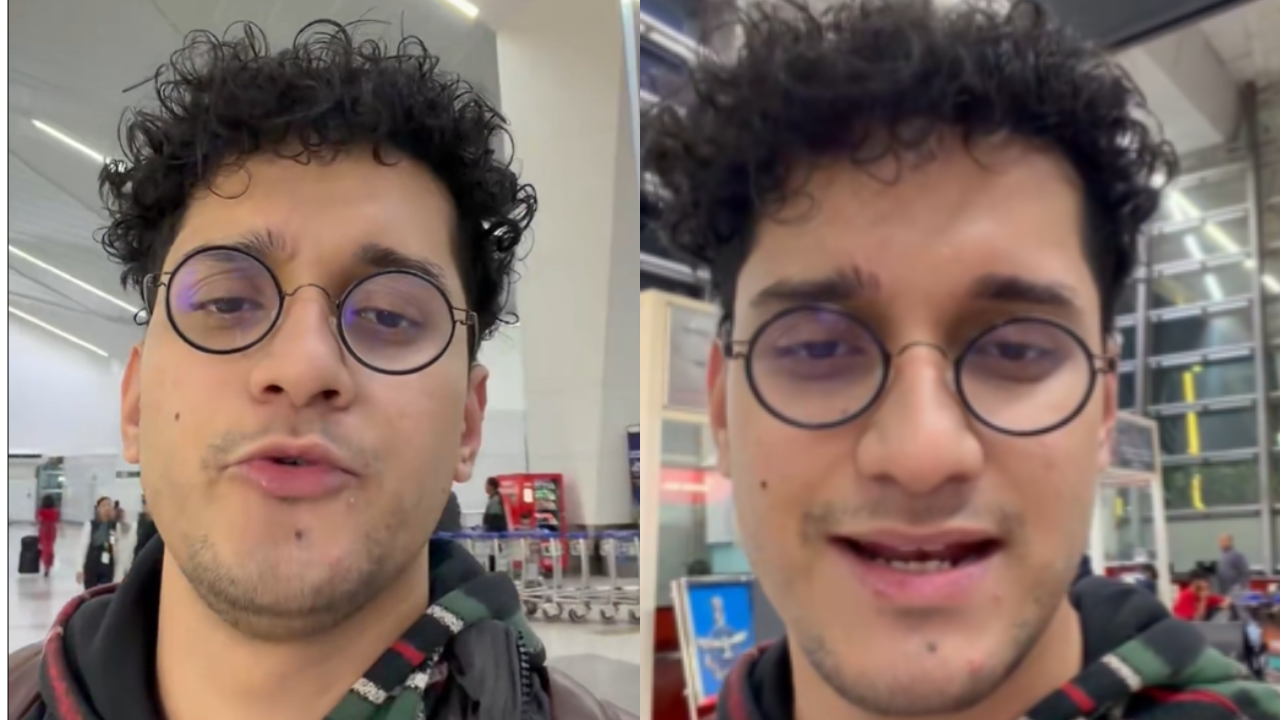
Cockroach Janta Party co-convenor Saurav Das was stopped by immigration officers at Delhi airport early Tuesday and prevented from boarding a flight to London, where he had been invited to speak at the Oxford Union and other UK universities. His passport was flagged in the system, officials told him, and he was not allowed to travel.
What happened at Delhi airport
Das arrived for a 01:00 local time departure on Tuesday (19:30 GMT Monday) and was told by immigration officers that his passport had been “flagged,” BBC News reported. He was not given a detailed reason at the counter and was barred from boarding.
The Hindu, citing sources, later reported that the Chennai Regional Passport Office had issued a show-cause notice to Das on November 23 — the day of his scheduled departure — over a discrepancy in his place of birth listed on the passport, and advised him not to use the document until he replied within seven days.
The last line of the email stated: “You are advised not to use the passport until you submit a response.” He said it was “a pre-planned and targeted harassment tactic” and that he would challenge the move in court.
Why Das was travelling
Das, 27, a former journalist and one of the most visible faces of the Gen Z-led Cockroach Janta Party (CJP), had been invited by the Oxford Union for a panel discussion on December 1. He also had speaking engagements lined up at Cambridge, the London School of Economics and the University of Edinburgh, according to his posts on X and reporting by The Times of India and The Independent.
“Indian students put their heart and soul to organise the events but this anti-intellectual government was scared of me going to these prestigious institutions,” Das wrote on X. “This coward government did not allow me to board my flight to London where I was invited by prestigious universities like Oxford, Cambridge, LSE, Edinburgh to deliver talks on the cockroach movement,” Das said in a social media post late on Monday.
CJP’s rise and recent clashes with authorities
The Cockroach Janta Party began as a satirical movement in May and quickly grew into a youth pressure group with millions of social media followers, The Guardian reported. In July, CJP-led protests over exam paper leaks forced the resignation of Education Minister Dharmendra Pradhan — a rare climbdown for the Modi government.
In October, Das and other leaders were among thousands detained during demonstrations demanding the resignation of Chief Election Commissioner Gyanesh Kumar over alleged irregularities in electoral rolls; the Election Commission has denied wrongdoing. Das and fellow leader Ashutosh Ranka were jailed for seven days that month for trespassing at Jantar Mantar, an 18th-century observatory recently denotified as an official protest site.
Party leaders and rights groups react
CJP founder Abhijeet Dipke wrote on X: “Wish Saurav had looted a bank or committed financial fraud, then the government would definitely have allowed him to fly to London,” alluding to billionaire loan defaulters who left India. Ratna Singh, another CJP leader also invited by the Oxford Union, said her visa had been rejected days earlier; she told ANI News that Das’s treatment “raised questions about freedom of expression and the space available for young people to voice their opinions.”
The UK chapter of the Students Federation of India condemned the “restriction” on Das’s trip, saying “our protests have sent shivers down their spine.” The group expressed solidarity with Mr Das and said it would “continue to resist these draconian measures.”

Government response and passport office explanation
The federal home ministry directed the BBC to airport authorities and Delhi police for comment. A ministry spokesperson did not address the flagging directly. NDTV and ThePrint, citing sources, said the Chennai Regional Passport Office flagged a mismatch in Das’s place of birth — listed as Chennai on the passport issued August 21, 2019 — and initiated impoundment proceedings.
“The details showed up in the system at immigration and he was stopped from travelling,” the source said. “Discrepancies in Saurav’s passport?” Dipke said. Das told The Independent he received the show-cause notice just five hours before his flight and called it “a pre-planned and targeted harassment tactic.” He said he would challenge the move in court.
Pattern of travel bans on critics
Das’s case follows a recent pattern. In September 2025, environmental activist Bhanu Tatak was stopped from boarding a flight to Dublin. In March 2022, journalist Rana Ayyub was barred from flying to London from Mumbai airport.
The Guardian also said that in 2022, authorities prevented photographer Sanna Irshad Mattoo from travelling to the US to collect her Pulitzer Prize, and that earlier this month India denied visas to more than 100 foreign speakers for an opposition-organised democracy summit. Critics say human rights and press freedoms have declined since Narendra Modi took office in 2014.
The Cockroach Janta Party (CJP) launched online on 16 May 2026 as a satirical movement founded by political communications strategist Abhijeet Dipke, whose tagline “Voice of the Lazy & Unemployed” reappropriated a Chief Justice’s comparison of unemployed youth activists to “cockroaches” and “parasites.” Within its first week, the mock party amassed over 15 million Instagram followers, rapidly overtaking major political parties’ official handles, The Guardian reported.
By July 2026, CJP-led protests over medical entrance exam irregularities forced the resignation of Union Education Minister Dharmendra Pradhan — a rare climbdown for the Modi government — transforming the satire into a potent youth pressure group.
What happens next
Das has seven days from November 23 to respond to the passport office notice. Meanwhile, CJP founder Dipke and co-convener Ranka are scheduled to address a “Save Constitution” rally at Samvidhan Chowk in Nagpur on November 26 — Constitution Day — from 4 p.m. to 6 p.m., The Hindu reported.
“See you all in Nagpur on November 26!” Dipke posted on X. He said the CJP will neither run in elections nor back any party, but will press for campaigns to centre on genuine youth concerns — education, healthcare, unemployment, semiconductors, renewable energy, technology and transport — instead of religious polarisation or Mandir-Masjid politics.
Keep reading
Hepatitis B Newborn Vaccination Rate Falls to 66%, Truveta Analysis Finds
Hepatitis B vaccination of U.S. newborns within 24 hours of birth fell to 66% by June, down from...
Indonesian Police Name Ex-Chief Listyo, Five Officers as Treason Suspects
Indonesian police named six senior officers as treason suspects on Monday, expanding a wiretapping investigation that already targets...

Irish Farmers Journal: Ireland Imposes Poultry Housing Order After NI Bird Flu Case
Ireland imposed a compulsory poultry housing order on Monday, 23 November, requiring all commercial and backyard flocks to...

Inquest Hears Convoy Separation and Delayed Alert Before Private Rooney’s Death in Lebanon
The two-vehicle convoy left Camp Shamrock in southern Lebanon to bring Gunner Jordan Tarrant Lowry and Trooper Shane...