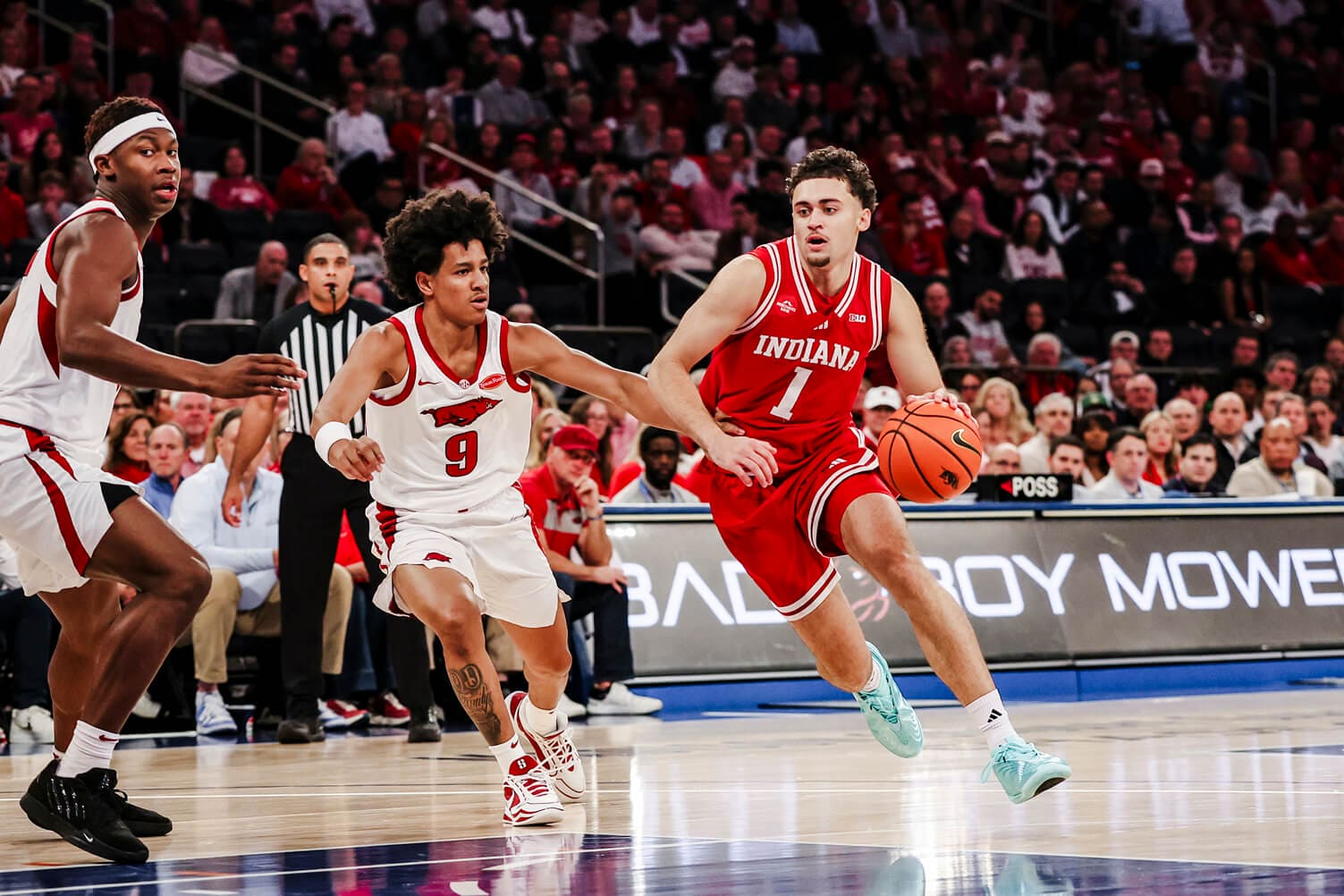
Indiana rallied for an 81-76 victory over No. 20 Arkansas at Madison Square Garden on Tuesday night.
On Tuesday night, Indiana found itself trailing No. 20 Arkansas by four points with two and a half minutes remaining, a scenario that has historically preceded a collapse for the Hoosiers in recent seasons. Instead, the team displayed a different kind of composure. Consecutive 3-pointers from Darren Harris followed by a go-ahead logo-distance triple from Bryce Lindsay propelled Indiana to an 81-76 victory, moving the program to 5-0 on the season.
This win marks the Hoosiers’ first victory over a ranked opponent this year, but the implications extend beyond the early-season standings. The game provided a diagnostic look at the program’s offseason overhaul.
After a first season in Bloomington that established a baseline for rebuilding, the coaching staff identified a critical deficit in physicality, interior production, and rebounding. The roster moves made in the transfer portal were a direct response to those specific shortcomings.
The commitment to size and athleticism was evident from the opening tip. Indiana surged to a 9-2 lead behind the play of transfers Samet Yigitoglu and Aiden Sherrell. The two big men acted as the primary offensive engine in the first half, combining for 29 of Indiana’s 36 points.
While the perimeter players struggled to find their footing—failing to connect on a single 3-pointer before halftime—the frontcourt’s ability to establish position in the paint kept the Hoosiers in the lead.
The game’s physical profile is best illustrated by the disparity in rebounding and second-chance opportunities:
| Metric | Indiana | Arkansas |
|---|---|---|
| Total Rebounds | 39 | 28 |
| Offensive Rebounds | 15 | N/A |
| Second-Chance Points | 21 | N/A |
Arkansas, a team built with its own considerable size, forced an adjustment in the second half by limiting Yigitoglu’s interior looks. This shift forced the Hoosiers to rely on their backcourt, which finally found the rhythm that had eluded them earlier.
Markus Burton broke the perimeter drought at the 16:29 mark, and the offensive balance shifted as Lindsay and Harris began to capitalize on space created by the earlier interior gravity.
The Razorbacks fought back, reclaiming a 67-66 lead with under five minutes to play on a basket by Billy Richmond III. When JJ Andrews hit a three to put Arkansas up 74-70, the Hoosiers were forced to prove the resilience that has been a focal point of their development. The response from the perimeter was immediate and clinical.
“We guarded the three until we didn’t,” Arkansas head coach John Calipari said afterward, pounding the table for emphasis. “It’s contagious,” Calipari added. “They’re snipers.”
The victory serves as a tangible metric for the program’s current trajectory, though it does not guarantee a path to the NCAA tournament or a dominant run through the Big Ten. The Hoosiers still experienced prolonged stretches of offensive inconsistency and allowed momentum to swing toward the Razorbacks repeatedly.
However, the ability to win while trailing late against a ranked opponent suggests the team is better equipped to handle high-pressure moments than the versions of the program seen in previous years.
With a high-stakes matchup against Kentucky looming on Friday in Indianapolis, the win at the Garden acts as a proof-of-concept for the roster’s new construction.
The Hoosiers are not yet a finished product, but the shift toward a more physical, multidimensional team is yielding results that go beyond the box score. They are currently positioned as a team capable of fighting back, rather than one that simply folds when the game reaches its most critical juncture.
Related reading

Boise State Controls Group of Six Playoff Path Starting Against San Diego State
Boise State sits at No. 17 in the College Football Playoff rankings, the only Group of Six team...
Hawaii Grown Report: Ah Yat Climbs Montana Record Book; Isle Stars Shine Across College Football
Kealii Ah Yat threw for 329 yards and three touchdowns to move into third on Montana's all-time passing...
Georgia State Visits Jacksonville State for Series Renewal and First Road Test
Georgia State hits the road Friday night for a 7 p.m. tipoff at Jacksonville State, the Panthers' first...

How to Spend 24 Hours in Wilmington: Riverwalk, Three Beaches & Dining
Yahoo Travel reported travelers can find a coastal trip and historic city getaway in Wilmington, North Carolina, where...