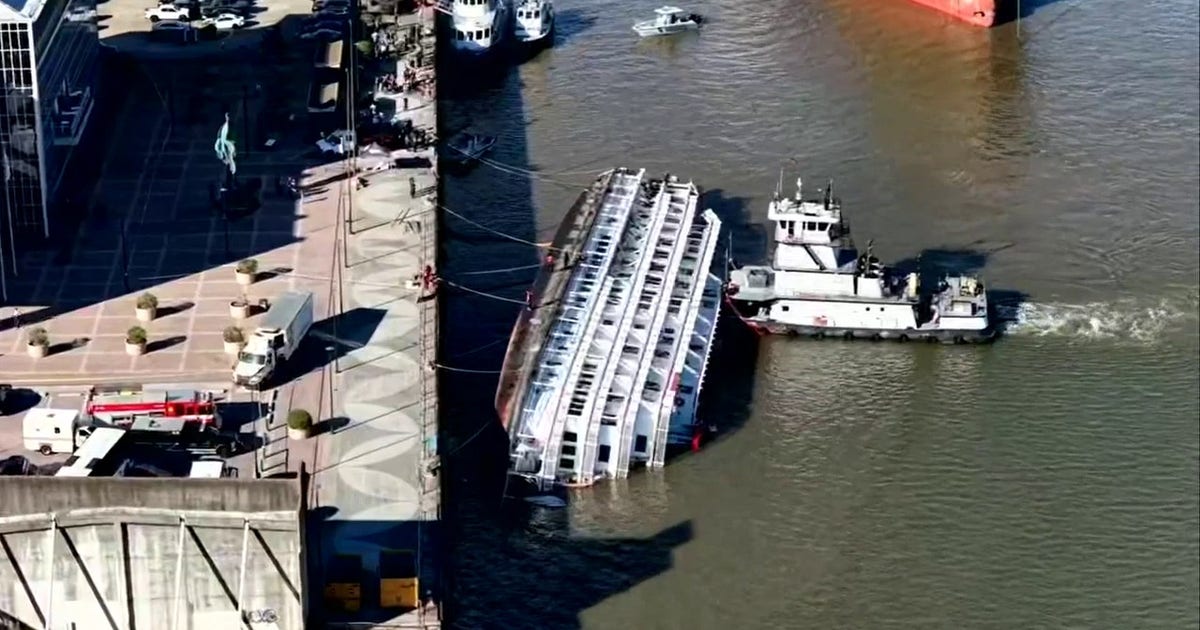
As authorities stated Saturday, roughly 100 individuals were rescued from the Mississippi River following a Friday incident where a tanker collided with a moored cruise ship in New Orleans, while the U.S. Coast Guard readies itself for a potentially multi-week effort to clear the overturned vessel.
According to New Orleans Mayor Helena Moreno, a total of 191 passengers and crew members were on board the American Heritage at the time the Atlantic Asphalt tanker crashed into the ship close to the Port of New Orleans. Everyone survived, though eight people remained hospitalized Saturday, including two in serious condition. The other six patients were stable, officials said.
Coast Guard Capt. Melanie Burnham said that teams were making preparations to extract 16,000 gallons of fuel from the American Heritage prior to the commencement of salvage operations. Divers were expected to assess the vessel, while pollution response teams monitored the river for potential leaks.
Furthermore, Burnham said that while no contaminants requiring cleanup had been spotted in the river by response units, she cautioned that hazardous materials could potentially escape during the operation.

“As the mayor said, we’re talking weeks, we’re not talking days, we’re talking weeks. So we’re going to do this safely, and we’re going to make sure that it’s done right,” Burnham said.”
The mayor also disclosed that the master of the American Heritage sustained injuries yet stayed on the craft until every passenger and crew member was accounted for, ultimately being the final person to exit the ship. “Every moment of the critical time Friday, he did not want to leave his ship,” Moreno said.
Footage captured by Randy Christie illustrates the sequence of events immediately following the collision between the Atlantic Asphalt tanker and American Cruise Lines’ American Heritage in New Orleans. The captain initially refused medical treatment until he knew where everyone was, according to the mayor.
Melanie Montro, the Harbor Police Chief for the Port of New Orleans, reported that emergency responders managed to evacuate upwards of 80 individuals prior to the ship flipping over, while approximately 100 people ended up in the water.
Additionally, Montro mentioned her assessment that the American Heritage turned over within 30 to 45 minutes after the impact, although the exact timeframe is still under review. Officials credited life jackets and the rapid response of emergency crews and nearby vessels with preventing fatalities.
Investigation into steering and safety
Probers are currently looking into a potential steering malfunction involving the tanker, even though the precise reason for the crash is yet to be determined. “I can say though I do not have any indication that this is terrorism related in any way, shape or form, but again, the investigators will continue to keep working through that,” Burnham said.

On Saturday, the National Transportation Safety Board verified that officials successfully retrieved the voyage data recorder from the Atlantic Asphalt, a device that records metrics such as the vessel’s speed, heading, and bridge audio. During a Saturday press briefing, NTSB board member John DeLeeuw announced that personnel will additionally review the tanker’s maintenance logs and mechanical background as part of their efforts to figure out what triggered the crash.
Warning that the organization is still in the preliminary phases of collecting data, he said that no definitive determinations have been reached thus far. DeLeeuw and a team of NTSB investigators began arriving Saturday after travel disruptions delayed its response. DeLeeuw said 16 investigators were on scene and preparing to interview crew members and others involved.
According to the organization, an initial statement is anticipated roughly 30 days from now, followed by a comprehensive final report outlining probable causes and safety recommendations within a timeframe of 18 to 24 months. The crash took place near 12:30 p.m. local time on Friday when the tanker collided with the American Heritage, which had been tied up at the dock for roughly two hours. The vessel began taking on water before capsizing.
In the time since, the Atlantic Asphalt has been shifted away from the collision zone, and the Coast Guard has partially restored two-way vessel movement on the waterway. A 500-foot safety zone remains in place around the wreck. American Cruise Lines, which operates American Heritage, is coordinating with local officials to assist displaced passengers as the investigation and recovery efforts continue.
Get updates and more at foxnews.com.

Sunday’s Playoff Roundup: Charlie Huff, Catholic Memorial Soccer Show Their Mettle in D1 Quarterfinal
Sixth-seeded Catholic Memorial secured a 4-3 victory over No. 3 Lincoln-Sudbury in a Division 1 quarterfinal thriller on...

Separating a Good Steak from a Great One: Understanding How Cut and Preparation Make … – KTVN
Just 41% of Americans feel confident in their knowledge of different steak cuts, according to a recent survey...

What Role for Climate Mobility at COP31 and Beyond? – European Policy Centre
Climate mobility is missing from the core agenda of the Climate Change Conference in Türkiye (COP31), despite growing...

Missouri State Sen.-Elect Deering Expects Republicans to Change | STLPR
Missouri state Sen.-elect Mike Deering expects House and Senate Republicans to alter how they govern after losing two...