
“This exceeded our expectations,” comments Tatsumi. “We knew trisulfides had diverse biological functions, but we never expected that simply mixing HGF with LASSS would produce such a striking effect. What this tells us is that LASSS does more than simply neutralize reactive molecules. It may interact directly with HGF and induce a subtle structural change, creating an enhanced ‘Super HGF’ form that binds c-met more strongly and resists nitration.”
In a laboratory breakthrough that could reshape how we approach muscle loss in old age, researchers in Japan have identified a sulfur-based compound that more than doubles the binding power of a protein critical to muscle regeneration, Science Daily reported.
The discovery, published in Scientific Reports by a team led by Tatsumi at Kyushu University’s Faculty of Agriculture, centers on lipoic acid trisulfide, or LASSS. For the millions of Americans watching their strength and independence fade with each passing year—or facing long stretches of bed rest after surgery—the finding suggests a future where the body’s own repair machinery might be chemically tuned up rather than replaced.
Satellite Cells Wait for the Signal
Skeletal muscles—the ones attached to bones that let us walk, lift, and maintain posture—endure constant wear and tear. Yet they possess a remarkable ability to repair themselves. Much of that healing depends on specialized stem cells called satellite cells, which lie dormant alongside muscle fibers until injury or mechanical stimulation wakes them.
pretty amazing Scientists Discover Compound That Rejuvenates Aging Muscles Scientists find compound that may help muscles stay strong as we age. Sulfur based compound called LASSS protects and boosts a key muscle repair protein (HGF), helping aging muscles repair themselves… pic.twitter.com/EvTV3B1amX
An essential player in this process is hepatocyte growth factor, or HGF. Despite its liver-centric name, HGF is stored within the supportive material surrounding muscle fibers and released when muscles experience injury or movement. It then attaches to a receptor called c-met on the surface of satellite cells, triggering the cells to multiply, mature, and rebuild damaged tissue.
A Damaged Key in the Lock
Tatsumi’s previous work revealed that HGF can undergo a chemical modification called nitration, in which a nitro group attaches to specific locations on the protein. The team identified two especially important sites, Y198 and Y250, both lying within the region that attaches to c-met.
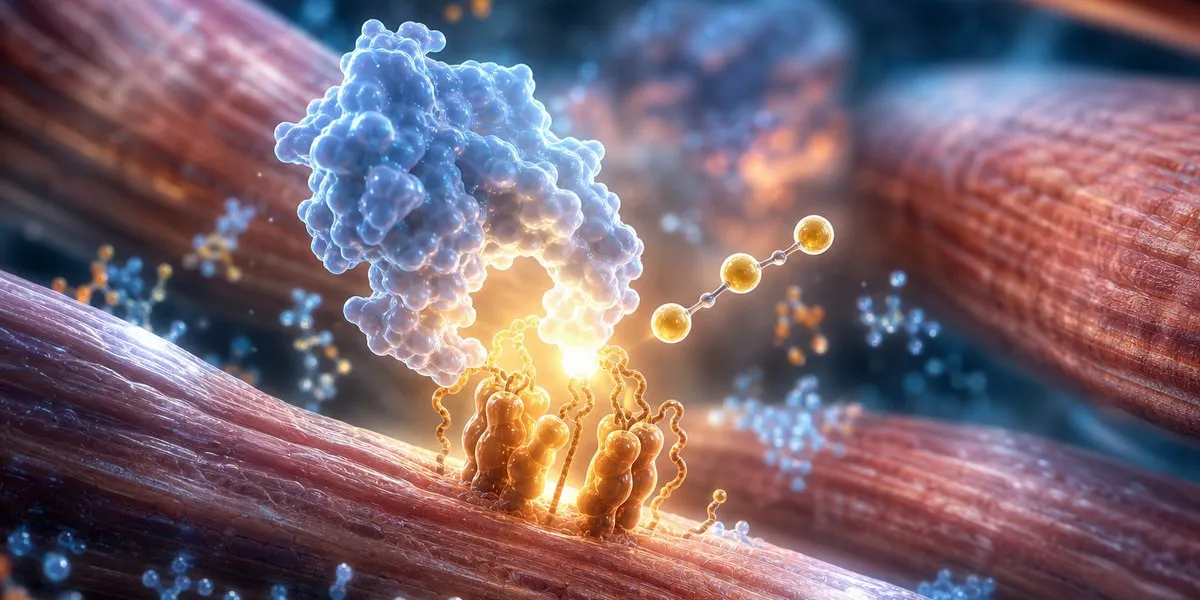
When these sites undergo nitration, HGF becomes less capable of connecting with its receptor—like a key that has been damaged and can no longer operate its intended lock. Tatsumi explains that HGF is not necessarily missing as we age; rather, it can be chemically altered after it is made. The result is a repair system that falters not from a shortage of protein, but from a protein that no longer fits.
From 1:4000 to 1:8000: The Unexpected Leap
To test whether antioxidants could shield HGF from this damage, the researchers studied two compounds with strong antioxidant properties: glutathione trisulfide (GSSSG) and lipoic acid trisulfide (LASSS). Both belong to a chemical family called trisulfides, defined by a chain of three sulfur atoms, and both can participate in redox reactions that move electrons through cellular chemistry.
A Sulfur Compound Could Protect Aging Muscle Japanese researchers identified LASSS, a compound that strengthens a key muscle-repair signal. – Increased HGF receptor binding by over 100% – Protected HGF from age-related nitration – Reduced HGF damage in a mouse disuse model… pic.twitter.com/x62svStQDY
In initial experiments, both compounds reduced nitration at Y198 and Y250. But simply preventing the chemical modification did not completely restore HGF’s ability to attach to c-met. The team therefore increased the amount of trisulfide relative to HGF, changing the molar ratio from 1:4000 to 1:8000.
At that higher concentration, LASSS produced a dramatic result. The protein’s binding affinity for c-met more than doubled compared with untreated HGF, and it became more resistant to the functional loss caused by nitration. GSSSG, by contrast, showed no such improvement in receptor binding.
Scientists have found a compound that could supercharge muscle repair in aging bodies. A sulfur based molecule called LASSS protects and enhances hepatocyte growth factor (HGF), a key protein that activates muscle stem cells after injury. With age, HGF often becomes chemically… pic.twitter.com/xfJYg5rDQk
“We knew trisulfides had diverse biological functions, but we never expected that simply mixing HGF with LASSS would produce such a striking effect,” Tatsumi said.
Mice Show Chemical Protection, Not Yet Strength
The researchers next wanted to know whether LASSS could protect HGF inside living muscle tissue. They used mice subjected to tail suspension, an established method for studying muscle atrophy that reduces normal weight bearing and produces changes associated with prolonged inactivity. Mice given LASSS before the experiment showed significantly less HGF nitration than untreated animals.
Yet the scientists emphasize what the study did not prove. The mouse experiments demonstrated protection against nitration, not restored muscle mass or improved physical strength. Stronger receptor binding does not automatically establish that muscle regeneration itself has improved. Studies involving aging animals are still necessary to establish the compound’s effectiveness and safety in vivo.
Beyond the Elderly: Bed Rest and Veterinary Promise
Muscle deterioration is not confined to older adults. It can also strike during prolonged bed rest or any situation where muscles are used less frequently, making recovery of lost strength especially challenging. The researchers believe the approach could eventually support patients in those scenarios, not just seniors.
They also suspect the underlying effects of LASSS on HGF may extend across species, raising the possibility of applications in veterinary care for aging companion animals such as dogs and cats.
For now, the findings mark an initial step toward learning how a naturally occurring muscle repair pathway could be boosted. Whether LASSS can safely preserve muscle function during human aging remains an open question. Still, the unforeseen discovery that a sulfur-based compound can both shield and strengthen a critical repair protein suggests a hopeful path toward the long-term aim of helping people retain mobility, independence, and quality of life as they grow older.
Keep reading

WHO Report: Progress Against Neglected Tropical Diseases Is Fragile and Underfunded
By June 2026, sixty-three countries had eliminated at least one neglected tropical disease, up from forty-two at the...

Fiosrú to probe garda’s gun holster in Castlerea murder case (2020)
What the Horkan family has been seeking is a public inquiry. What they got this week is an...

PH bets on coconut and halal products to expand export reach
Filipino exporters hunting overseas buyers got a direct line this week as the country's largest export gathering opened...

CSFLI Cuts Non-Motor OFF-Period Fluctuations in Advanced Parkinson’s
In a prospective, single-centre, real-world study of 40 patients with advanced Parkinson's disease in Naples, Italy, three months...