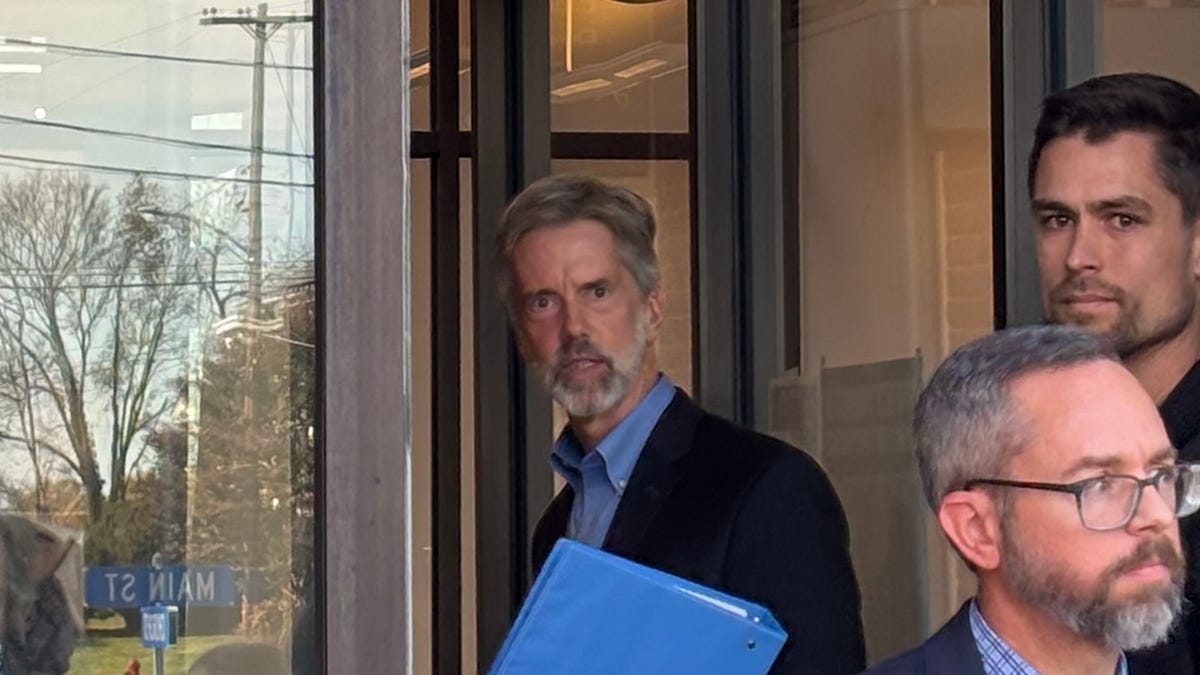
At least 50 supporters packed the Madison County Circuit Court gallery on Nov. 4, bringing children and signs of deep division as the legal battle surrounding former Orange Town Council member Jeremiah Pent’s pastoral leadership at Walker’s Chapel was continued until February.
The civil lawsuit, which landed in court after a bitter church governance dispute, centers on whether church leadership was wrongfully seized from its board of directors and tied to a conservative denomination. As Byrd Street reported, the proceedings ground to a temporary halt when plaintiffs’ attorneys filed a motion to disqualify the legal counsel representing Pent and his co-defendants, pointing to a potential conflict of interest.
In addition to Pent, the defendants named in the filing include Walker’s Chapel elders Scott Magnino of Madison, Jody Simmons of Lynchburg, and Roger Rutt of Orange. The underlying dispute dates back to April, when a civil suit was filed in Madison County Circuit Court by counsel representing Debra Byrd of Orange alongside Carolyn Byram and Joyce Garrison of Madison County.
The three women comprise the former board of directors that initially hired and subsequently fired Pent, only to watch him revoke their church memberships and continue operating as pastor.
The litigation pivots on three distinct flashpoints: the adoption of Walker’s Church’s new constitution and bylaws, the controversial manner by which Pent and the defendants assumed institutional control, and Pent’s concerted push to place the congregation under the auspices of the Communion of Reformed Evangelical Churches, a network of conservative churches associated with Christian Nationalist perspectives.
If Judge David B. Franzén ultimately rules in the plaintiffs’ favor, that connection to the CREC would likely be severed.
During the Nov. 4 hearing, Judge Franzén acknowledged the packed room and urged both sides to seek an out-of-court resolution, noting that his eventual ruling “may not satisfy anyone.” Both legal teams expressed a willingness to explore mediation through a judicial settlement conference overseen by a retired judge.
“We’re all Christian gentlemen,” Thomas Woehrle of Cornerstone Law Group PLLC in Fredericksburg, representing the plaintiffs, told the judge before suggesting the alternative dispute resolution route.
Woehrle elaborated on the mechanics of the process outside the courtroom, explaining that a retired judge acts as a neutral mediator to preview how evidence might land in an actual trial.
“They try to get the parties to talk and see if there’s some common ground they can find to resolve things, and perhaps there is or perhaps there’s not, but they can use their knowledge as a judge to point out the difficulties in your case or the advantages of your case,” Woehrle told Byrd Street.
Before any settlement talks or merits arguments can proceed, however, the preliminary disqualification motion must be resolved. Woehrle said that the court must first determine whether the defense attorneys had improper prior involvement with both parties.
“If it’s sorted out in their favor, they stay in the case. If it’s sorted out against them, then they will have to be excused from the case. And after that, we’ll get on with the merits of the case,” he said.
In the meantime, Judge Franzén scheduled a court date for a declaratory judgment at 1:30 p.m. on Friday, Feb. 12, inside the Orange County courthouse. The venue was selected purely to accommodate scheduling needs rather than a formal change in jurisdiction. Whether the congregation’s warring factions can forge an agreement before then remains an open question.

4-Time World Champion Marvin Garrett Inducted Into Rodeo Hall of Fame
Marvin Garrett gathered with all ten of his grandchildren and their families in Oklahoma City on Saturday for...
Thieves Steal Hundreds of Thousands From Wisconsin ATMs in Jackpotting Scams
Thieves targeted automated teller machines near Milwaukee in two recent heists, stealing hundreds of thousands of dollars through...

Governor Morrisey Announces $1,144,689 for WVU Medicine Programs
Patrick Morrisey announced a $1,144,689 award to West Virginia University Medicine to establish community paramedicine programs across Harrison,...

Drew Lock Throws Two Touchdowns in Seahawks 21-13 Win Over Raiders
Drew Lock threw for 240 yards with two touchdowns and no interceptions on Sunday as the Seattle Seahawks...