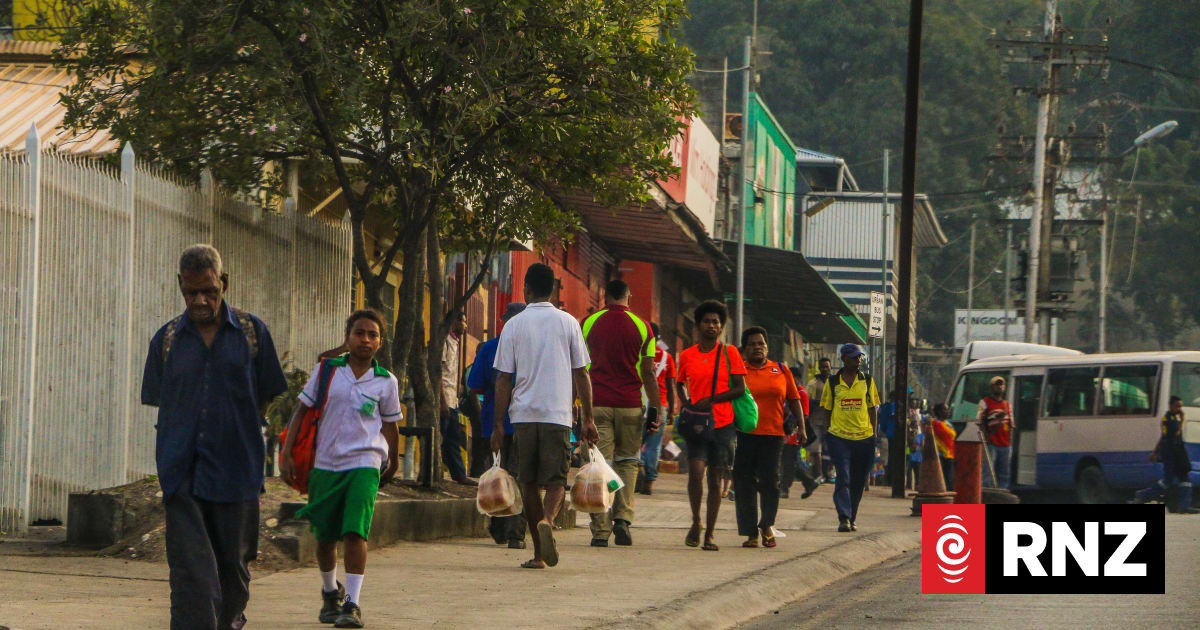
Prime Minister James Marape has revealed that Papua New Guinea’s leadership will soon roll out a national family planning strategy aimed at reining in the nation’s rapid birth rate by urging households to cap their offspring at three children.
Marape announced the initiative this month to curb uncontrolled demographic expansion, prevent unplanned pregnancies, and reduce economic burdens on households, according to RNZ Pacific. The policy responds to figures from the 2024 census, which put the country’s population at 10.18 million with some reports estimating it even higher, alongside a 2.6 percent annual growth rate that adds 180,000 people each year.
Public infrastructure, education and health services are under strain, driven by a birth rate sitting at approximately 2.4 percent annually according to World Bank figures.
“We should have done what the prime minister is proposing a generation ago because now the age structure of our population is such that nothing can cope,” said Professor Glen Mola, a professor of obstetrics and gynaecology and the head of reproductive health at the University of PNG, who told RNZ Pacific he welcomed the announcement.
Mola described the situation as an emergency that had been building for 30, 40 years, pointing out that 50 percent of the nation’s population is under the age of 18. He warned that without an implementation plan, the policy is just words.
Mola said that there was a lack of political discourse on the issue from MPs, stating “everyone’s been quite silent.”
“Lots of the politicians have more than one wife. Lots of them have five, six, seven, eight, nine, ten children. So I suppose they find it a bit of a challenge,” Mola told RNZ Pacific.
Addressing the issue requires more work, according to researchers. Dr Nalisa Neuendorf, a social anthropologist and research fellow at PNG’s Institute of Medical Research, emphasized that different provincial settings create an opportunity for a mixed approach.
“In a country like PNG, I think it is also really important to remember that our different provincial settings also create an opportunity for a mixed approach,” Neuendorf told RNZ Pacific, suggesting that understanding at a provincial level might be a better way forward than a one size fits all approach.
Neuendorf also highlighted ongoing work targeting adolescent pregnancy and family planning pathways. Researchers are involving young people in the research process to better gauge what is appropriate for them in terms of family planning pathways.
Furthermore, Mola cautioned that permitting both rapid population expansion and heavy migration toward cities to continue unchecked could prove catastrophic for PNG’s social fabric. Young men are flooding urban areas, which Mola said is one of the reasons why there is so much sexual violence.
“Urban areas are being flooded by mostly young men, which is one of the reasons why there’s so much sexual violence,” Mola told RNZ Pacific. He said that some rural areas are being denuded of young people.
Mola pointed out that while Asian nations such as Vietnam and China experienced varied outcomes when attempting to restrict household sizes, Papua New Guinea should examine Indonesia’s 1970s two-child strategy as a successful model for demographic stabilization.
“We’re certainly in the sort of boat that the Indonesians found themselves in the 70s, and that’s what we need to do,” Mola told RNZ Pacific.
“First of all, there needs to be a national consultation to explain the issue, and then set up our version, the way we should do it in PNG,” he said.
Worth a look
Lithuanian FM Warns Europe Not to Fall for Russia’s Peace Negotiation Traps
Europe must avoid falling into diplomatic traps and instead stay laser-focused on securing a lasting ceasefire in Ukraine,...

Campbell College Headmaster Discusses Masculinity and School Life
On the edge of Belfast city, Jonathan Anderson leads Northern Ireland’s last remaining all-boys boarding school through a...

Leaders Pay Tribute to DUP Figure Following Family Tragedy
"There are no words that can ease the pain of such an unimaginable loss," DUP leader Gavin Robinson...

Over 5,000 Guests Attend Made in Russia International Export Forum
Russia is recalibrating its industrial strategy, moving away from a traditional reliance on raw materials toward a model...