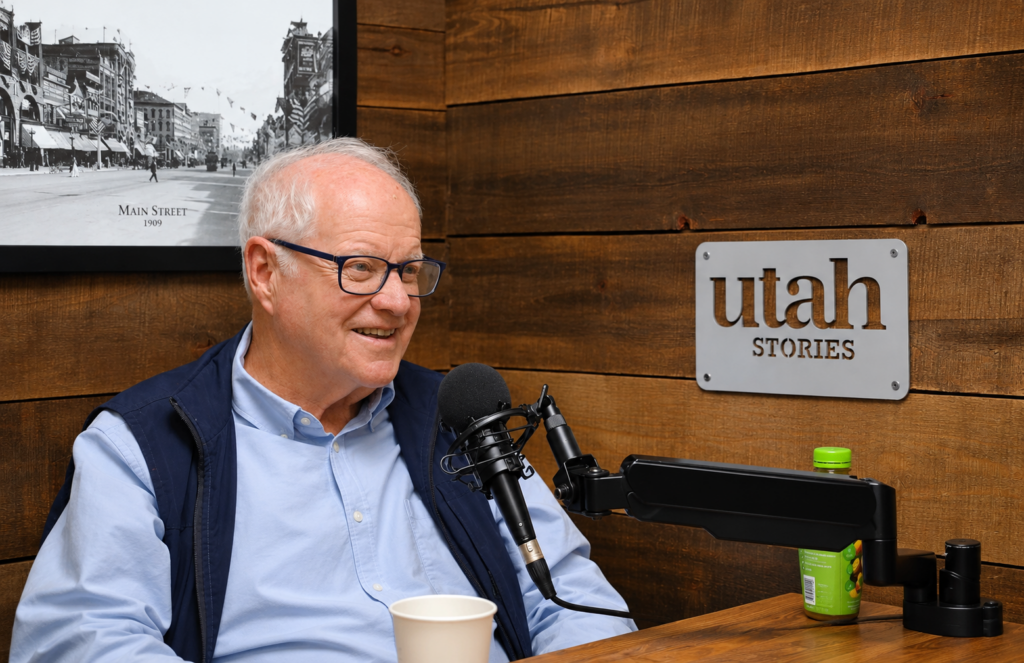
“You’d go downtown, and my mother would put gloves on, and then you’d be in the car. And in Auerbach’s, there’d be an elevator, and somebody would be, you know, ‘Third floor, lingerie’ — that was the one that always made me smile when I was 11 years old,” said JOHN PRINCE.
John Prince, now 85, shared that memory on a recent Utah Stories podcast, framing a lifetime of watching Salt Lake City reinvent itself. Born in 1941, Prince watched Main Street shift from a corridor of locally owned department stores — ZCMI, Auerbach’s, Hibbs, Makoff’s — into a landscape defined by suburban malls, national chains, and eventually developments like City Creek Center.
His own career traced that arc: from a hamburger stand called Watney’s at Crossroads Mall to the Ponderosa Steakhouse franchise and a stake in the investment group that turned old bus barns into Trolley Square.
The Trolley Square story began with ten men putting in roughly $25 a month. One of them, Wally Wright, had seen Ghirardelli Square in San Francisco and thought Salt Lake could do the same with the city’s former bus facilities. The group, known as 10 Power Investment, saw potential in the maintenance pits beneath the barns for electrical runs, but they had no experience building a shopping center.
“There we are investing like we know how to build a shopping center,” Prince recalled. Gas shortages in the 1970s kept recreational drivers away, lenders pressed for repayment, and legal disputes piled up. After approximately eight or nine years the group sold the property for enough to repay the banks; Prince remembered receiving little financial return.

What endured was the tenant mix. Jack Bernard’s Chalk Garden, Pamela Prince’s stationery shop Personal Papers, the Old Spaghetti Factory — each reflected an era when retail meant individual entrepreneurs rather than replicated logos. Prince’s own Ponderosa commercials, filmed locally instead of using national spots, advertised two steak dinners for $5.99 and made him a recognizable face across Utah television.
That personal connection, he argued, was what downtown lost when the mall era arrived.
“Had I been reflective, I probably would have noticed it sooner. I’m sure there were people who said, ‘When Crossroads Mall gets built, it’ll destroy the rest of downtown.’ I’m sure nobody listened. And it happened.”
— John Prince, to Utah Stories
Prince and his wife Pamela rode that wave themselves. They opened Pamela’s, a lifestyle shop, and Watney’s in the Crossroads food court — “we took mustard, mayonnaise, and ketchup, mixed it together, and just stuck it on every burger,” he laughed. Watney’s later became an A&W.
The brands multiplied, and the intimate knowledge of who owned the store, who ran the bank, faded. Prince remembered Continental Bank on Main feeling “like a church to money,” a place where his parents knew the owners. That world, he said, blurred the Mormon–Gentile divide that structured so much of civic life; downtown was where everyone “mushed together.”
Today, Prince acknowledges the beauty and investment behind City Creek Center but questions whether professed support for local business matches actual spending. “You can say people like local things, but if they like local things, why aren’t they thriving?” he asked on the podcast.
The question extends well beyond Salt Lake City: independent retailers nationwide face the same pressure from e-commerce, national chains, and shifting consumer habits. Trolley Square remains, preserving a fragment of the entrepreneurial energy Prince helped seed, even as the city around it keeps remaking itself.
Related reading
Outraged Port Officials React After ICE Arrests Family at Sea-Tac Airport
Outraged officials reacted after ICE arrested a family inside a crowded jetway at Sea-Tac Airport on Saturday morning....

Boise State Hosts San Diego State in Pac-12 Week 12 Clash
Boise State took the blue turf with a record and the Pac-12 title game already locked up, hosting...

Wolf Pack Swimmers Win 2 Titles, Relay 2nd in Boise; Divers 7th, 12th, 17th in Flagstaff
Calyn Lothian led four Nevada swimmers in the top 12 of the 200-yard freestyle, earning third place in...

2027 Hyundai Santa Fe Trims Priced $35,300-$49,650 in Houston Showrooms
The 2027 Hyundai Santa Fe arrives in Houston showrooms with five trims priced from $35,300 to $49,650, offering...