Sen. Jon Ossoff defeated Republican Mike Collins by roughly 18 points in his Georgia reelection this month, a margin that far exceeded his one-point win in 2022 and came two years after Donald Trump carried the state by about two points over Kamala Harris.
A post-election Emerson College poll places Ossoff at 17% in a hypothetical 2028 Democratic primary, narrowly leading former Vice President Kamala Harris and Rep. Alexandria Ocasio-Cortez, with former Transportation Secretary Pete Buttigieg and California Gov. Gavin Newsom rounding out the top five, CBS News reports. In a straw poll at Crooked Con, a mainly progressive event held in Washington after the midterms, Ossoff secured 38% of first-choice votes, outpacing Ocasio-Cortez and Buttigieg.
Despite the early polling, Ossoff, 39, said during an October debate that he had “zero interest in running for president” in 2028.
Exit polling shows Ossoff maintained strong support among Black voters, winning 93% of a group that makes up almost one-third of the Georgia electorate, while also improving his performance among white voters and suburban women, the Associated Press reports. The coalition included swing constituencies Democrats have struggled with in recent cycles.
“I think he would make an attractive presidential contender on the Democratic side,” said Jerry Gonzalez, CEO of the GALEO Impact Fund PAC, a Georgia-based Latino political action committee that endorsed Ossoff. “He is not afraid, he won’t shy away from holding the Trump administration accountable, but in a way that works towards actually building coalitions to get something done.”
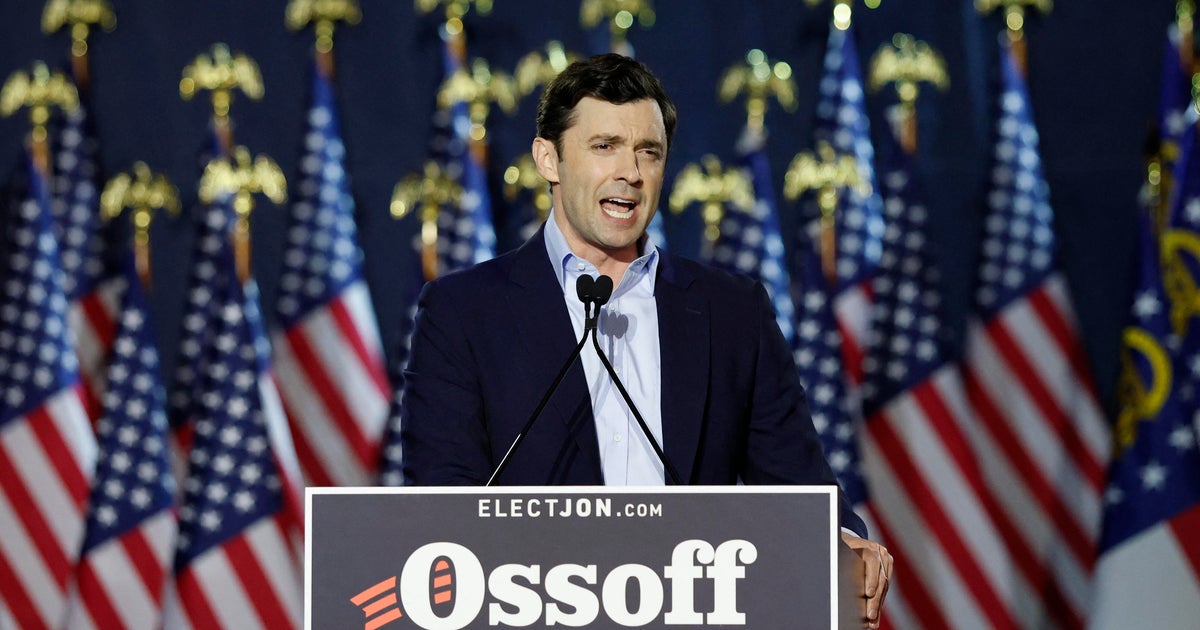
Charles Bullock, a longtime political science professor at the University of Georgia, said Ossoff “comes across, and tries to present himself, as a moderate, and he talks about issues which moderate conservatives could get behind.” But Bullock added, “Obviously, he’s successful here in Georgia. How would he play elsewhere? I think what we will be seeing is preparation, maybe for a later run.”
Latino Outreach Helped Expand Ossoff's Winning Coalition
Ossoff improved his performance among Hispanic voters in Georgia, a group that makes up less than 10% of eligible voters but has grown rapidly into a swing demographic capable of deciding close races, CBS News reports. The GALEO Impact Fund, a Georgia-based Latino advocacy group, endorsed Ossoff and produced “Ossoff Lotería” campaign merchandise to mobilize support.
Precinct-level data from Hall County illustrates the shift: three comparable precincts moved from an 11-point Trump advantage in the presidential race to a 33-point Ossoff victory in the Senate contest, according to CBS News.
Moderate Profile Creates Primary Uncertainty for 2028
Bullock added that the issues Ossoff stresses “are things which are within the broad mainstream of ‘These would be good things.'” However, he cautioned it is unclear how well a moderate would fare in early nominating states where Democratic primary voters often reward ideological purity over swing-state caution.

Bullock said Ossoff’s Georgia success is obvious, but questioned “How would he play elsewhere?” and speculated, “I think what we will be seeing is preparation, maybe for a later run.”
Ossoff entered politics in 2006 as a volunteer for Hank Johnson’s successful primary challenge against incumbent Rep. Cynthia McKinney, then served as a national security staffer and legislative assistant in Johnson’s congressional office from 2007 to 2012.
He launched his own candidacy in the 2017 special election for Georgia’s 6th congressional district, transforming a safe Republican seat into a national referendum on the new Trump administration and raising over $8.3 million while earning endorsements from Rep. John Lewis and Sen. Bernie Sanders.
After narrowly losing that House race, Ossoff won Georgia’s 2021 Senate runoff against incumbent David Perdue, becoming the youngest sitting senator and securing the seat that gave Democrats a 50–50 majority with Vice President Kamala Harris as the tie-breaking vote.
Ossoff’s record offers attack lines for rivals on both flanks. Progressives have faulted his vote for the Republican-backed Laken Riley Act and his unwillingness to endorse “Medicare for All,” while his votes to restrict certain weapons sales to Israel and his criticism of its military conduct in Gaza have drawn objections from some pro-Israel Democrats and donors.
Rep. Ro Khanna, another potential 2028 candidate, wrote on X last week: “Medicare for All means healthcare for everyone, like public school is free for every kid,” arguing that “‘Medicare for All who want it’ is pablum. It’s telling parents they have to pay for public school.”
Related reading
Colorado Senators Split as Senate Passes Bipartisan Energy-Permitting Bill
The Senate passed the Bipartisan American Affordability and Jobs Act 62-33 on Thursday, sending the permitting overhaul to...
MIT PhD Student Develops Faster Simulations for Fusion Reactor Design
MIT PhD student Jonathan Trieloff is developing faster computer simulations for neutron transport in fusion reactors. His goal...
Virginia Garage Door Cable ‘Slipped Off Drum’, Expert Fixes
A property manager in Virginia Beach reported a rental garage door that would not close evenly on a...

Man, 37, Critically Injures Self After Stabbing Two Women in Bronx Building
A 37-year-old man critically injured himself after stabbing two women inside a Bronx apartment building Sunday afternoon, police...