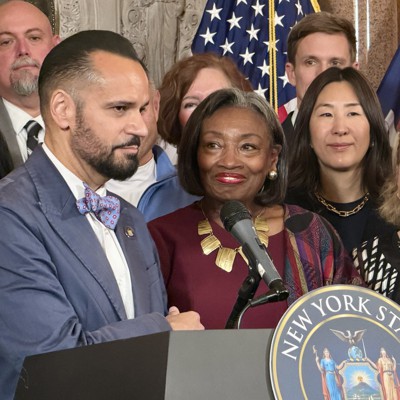
Senate Majority Leader Andrea Stewart-Cousins is maintaining control of the New York State Senate leadership while elevating José M. Serrano to the position of deputy majority leader.
The announcement came in Albany on Monday as Democrats, including several newly elected members, met to unanimously elect Stewart-Cousins to lead the upper house through the end of the next Legislature. This leadership consolidation follows an election cycle that secured a veto-proof supermajority for the party, a shift that fundamentally alters the legislative math in Albany.
“Over 76% of the people of New York are now represented by a Senate Democrat,” Stewart-Cousins told reporters in the Capitol. “New Yorkers have given us their confidence, now we have to deliver results.”
Serrano, who was first elected to the state Senate in 2004, succeeds former state Senator Mike Gianaris in the deputy majority leader role. Serrano is the son of the late former South Bronx Representative José E. Serrano, who was New York’s longest-serving Hispanic American in the U.S. House of Representatives until he left office in 2021.
Rules changes end leadership limits
To facilitate this continued leadership, the Democratic conference plans to adopt new rules that eliminate the current cap on how long a single lawmaker can serve as the Senate’s temporary president. The existing eight-year term limit was established by Democrats when they assumed the majority in 2019. Lawmakers are expected to formally vote on these changes when they return to Albany in early January.
The shift in rules also extends to committee leadership. While the conference has not yet finalized committee assignments, the upcoming rule changes will remove existing term limits for lawmakers serving as committee chairs. This comes as several outgoing lawmakers opted not to seek reelection, partly due to new income limits taking effect next year.
“This really is the honor of a lifetime, both personally and professionally,” Serrano said. “There has been a clear message that has been sent that the leadership that we need is very much right here, and it is really important that we continue to do that – that we speak for those who are often voiceless.”
Stewart-Cousins declined to specify how long she intends to lead the chamber or if Serrano’s elevation to the No. 2 position signals a future succession plan.
Taxation and the supermajority
With a veto-proof supermajority, the Senate Democratic conference possesses significant leverage over the executive branch, though Stewart-Cousins was cautious about how that power will be deployed. She would not rule out using the supermajority to pass priority legislation, but she would not confirm if they intend to do so, stating, “We are not looking at this as a tool that will force this or that.”
A central tension for the upcoming session involves progressive taxation. Stewart-Cousins indicated she is prepared for a fight to raise taxes on the wealthiest New Yorkers, a policy area that has highlighted friction between Governor Kathy Hochul and New York City Mayor Zohran Mamdani.
While the majority leader emphasized that progressive taxation remains a top priority, she did not specify whether the conference would pursue income tax hikes, corporate tax increases, or other revenue-raising measures.
“We need to meet the needs of New Yorkers while so many are struggling,” Stewart-Cousins said. “We will, as usual, push our priorities and find a way to meet those needs.”
The economic implications of these potential tax shifts remain a point of contention for fiscal conservatives and business interests, who argue that aggressive revenue hikes could impact the state’s competitive landscape. Conversely, proponents argue that the state must find ways to fund essential services amidst a period of significant economic struggle for many residents.
According to City & State NY, the leadership’s next steps involve navigating these internal and external pressures while managing a changing roster of senators. Among those present at the conference were senators-elect who helped flip six seats for Democrats on Election Day, as well as Devin Lander, the Democrat in Rensselaer County who declared victory over state Senator Jake Ashby, who has refused to concede.
The composition of committee leadership remains in flux. Senator Weaver, the longtime chair of the Finance Committee, told City & State NY she is not interested in taking over the Housing Committee, despite previous interest. Weaver noted she is open to co-chairing the Finance Committee to share its significant responsibilities or potentially taking a backseat entirely if leadership decides.
When asked about the possibility of splitting the Senate Finance Committee chair role into two distinct positions, Stewart-Cousins laughed and left the room without answering.
Zach Edey and Anthony Davis Trade Defensive and Scoring Plays
The Memphis Grizzlies and Washington Wizards engaged in a closely contested opening period characterized by frequent scoring shifts...

Virginia Tech Softball Announces Five Newcomers for 2027 Class
Virginia Tech softball head coach Pete D’Amour announced the program's 2027 signing class, adding five newcomers to the...

Brooklynne Kadlac Faces Charges After Driving Incident in Montpelier
A New York woman faces felony and misdemeanor charges following a dangerous driving incident in Montpelier on Nov....
People with Parkinson’s & Care Partners Support Group – Central Austin – Eventbrite
People living with Parkinson’s disease and their care partners in Central Austin have a dedicated space to connect...