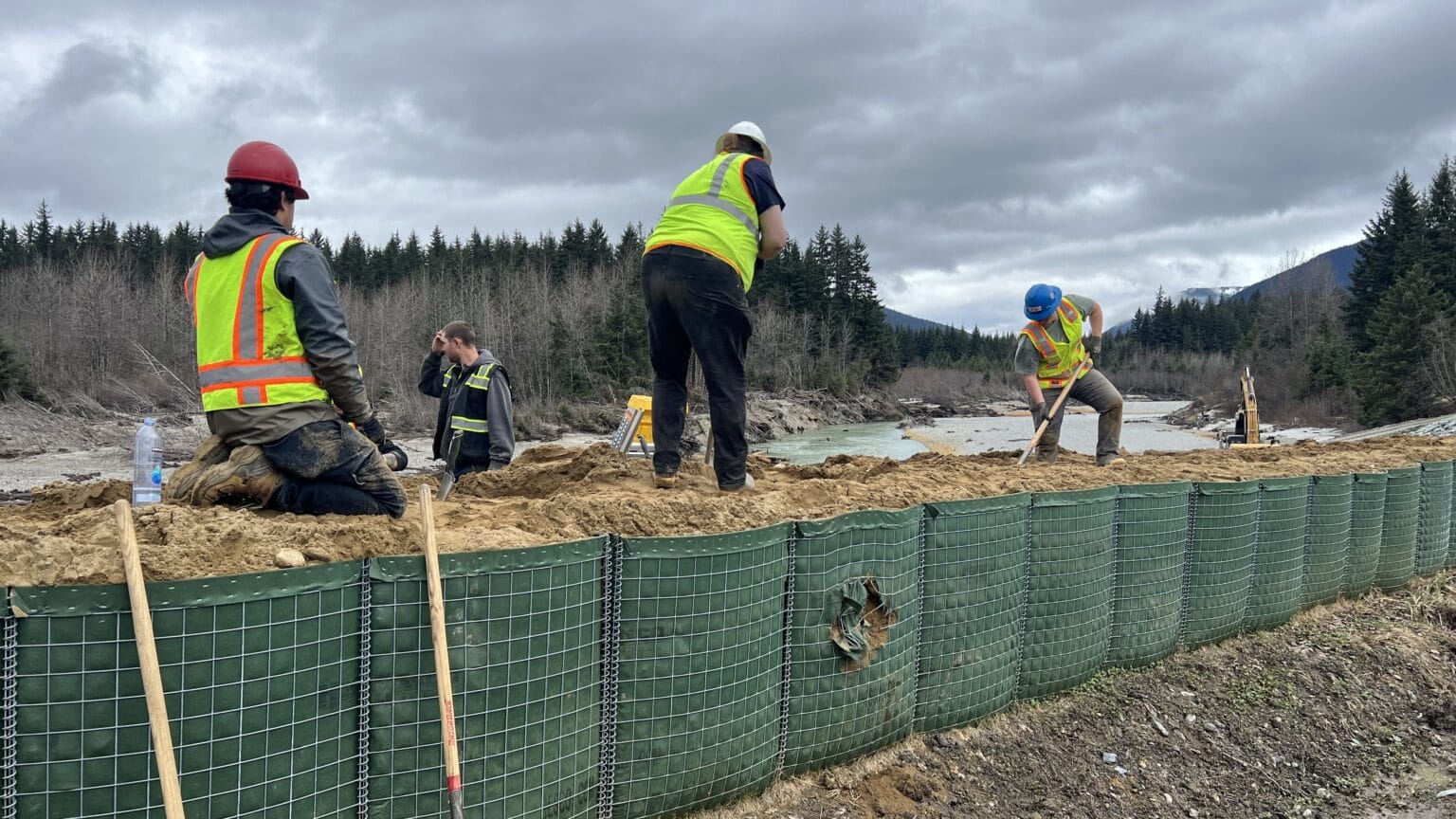
The Juneau Assembly renewed the city’s glacial flood emergency for another 180 days on Monday, pushing the declaration into May and keeping a state of crisis officially alive since the catastrophic August 2024 inundation.
Emergency Programs Manager Ryan O’Shaughnessy presented a survey of 88 flood-zone households and testimony from a September 16 public meeting that laid bare the cost of living behind the wire-and-fabric baskets.
“Several respondents to the survey, in particular, expressed a desire for more in-home assistance,” O’Shaughnessy told the Assembly. “Things like moving furniture, setting up sandbags, taking sandbags down.”
Residents described anxiety and exhaustion that “lasted weeks or months rather than only during the flood,” the memo said. Some said they felt unable to leave town for weeks at a time. Families reported lingering fear in children, and a handful said they were considering leaving Juneau entirely. Others felt calmer this season, crediting stronger barriers, pumps, and better information — but even they called the annual scramble “unsustainable indefinitely.”
This year’s main release crested on August 13 at 14.7 feet — nearly two feet below the 2025 record of 16.65 feet. A second, smaller pulse peaked at 10.18 feet on October 2. The HESCO barriers, engineered for a flow of 63,500 cubic feet per second, withstood both.
Damage was real but limited: 12 of 186 assessed homes took water, mostly on Meander Bend and View Drive, the same streets hit in 2025. O’Shaughnessy credited the barriers and pumps, but also a slow release, a dry summer that left the river low, favorable weather, and a daytime crest that gave crews visibility.
The Corps’ most likely worst-case scenario — 90,000 cfs — would reach 2,067 homes in an area where structures are assessed at roughly $1.5 billion. Falling trees remain the likeliest failure mode for the barriers, O’Shaughnessy told the Assembly in August.
Maintaining the temporary system now costs more than the earlier $6 million to $10 million annual estimate. Juneau has set aside about $4 million toward a $12.9 million state loan that covered its share of the barrier construction.
The engineering fix — a permanent diversion or dam — could exceed $600 million. The Corps hopes to start a mid-term project as early as late 2027; a permanent solution is seven to ten years out. Juneau wants the federal government to cover 90 percent. But the Corps doesn’t expect even a rough cost estimate until spring or summer 2027, City Manager Katie Koester has said, pushing a local bond vote to October 2027 at the earliest.
Three Assembly members have argued the local share should fall on the whole borough, not just valley homeowners, citing commercial and public infrastructure the entire town relies on and Juneau’s acute housing shortage.
Mayor Beth Weldon, Koester, and members of the Central Council of the Tlingit & Haida Indian Tribes of Alaska traveled to Washington, D.C., Tuesday to press for long-term funding and a federal solution. The emergency declaration they just extended is the key that unlocks state assistance and streamlined permitting — tools the city will need every summer until the permanent fix arrives.
Keep reading

Kaneohe Water Main Break Closes Paleka Road and Disrupts Service
A water main break on Tuesday afternoon in Kaneohe prompted road closures and left several residents without water...

Jacksonville Woodlands Offers 16 Miles of Trails and Views
Jacksonville Woodlands offers 16 miles of trails with several starting points. Sixteen miles of trail braid the hills...
Morehouse Student Arrested on Off-Campus Rape Allegation, President Says
Morehouse College police arrested a student Friday, Nov. 13, on an allegation of off-campus rape, President F. DuBois...

Delaware Reports 25 Measles Cases, Urges Vaccination Record Checks
Delaware shattered a decade of quiet on November 17 when health officials confirmed 25 measles cases — every...