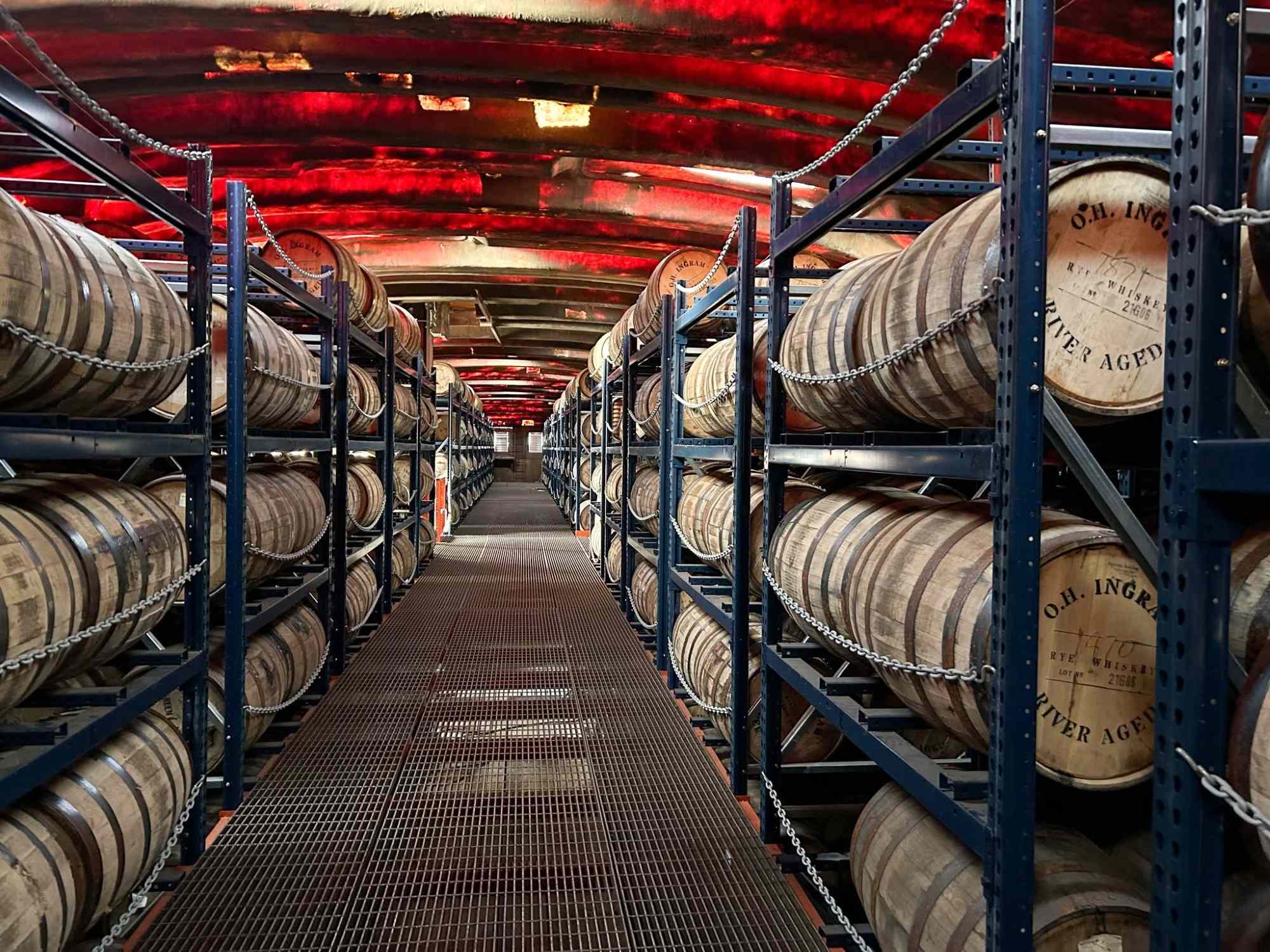
Kentucky bourbon traditionally ages in hillside rickhouses, but Ingram Distillery in Columbus, Kentucky, moors its barrels on decommissioned barges along the Mississippi River, Southern Living reported.
Founder Hank Ingram traced the idea to his family’s river-commerce roots dating to 1865 and to bourbon’s own history: “Bourbon started its journey to the rest of the world by going down the river. In the late 1700s [and] early 1800s, the river really served as the highway,” he told Southern Living. “it really started me thinking, 'Well, goodness, if the world learned about bourbon because it was transported on the river, did we lose anything in that process by removing bourbon maturation from the river?'” Ingram said.
Ingram said his great-great-great-grandfather built his own towboat and a few barges in 1865 to move lumber. “It’s fun to be able to tie this new venture to this family story that’s been around the river for generations,” Ingram said. He also noted bourbon’s strong historical connection to river trade.
Legal precedent cleared the way
Early attorneys said warehousing spirits on a vessel was illegal. Ingram found a workaround in the U.S. Supreme Court’s 2014 Lozman decision, which held that a floating house without self-propulsion was not a vessel. “If we take a barge and moor it on the bank of a river and decommission it for navigation, it is now a floating barrel house,” Ingram told Southern Living.
An attorney told Ingram he had just attended a tax convention where the Lozman case was discussed, in which a man with a floating house successfully argued his home was not a vessel because it could not power itself.

River motion and temperature change the chemistry
Master blender Scott Beyer said the gentle current creates turbulence inside the barrel, increasing contact between whiskey and oak. “That fluid movement helps to increase these activation sites that you would see between the whiskey and the oak,” Beyer told Southern Living.
The river also helps keep the barrel at a more stable temperature than it might achieve in an on-land rickhouse. Beyer explained that maturation is the aging definition for any spirit in a barrel and that the river method comes down to alternative maturation.
The result, both men said, is a richer and more nuanced profile.
River moderates barrel heat in summer
When bourbon barrels sit in floating rickhouses during summer, the river pulls a large amount of heat out of them over the course of a day, master blender Scott Beyer told Southern Living. The barge transfers much of that heat away from the barrels, lowering the risk of evaporation and off-kilter flavors.
The river method relies on that principle rather than traditional warehouse conditions.
Capacity forces a third barge build
Two barges are now completely full, with every nook and cranny occupied, founder Hank Ingram told Southern Living. The distillery must build a third barge to accommodate continued production.
Ingram Distillery traces its concept to founder Hank Ingram’s five-generation river-commerce legacy beginning in 1857 and to bourbon’s early reliance on the Mississippi for transport, asking whether maturation lost something when it left the water. The company secured legal footing via the U.S. Supreme Court’s 2014 Lozman decision, which classified a non-self-propelled floating structure as a building rather than a vessel, allowing decommissioned barges to serve as bonded barrelhouses.
Master blender Scott Beyer explains that the river’s gentle current creates turbulence inside barrels, increasing whiskey-to-oak contact, while the water mass pulls heat from barrels in summer, stabilizing temperature and reducing evaporation compared with hillside rickhouses.
Capacity is maxed out
Two barges are full. I mean, I think every nook and cranny has been filled,” Ingram told Southern Living. Barge three will incorporate lessons from the first two.
Keep reading

NJBIA Releases Six Policy Recommendations for AI Data Center Development in New Jersey
New Jersey Business & Industry Association released six policy recommendations on Monday aimed at shaping how the state...

Florida-Florida State Rivalry Carries Bowl Stakes; Gators’ Baugh Chases 1,000 Yards
Florida and Florida State meet Friday in Tallahassee with both programs bowl-eligible and the rivalry carrying postseason stakes...

Detroit Activist Sues City, Police Chief, Officials Over Sheffield Photos
Detroit activist Jahdante Smith filed a lawsuit Wednesday alleging the city’s police chief and the mayor’s community engagement...
Immigrants Sue GEO Group, Ex-Officials Over Forced Labor, Sexual Abuse at Louisiana ICE Facility
Four immigrants who were detained at a Louisiana ICE facility filed a federal lawsuit Monday accusing a former...