
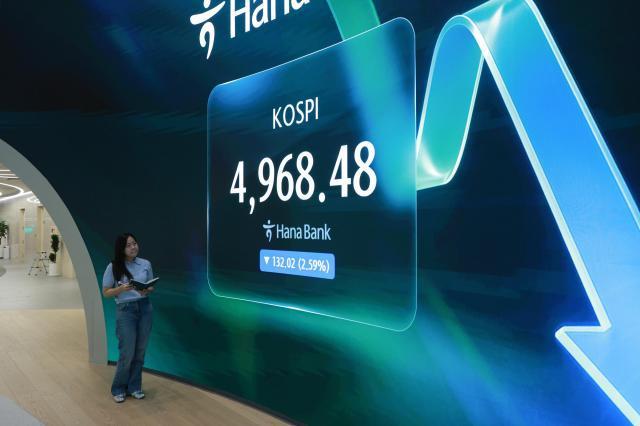
“The people’s assets are not gambling chips for President Lee and the Democratic Party,” said Choi Bo-yun, People Power Party Chief Spokesperson, criticizing the government after the KOSPI collapsed 5.21 percent on Friday to close at 4,869.96, its first finish below 4,900 in about 10 months, The Korea Times reported.
The index shed 267.93 points in a single session, dragging its weekly loss to 7.95 percent as doubts over artificial-intelligence returns hammered semiconductor heavyweights. Samsung Electronics and SK hynix — together nearly half the KOSPI’s weight — fell 6.1 percent and 5.8 percent respectively in morning trade, 24/7 Wall St. reported. The sell-off erased 3,400 trillion won in market capitalization from the June peak of 7,450 trillion won, leaving total capitalization at 3,991 trillion won, according to Aju Press.
Samsung and SK hynix alone accounted for roughly two-thirds of Friday’s index decline, 24/7 Wall St. calculated. Yet both companies are posting record profits — earnings have grown ninefold at Samsung and sevenfold at SK hynix — and plan up to 210 trillion won ($157 billion) in shareholder returns for 2026. MSCI’s Korea index trades at 3.27 times forward earnings, about a fifth of the global multiple of 15.35, LSEG data cited by Reuters show.
The Alpha Metric: 75 Percent Foreign Short Flow
Short-selling transactions on the KOSPI and Kosdaq totaled 21.6 trillion won ($16 billion) over 14 sessions through Thursday. Foreign investors accounted for 16.21 trillion won, or 75.1 percent of the total, Korea Exchange data cited by The Korea Times show.

Retail Margin Calls and the Leveraged-ETF Fallout
Regulators eased collateral requirements for brokerages this month, giving margin borrowers three extra months before forced liquidation. The relief is narrow: brokerages can still sell shares if values drop far enough, while investors keep paying loan interest, The Korea Times reported.
Meanwhile, single-stock leveraged ETFs — approved by the Financial Supervisory Service in 29 days versus a 62-day norm — have inflicted 6.3 trillion won ($4.73 billion) in retail losses in under three months, with 2.3 trillion won in confirmed losses, Choi told Herald Business.
Choi said of Lee Jae Myung that he called the public in with lines like “I’m in the same boat as 14 million retail investors” and “join now before things get even better.” The floor leader Jung claimed the episode the “2026 ‘Lee Jae-myung bubble,'” comparing it to the 2000 dot-com collapse, JKN reported.
Policy Crossroads: Stabilization Fund vs. MSCI Status
Taiwan moved to tighten short-selling rules as its stock market also came under heavy selling pressure. Kim said at a policy meeting on the capital market chaired by Lee Jae Myung on Nov. 13 that merely signaling activation of the market stabilization fund could deter short sellers without actual deployment.
Kim said foreign investors told The Korea Times that a signal the market stabilization fund could be activated would help curb short-selling activity.

Emergency F4 Meeting Before Monday’s Open
Lee Hyung-il will chair an emergency “F4” meeting Sunday afternoon with Shin Hyun-song, Lee Eok-won, and Lee Chan-jin, BigGo Finance reported. The session — the second this month — will gauge spillover from Thursday’s U.S. plunge (Nasdaq -5.28%, S&P 500 -3.70%, Dow -1.93%) and decide on pre-open cushioning measures. Nasdaq has now surrendered all 2026 gains; the Dow and S&P 500 are more than 10 percent off recent highs.
Main Street Bridge: The 401(k) Filter
For a Vanguard Target Retirement 2030 Fund holder with $500,000, direct Korea exposure is about $6,907 (1.38 percent). Friday’s move clipped roughly $1,772 across Samsung, SK hynix, and TSMC combined, Yahoo Finance calculated. The larger hit comes through the fund’s 35.3 percent U.S. slice ($176,500), where a 2.0 percent drop costs $3,530 — more than double the Korea hit. Most savers never felt the June boom either: a 116 percent KOSPI surge added only ~1.4 percent to the fund.
Smart Money Tracker: Valuation vs. Flow
Goldman Sachs cut its KOSPI target this week to 7,500 — still 53 percent above Friday’s close. The iShares MSCI South Korea ETF (EWY) slipped 0.5 percent in U.S. after-hours Thursday to $133.95, up 38 percent year-to-date but down 39 percent from its June 18 peak.
Emerging-market funds built on MSCI indexes carry the same concentration risk. The question is whether policy can decouple Korean valuations from the global AI re-rate, or if the 3.27x forward multiple simply marks a value trap until sentiment turns.
The F4 meeting concludes Sunday. Markets reopen Monday.
Disclaimer: The information provided in this article is for educational and market analysis purposes only and does not constitute financial, investment, or legal advice. Always consult with a certified financial professional before making investment decisions.
Worth a look

Group 1 Hyundai Southwest Houston Serves Southwest Houston Buyers for Elantra
For Houston buyers looking for an Elantra, Group 1 Hyundai Southwest Houston at 10301 Southwest Freeway serves as...

Charity Cooperative Nassau County 5k Supports Local Non-Profits on March 27th, 2027
Charity Cooperative Northern Virginia 5k supports local non-profits on March 27th, 2027. The Charity Cooperative Nassau County 5k...

Oklahoma Offers Adrian Peterson Jr. for 2030 Class on Saturday
Oklahoma football offers Adrian Peterson Jr. for the 2030 recruiting class on Saturday night. This offer connects a...

Iowa topped Illinois, 34-17 on Saturday
Iowa topped Illinois, 34-17 on Saturday. This win, Iowa's fourth straight, doesn't just count for the Big Ten...