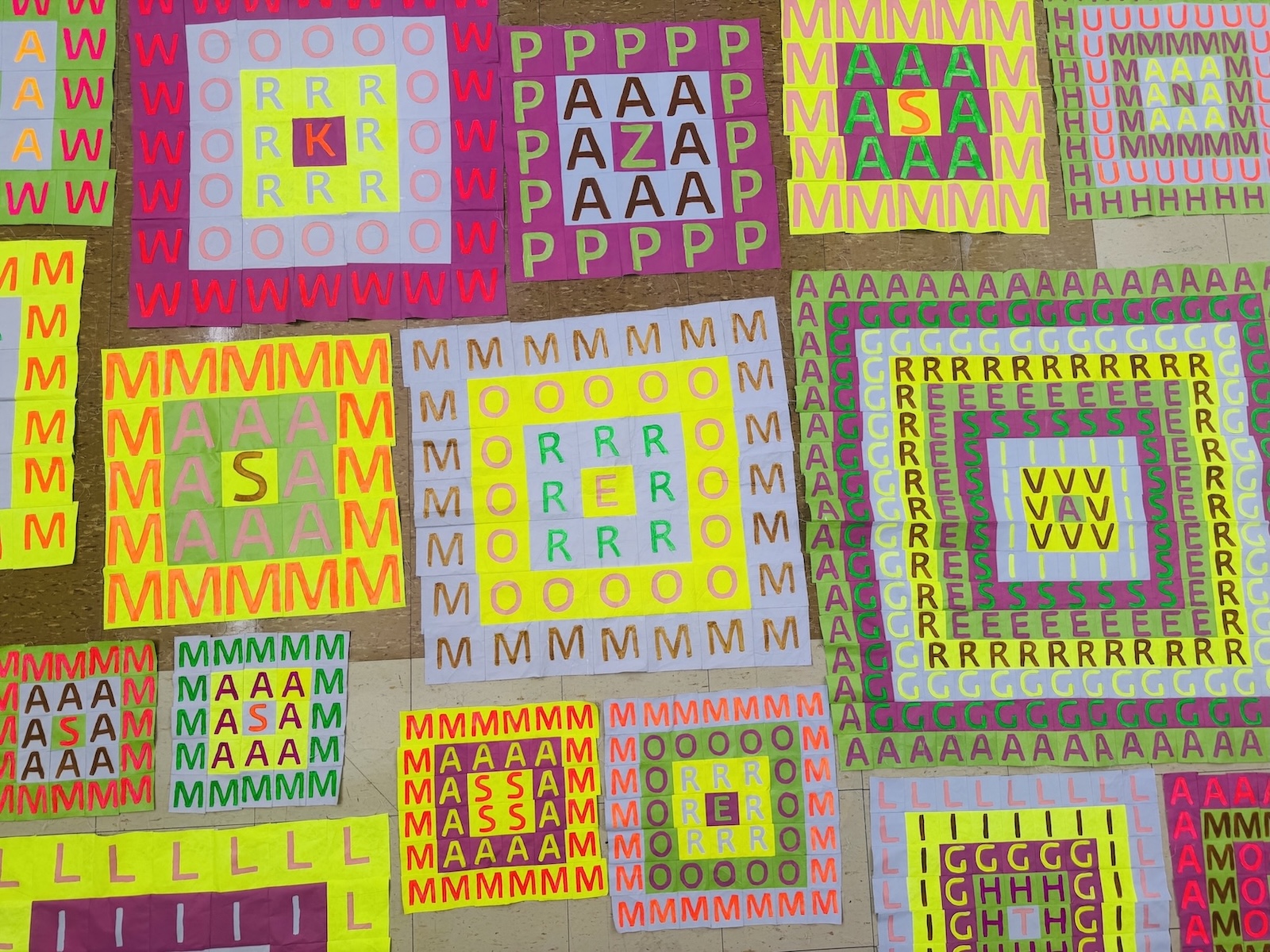
Krystal Ramirez builds analog glitches out of heavy construction materials, turning historical picket lines into woven grids.
Fresh artistic creations by Las Vegas creator Krystal Ramirez make up the exhibition More, which the Marjorie Barrick Museum of Art is delighted to showcase. Ramirez explores the significance of resistance and suggests that disrupting our usual mental habits helps keep us grounded in reality through her use of historical photography, puzzles, and massive textile sculptures.
Inspired by her relatives’ involvement with the Culinary Union, she arranges terms discovered in past demonstration images sourced from University of Nevada, Las Vegas Special Collections and Archives into quilt-shaped patterns. By employing Tyvek—a durable substance generally utilized in building sites—she strengthens the link between her artistic objectives and a familial background rooted in blue-collar employment.
Exhibition Runs Through May 2027 at West Gallery
The exhibition runs in the West Gallery of the Marjorie Barrick Museum of Art from Oct. 23, 2026, through May 22, 2027. A reception will take place during the University of Nevada, Las Vegas Art Walk event on Oct. 23 from 5 to 9 p.m.

“The conceptual fabric of Ramirez’s work resides in her understanding of protest as process: a means of overturning the utopian, ahistorical foundations of artistic abstraction and transforming them into a poetic declaration of anger and a call to action,” says Emmanuel Ortega, Ph.D., who serves as assistant professor in art of the Spanish Americas at the University of Illinois at Chicago and Marilynn Thoma scholar.
She “reminds us that there can be no creative path forward without a rigorous reckoning with history and its enduring impact on contemporary society.”
Her grids refer back to the nested squares that the German American artist Josef Albers used to test the effectiveness of small changes between different combinations of colors. The shapes found in precolonial architecture during a trip to Mexico served as an inspiration for Albers, notes Ramirez, who identifies as a Mexican American artist.
Ramirez builds what she terms analog glitches that encourage audiences to focus deliberately on the reading process by arranging letters and words as if they were ornamental pieces shifting across a vibrant system. Modern artificial intelligence systems, which encourage us to assume gathering information is effortless and fast, are directly challenged by her pieces.
Museum Open Tuesday Through Saturday with Free Entry
The Marjorie Barrick Museum of Art is open from Tuesday through Saturday, 10 a.m. to 5 p.m., when exhibitions are open. It is closed on state and federal holidays, and entry is free.
The Marjorie Barrick Museum of Art opened in 1967 as a natural history museum under the Desert Research Institute before joining UNLV’s College of Fine Arts in 2011 and reopening the following year as a contemporary art museum. Its collections grew significantly after a 1979 donation of pre-Columbian art, and in 2012 it absorbed the collection of the closed Las Vegas Art Museum.
The exhibition was created in collaboration with Emmanuel Ortega, Ph.D., and UNLV Special Collections and Archives. Support for the Marjorie Barrick Museum of Art’s Bus to Barrick field trip initiative comes from Howard Watts III, the College of Fine Arts Alumni Association, and UNLV’s Office of Government and Community Engagement.
Keep reading

New Mexico Seven-Day Firearm Waiting Period Pause as AG Agrees to Stipulated Injunction
Seven days of waiting might finally end for New Mexico firearm purchasers as the state agrees to pause...

Indiana Man Arrested in Gilbert Over Alleged $600 Million Ponzi Scheme
Federal authorities arrested 29-year-old Devin Allen Johnson of Zionsville, Indiana, in Gilbert on Wednesday, Nov. 18. The arrest...

Pochettino Managing Manchester United Against Liverpool at Anfield Sunday
Manchester United will travel to Anfield on Sunday with Mauricio Pochettino in the dugout for his first match...

Dr. Brooks Williams Says BREC Owes Baton Rouge More Than Another Argument
"We owe Baton Rouge more than another argument," said Dr. Brooks Williams, Superintendent. That is the message BREC’s...