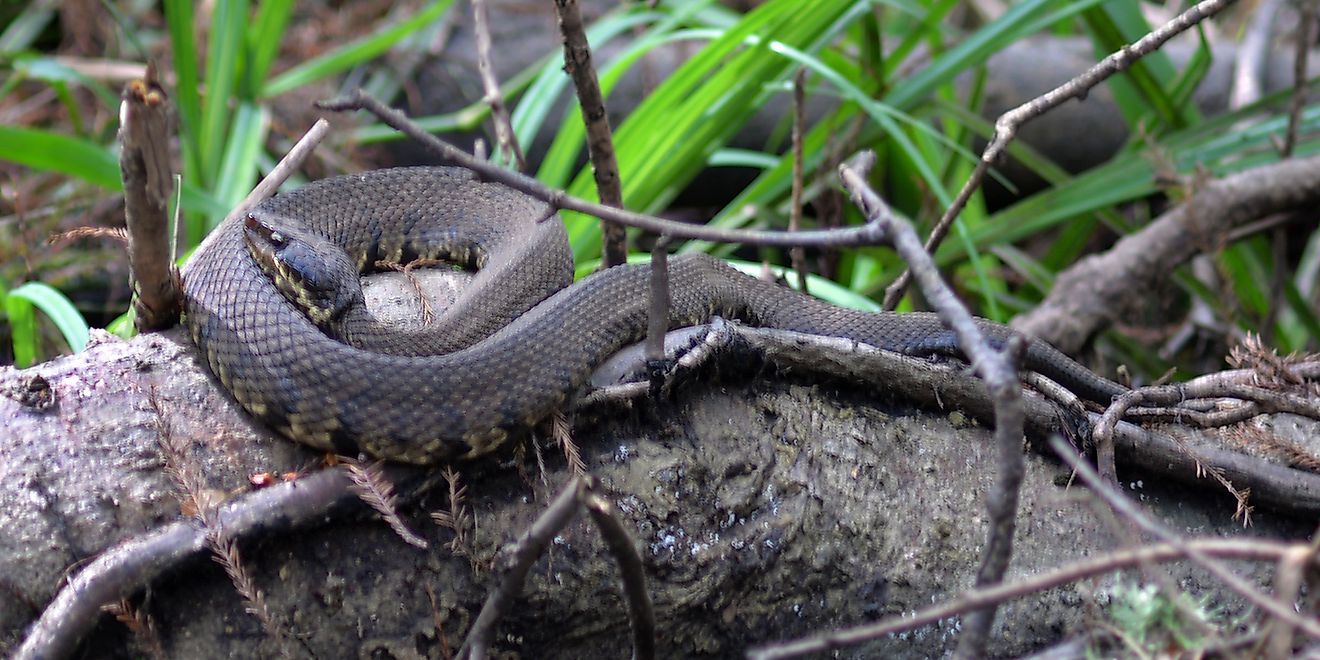
For years, participants aboard watercraft navigated around a single Louisiana body of water to eliminate basking serpents by the thousands. Many were cottonmouths.
Lake Providence stands apart in that grim count because its record is built on an explicit body count rather than camera traps. In northeast Louisiana, the East Carroll Parish Sheriff’s Office sponsored a snake rodeo in most years from the mid-1960s until 2024, billed as a way to control the snake population on the lake.
Participants shot an unlimited number of snakes from their boats as the animals basked, with cottonmouths making up a steady share of the toll. Records show the 2016 rodeo took 84 cottonmouths, while the 2018 event yielded 46.
That era of open shooting is over. During November 2024, the Louisiana Wildlife and Fisheries Commission put its stamp of approval on regulatory updates banning organized competitions that purposefully or intentionally waste native amphibians or reptiles. Those rules took effect in January 2025, bringing an end to the Lake Providence snake rodeos.
Other waters across the South rely entirely on photographic tallies rather than culling. Around two state-park lakes near Houston, visitors have logged 184 cottonmouth sightings, while a Florida prairie sink accounts for 142 research-grade entries on iNaturalist.
At Paynes Prairie Preserve State Park just south of Gainesville, Florida, walkers on the La Chua Trail follow the Main Dike out across wet prairie and marsh toward Alachua Sink and Alachua Lake.
Photographs posted to iNaturalist put 142 research-grade sightings of Florida cottonmouths within about 3 miles of the sink. The state park lists snakes among the animals commonly seen there alongside alligators, otters, and sandhill cranes, with pets banned on certain trails due to potential wildlife conflicts.
Farther north in central South Carolina, Congaree National Park hosts 21 kinds of snakes, including three venomous species: the timber rattlesnake, the copperhead, and the water moccasin. iNaturalist users have logged 175 verified cottonmouth photographs within about 2.5 miles of Weston Lake, where the park’s boardwalk tour features an overlook at Stop 10 where turtles, snakes, and alligators turn up in the water and on logs.
On the Texas and Louisiana line, Caddo Lake’s tally runs to 113 verified cottonmouth photographs within about 6 miles of its center. Texas Parks and Wildlife paddling trails there pass tall bald cypress draped in Spanish moss, guiding visitors past nonvenomous water snakes, ribbon snakes, and cottonmouths alike.
Along the Texas and Oklahoma border, Hagerman National Wildlife Refuge covers more than 11,000 acres along the southern shore of Lake Texoma. The refuge wildlife-watching guide points visitors to snakes along the banks of Big Mineral Creek, and a cottonmouth was photographed on the refuge as recently as September 26, 2026.
The Friends of Hagerman support group notes that the species keeps to wet or moist areas and often swims on ponds, starting their movement as spring arrives.
Visitors exploring Brazos Bend State Park located southwest of Houston can walk paths bordering several bodies of water, such as the 40 Acre Lake Trail, the Elm Lake Loop, the Hale Lake Loop, and a Creekfield Lake trail featuring an observation pier.
Within roughly a radius of 2 miles around Elm Lake, the iNaturalist platform records 184 research-grade observations of cottonmouths, supplemented by fresh submissions stretching through autumn 2026, which include specimens captured in photographs on the Hale Lake Loop on October 8 and on the Creekfield Lake ADA Trail on October 10.
Not every snake encountered on these popular park logs is a cottonmouth. Out of all the Lake Providence rodeos that maintained documented tallies between the years 2003 and 2019, 80 percent of the reptiles destroyed were harmless. State wildlife agency lists show that cottonmouths prey on water snakes alongside fish, frogs, and small mammals, linking the harmless species to the same shoreline habitats.

Greek Banks Recoup 77% of Crisis Losses, Full Recovery Tied to RRF
The Greek credit system has recouped 77% of the financial losses accumulated during the crisis period between 2022...
UW Economics PhD Student Finbar Curtin Invited to Beijer Young Scholars Cohort
“The multidisciplinary setting should be a great opportunity to better understand how other fields study climate change and...

Heat Top Bucks 137-130 Behind Mitchell’s 24 Points, Team’s 22 Three-Pointers
The Miami Heat defeated the Milwaukee Bucks 137-130 on Wednesday powered by Davion Mitchell's 24 points and 22-of-48...

Wade Ties Career-High 23 as Slippery Rock Women Beat West Virginia State 80-65
The Slippery Rock University women's basketball team secured an 80-65 victory over West Virginia State University on Wednesday...