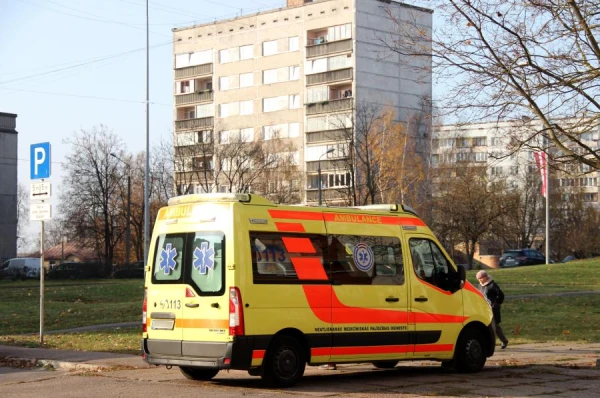
Latvia’s emergency medical service will sort calls into three priority tiers with fixed response-time targets, Health Minister Normunds Stanevics and service head Liene Cipule agreed on Monday, Inbox.eu reported.
The Cabinet of Ministers will review draft amendments to the rules governing emergency care, said Oskars Schneider, head of the Ministry of Health’s Communication Department. Specific criteria for each category and the arrival standards attached to them have not been published.
Hospitals will face a mandated window to accept patients delivered by NMPD crews, ending the current practice of ambulance staff waiting to hand over patients. Facilities must also have patients ready for inter-hospital transport before the ambulance arrives, freeing vehicles and crews for the next call.
Cipule told the minister the ambulance fleet needs urgent renewal, calling it a priority for maintaining coverage across all regions. The two also discussed staff motivation, technical equipment and the impact of 2025 budget cuts ordered by the previous government.
“Our common goal is a healthcare system where the needs of the patient are at the center of decision-making,” Stanevics said. He added that NMPD management decisions on optimization are based on careful assessment and objective data.
The changes sit inside a broader reform pledged by Prime Minister Andris Kulbergs’ government. Plans include a unified patient registry, shorter specialist wait times, a hospital network review and converting the National Health Service into a single-payer National Health and Care Insurance Fund. The government also intends to stimulate pharmaceutical competition to lower drug prices and abolish quotas for children’s services within budget limits.
Latvia spans 64,573 km² yet holds just 1.83 million people, a density that stretches the National Emergency Medical Service’s (NMPD) fleet thin across rural expanses and forces crews to cover vast distances between calls. Cipule warned the minister that the ambulance fleet needs urgent renewal, calling it a priority for maintaining coverage across all regions, a challenge amplified by the country’s geography and sparse settlement pattern.
With a population of 1.83 million distributed over 64,573 km², Latvia’s low density means fixed response-time targets must be met across long rural stretches where hospitals are few and inter-facility transports consume crew hours.
The draft rules on call categorization still require Cabinet approval.
Related reading

Weekly HIV Pills and Four-to-Six-Month Injectables Advance in Late-Stage Trials
Weekly oral pills and injectable combinations dosed every four to six months advanced through late-stage trials, researchers reported...
Residents Warn of Sewage Pools on Dry River Dore Bed
Where the river stops flowing it goes completely dry, absolutely no flow, said Alice Elliott of the Dore...

Mechanical Crowding Near Memory Hub May Accelerate Alzheimer’s Progression, Study Finds
A small study from Columbia University and Mount Sinai finds that people with mild cognitive impairment and high...

High Court Dismisses Couple’s Claim Demolition of Unauthorised Meath Home Breached Human Rights
A High Court judge has dismissed Chris and Rose Murray’s claim that the demolition of their unauthorised Co...