Governor Maura Healey invoked an emergency preamble on November 6 to put the state’s expanded abortion law into immediate effect, leapfrogging a petition drive that had gathered more than 113,000 signatures to suspend it.
The move came two days before the law would have taken effect under the standard 90-day timeline and before the Secretary of the Commonwealth could verify the signatures.
The law, Chapter 188, removed the 24-week gestational limit and replaced a narrow set of exceptions with the “professional judgment of the physician.” Healey signed it on August 10. Under the state constitution, filing enough valid signatures triggers an automatic suspension until voters decide the measure at the next biennial election — in this case, November 2028. The Elections Division has since confirmed the petition qualified for the 2028 ballot.
Sam Miele, chair of the Compassionate Care Coalition’s campaign to suspend and repeal Chapter 188, filed a complaint in Suffolk Superior Court on November 16 challenging the emergency preamble. The lawsuit argues the declaration failed to establish a legitimate basis for bypassing the constitutional referendum process and was used to prevent the law’s suspension while the repeal petition moved toward the ballot.
Miele is asking the court to declare the preamble ineffective and affirm that the filing of sufficient signatures triggered the constitutional suspension.
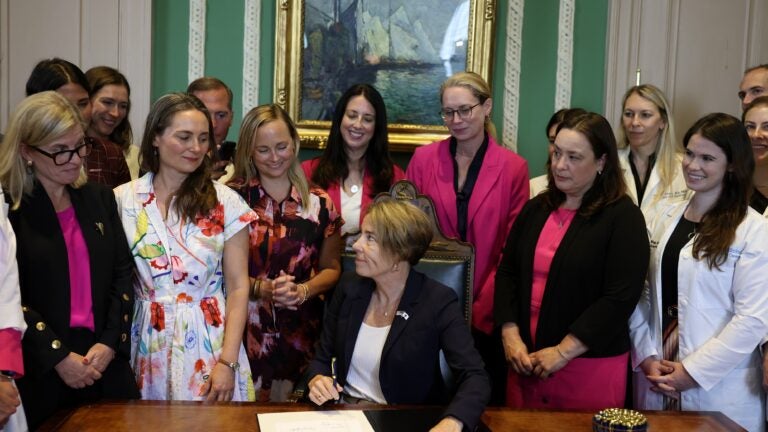
“We commend Sam for his willingness to seek justice for more than 113,000 signatories whose voices Governor Healey, without legitimate reason, disregarded and silenced.”
said Myrna Maloney Flynn, President of Massachusetts Citizens for Life and Vice-Chair of the Compassionate Care Coalition.
Healey defended the preamble on her Substack, writing that at least nine patients had been denied care since she signed the law. “If certified, that effort would suspend the law until voters decide its future. That could mean two more years of women being denied care,” she wrote. “That’s not a reality I can accept here in Massachusetts.”
She added that she would respect the voters’ decision in 2028 but insisted families should not go without care while the process plays out.
The governor deployed a similar emergency preamble two years ago when a petition drive threatened to block a sweeping gun-reform law — a law more than 67 percent of the electorate voted to uphold last week.
Department of Public Health data shows 99 abortions at 24 weeks or later in 2024, compared to 84 in 2023. Those figures represent 0.2 percent of the 49,450 abortions in Massachusetts in 2024 and 0.34 percent of the 24,355 in 2023. The Catholic Church has opposed the law; Archbishop Richard Henning of Boston and bishops Robert McManus of Worcester, Edgar da Cunha of Fall River, and William Byrne of Springfield called it “radically permissive” and questioned the emergency preamble.
The Compassionate Care Coalition submitted 113,477 signatures to Secretary of State William Galvin on November 17, of which 80,412 were certified — well above the 37,287 required to place the veto referendum on the November 2028 ballot. The vote will mark the first time Massachusetts voters decide a ballot measure on abortion policy since 1986, when Question 1 was defeated.
The court’s ruling will determine whether Chapter 188 remains in effect during the two-year run-up to the November 2028 referendum.

Illinois Man Charged With Generating Child Abuse Material Using Super Intelligence
By ByteWire News Staff NEWARK, N.J. — Friday, November 20, 2026 Federal prosecutors charged a 47-year-old Joliet, Illinois...

No. 3 West Virginia Targets NCAA Cross Country Title After Record Regional Win
West Virginia put four runners across the line before most teams had one, scoring a program-record 19 points...

UCA Bears Open ASUN Crossover at Jacksonville, North Florida
The University of Central Arkansas Bears step onto the floor at Swisher Gymnasium on Saturday afternoon carrying a...

Downtown Development Review Board Grants Final Design Approval for UF LaVilla Building
Jacksonville's Downtown Development Review Board voted 7-0 Thursday to grant final design approval for the University of Florida's...