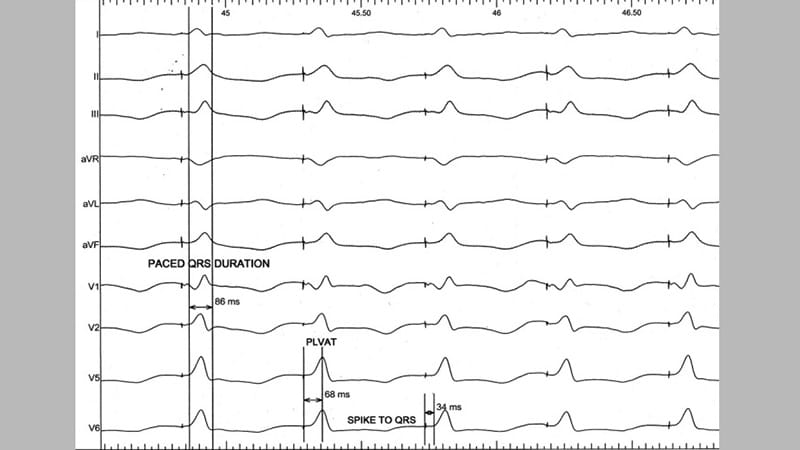
Left bundle branch pacing reduces deaths, heart failure hospitalizations, and pacing-induced cardiomyopathy compared with traditional right ventricular pacing in patients needing pacemakers for atrioventricular block.
That finding emerged from the OptimPacing trial, presented at the American Heart Association Scientific Sessions 2026 and simultaneously published in The New England Journal of Medicine. The international multicenter study enrolled 685 patients with an average age of 68.4 years who required pacemakers due to atrioventricular block, assigning them in a 1:1 ratio to left bundle branch pacing or right ventricular pacing.
Traditional right ventricular pacing implants the active lead in the RV septum or apex. By contrast, left bundle branch pacing fixes a 3830 lumenless lead into the interventricular septum until it reaches the LV subendocardium.
Jiangang Zou, professor of cardiology at the First Affiliated Hospital, Nanjing Medical University in Nanjing, China, presented the trial data. “This study provides evidence supporting the consideration of LBB pacing as a first-line pacing strategy for patients with an anticipated high ventricular pacing requirement,” Zou said.
The trial randomized 342 patients to left bundle branch pacing and 343 to right ventricular pacing. Eleven patients failed the LBBP approach and crossed over to RVP. The final analysis included 331 patients in whom LBBP was successful.
The prespecified subgroup analysis showed that LBBP was superior to RVP in reducing the composite clinical outcome. Specifically, 8.5% of patients in the left bundle branch group experienced the primary study outcome—defined as all-cause death, heart failure hospitalization, or pacing-induced cardiomyopathy—compared with 19.2% in the right ventricular pacing group. That yielded a hazard ratio of 0.41.
The median follow-up period reached 35.1 months after an interim analysis triggered by 51 primary outcome events. Paced QRS duration averaged 124 ± 17 milliseconds in the newer pacing group versus 151.7 ± 20 milliseconds in the conventional group, while ventricular pacing burden surpassed 90% in both cohorts.
Examining the individual components of the composite primary endpoint reveals where the physiological advantages concentrated. Zero patients in the left bundle branch pacing group developed pacing-induced cardiomyopathy, compared with 11.7% of patients in the right ventricular pacing group.
Hospitalization rates for heart failure were 1.5% versus 1.9%, and all-cause mortality was 7.4% and 7.7% respectively. Zou noted four main study limitations: early trial termination which could overestimate treatment effects, missing echocardiograms at specific timepoints, unblinded echocardiographic reading bias, and an enrollment pool consisting mostly of patients with normal left ventricular ejection fraction.
“Further studies are warranted in patients with reduced LVEF,” Zou said.
Hani Najm, chair of pediatric and congenital heart surgery and executive co-director of the Pediatric and Adult Congenital Heart Center at Cleveland Clinic, highlighted the broader clinical implications of the study.
“We always worry about inserting pacemakers specifically in younger patients because they are going to have them for a longer time. So, if we are able to put in a pacemaker that will avoid either mortality, cardiomyopathy, or a readmission to the hospital for heart failure, then that would be a great added value,” Najm said.
At the same time, Najm emphasized that early trial termination leaves important questions regarding long-term fibrotic tissue encasement unanswered.
“It’s still a bit early,” Najm said. “We have to see what the reaction of the heart is. It can encase any foreign body with fibrous tissue. We want to know, is that going to interfere with pacing or not? Are they going to lose patients or not. All that is study that happens over the years. We need to still follow that.”
Worth a look
At Final ASEAN-UN Summit, Guterres Upholds Cooperation and Action on Myanmar – UN News
United Nations Secretary-General António Guterres wrapped up his final ASEAN-UN Summit appearance on Monday by pressing regional leaders...

GAA Clubs Used in Lung Cancer Screening Pilot to Help Improve Outcomes
A mobile unit parked outside an O’Rathallaigh Park GAA clubhouse in Drogheda has become the unlikely setting for...

Tamil Nadu Minister Aadhav Arjuna and Wife Daisy Martin Part Ways After 14 Years
Tamil Nadu Minister and Tamilaga Vettri Kazhagam (TVK) leader Aadhav Arjuna and his wife, Daisy Martin, have mutually...

Cloudflare Open-Sources Kitesurf, Allowing Self-Deployment
Cloudflare open-sourced its Kitesurf browser engine on Friday granting developers direct access to the Apache 2.0 licensed code...