
Two Libyan naval officers died Tuesday from wounds sustained in a Sunday Ukrainian drone strike on a Russian warship docked at Benghazi Naval Base, the Libyan National ARMY said.
Two Libyan Officers Die After Strike
Ukrainian sea drones hit the Russian Navy corvette Merkury — a Project 20380 Steregushchiy-class vessel commissioned three years ago — while it was refuelling and resupplying at the base in eastern Libya. The LNA said at least four drones were intercepted and two struck the ship, which capsized and sank.
At least ten people, both Libyan and Russian nationals, were wounded. The two Libyan officers succumbed to their injuries two days later. President Volodymyr Zelenskyy confirmed Monday that Ukrainian forces deployed seven drones in the operation, calling it an “exemplary Ukrainian operation” carried out by the Security Service of Ukraine and the Defence Forces.
LNA Vows Retaliation
The LNA’s General Command, led by Gen. Khalifa Hifter, vowed to retaliate “at the appropriate time and place, and by the appropriate means.” The force controls eastern and southern Libya and maintains close ties with Moscow.
An initial investigation cited by LNA-affiliated officials said the drones were launched from a base operated by Ukrainian forces in western Libya, though Kyiv has not disclosed the launch point. Italian Foreign Minister Antonio Tajani said Rome was not informed of the operation and did not provide any support to the Ukrainians.
Russia Expands Footprint in Eastern Libya
Russia has expanded its military footprint in eastern Libya since losing its bases in Syria after Bashar al-Assad’s fall in December 2024. Estimates place 1,000 to 1,800 Russian personnel in the country, including elements of the Africa Corps, a Defence Ministry unit formed to replace the Wagner Group.
The Merkury had previously helped evacuate Russian military equipment, including S-300 air-defence systems, from Syria. Analysts say the port serves as a critical logistics hub for Moscow’s operations across Africa.
Tripoli Condemns Attack
The internationally recognised Government of National Unity in Tripoli denounced the strike as a violation of Libyan sovereignty and a threat to maritime safety, warning it would take legal and diplomatic measures against those responsible.
A suspected Ukrainian drone strike hit a Russian warship on Sunday (November 22, 2026) at a naval base in Libya, officials said, the latest attack in the North African nation linked to the Russia-Ukraine war.https://t.co/Dv3n84BfQo
“The Libyan government will not allow Libyan ports, territory or territorial waters to be turned into an arena for settling scores or exporting international conflicts,” it said. The GNU has cultivated ties with Ukraine and Turkey to counterbalance Russian influence in the east, and in 2022 issued an unqualified condemnation of Russia’s invasion of Ukraine.
Baltic Sea Strikes Surge
The Benghazi attack coincided with a surge in Ukrainian drone operations against Russian shipping in the Baltic Sea. On November 11, drones struck the corvette Naro-Fominsk at the Ust-Luga oil terminal. Days later the cargo vessel Sparta II caught fire off Finland while sailing from St. Petersburg to Kaliningrad.
Estonia’s prime minister, Kristen Michal, said the Baltic strikes were “neither surprising nor the first time” Ukraine had targeted Russian vessels there. Finland’s president, Alexander Stubb, called the consequences of Russia’s war “visible in our region.”

Europe Fears Escalation
Italy fears Russian retaliation in Libya could reignite civil conflict on its southern doorstep. “No member state wants to see the war in its backyard,” the official said. “But the spillover didn't start two days ago. Russia is violating EU territory every day of the week.”
Ukrainian Units Operate in Western Libya
Ukrainian drone units have operated in western Libya for at least three years with the knowledge and support of the Tripoli government, The Independent reported. According to a POLITICO source, the Ukrainians have helped counter the threat posed by eastern warlord Khalifa Hifter, who is known to have support from Russia and the United Arab Emirates in his civil war against the UN-recognised government.
The Associated Press added that an initial investigation found several Ukrainian sea drones were launched against the corvette from a base operated by Ukrainian forces in western Libya.
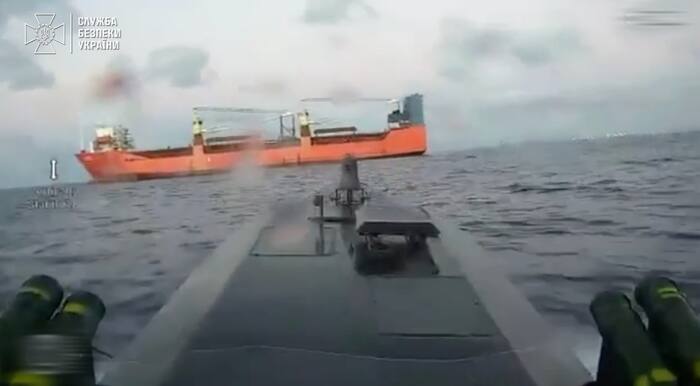
Ukrainian officials insisted the previous day that Kyiv’s forces had not targeted Libyans in the operation, conducted some 2,400 kilometres from the war’s front line, according to AP. The internationally recognised Government of National Unity has cultivated ties with Ukraine and its Western allies, partly to support its efforts to stay in power, AP reported.
A drone strike ignited the Sparta II off the Finnish coast on Saturday as the vessel traveled from Saint Petersburg toward Russia’s Baltic exclave of Kaliningrad.
According to the Christian Science Monitor, Finnish Prime Minister Petteri Orpo suggested on the social media platform X that Ukrainian drones were responsible for setting the Russian cargo ship ablaze in the Gulf of Finland that Saturday. “War is spilling over into our immediate vicinity,” Mr. Orpo said, as quoted by the Irish Times.
Russian Personnel Estimated at 1,000 to 1,500
Estimates place between 1,000 and 1,500 Russian personnel in the country, including elements of the Africa Corps, a Defence Ministry unit formed to replace the Wagner Group, according to a POLITICO source.
A CEPA analysis said that “the Mediterranean is rapidly becoming another front in Russia's war in Ukraine,” noting the Mediterranean is not the only scenario for this new extension of the war, according to MundoAmerica.
Ukraine’s foreign ministry spokesperson, Heorhii Tykhyi, invoked the UN Charter’s right to self-defence, stating that Ukraine has the full right to strike the aggressor’s legitimate military targets, including Russian warships, cargo vessels transporting military equipment, and tankers belonging to the shadow fleet, according to Source 12.
Since assuming command of the Libyan National Army in 2015 and becoming the de facto ruler of eastern Libya by early 2017, Khalifa Hifter has governed the region as a military dictatorship, controlling the territory where the Merkury was struck and where Russian personnel, including Africa Corps elements, are concentrated.

His command structure is personalist and centralized, with the LNA General Command issuing the retaliation vow directly, meaning any response would flow through his authority rather than a formal state chain of command.
Hifter’s long-standing relationship with Moscow — reinforced by his Soviet-era training at the M. V. Frunze Military Academy in the late 1970s and his fluency in Russian — enables direct coordination with Russian military leadership, but also constrains independent escalation.
Satellite Imagery Shows Submerged Merkury
The LNA’s retaliation threat hangs over eastern Libya, where Russian and Haftar-aligned forces are concentrated. Estonia plans to close all road border crossings with Russia on December 1 in response to alleged sabotage operations. Meanwhile, satellite imagery from November 21 and 22 shows the Merkury submerged at its Benghazi berth, its bow the only part still visible.
Keep reading

Kilmar Ábrego García Departs US for Spain, Ending Deportation Battle
Kilmar Abrego Garcia boarded a commercial flight to Madrid from Washington Dulles International Airport on Tuesday night, ending...
Transport Minister Announces Somali Airlines Relaunch for December 10, 2026
Somalia's Transport Minister Mohamed Farah Nuh announced Monday that state-owned Somali Airlines will relaunch on December 10, 2026,...

Reform UK Fails to Oust Senedd Presiding Officer Huw Irranca-Davies
Reform UK's attempt to unseat Senedd Presiding Officer Huw Irranca-Davies failed 55 votes to 29 on Tuesday, ending...

Venezuela Reports $237.5 Billion Debt, Outlines Restructuring Steps
Venezuela's government published a macroeconomic framework Tuesday putting total public debt at $237.5 billion — 242% of GDP...