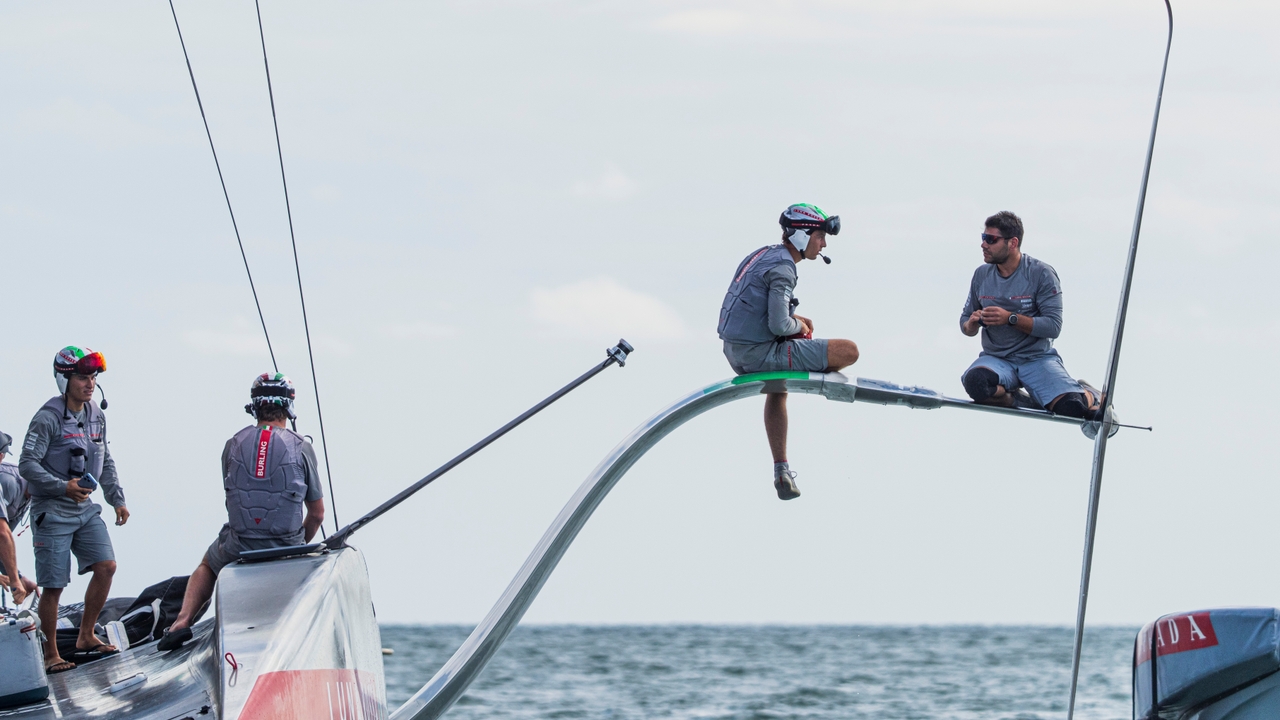
Sensors are invisibly transforming the AC75 as teams push the boundaries of aerodynamic and hydrodynamic performance on a single submerged foil wing, Louis Vuitton 38th America’s Cup reported.
- High-precision GPS systems measure velocity, heading, and trajectory during testing.
- Fibre-optic lines run along shrouds on La Roche-Posay Racing Team masts.
- Emirates Team New Zealand added an extra Starlink on their comms pod in April.
Calibrating The Invisible Network
High-precision GPS systems track velocity, heading, and trajectory, while inertial measurement units monitor pitch, roll, yaw, and acceleration. Ride-height sensors measure distance above the water, and wind instruments record apparent wind speed and direction.
Teams calibrate these instruments carefully before heading out. According to the Naples Recon team, La Roche-Posay Racing Team suspended their boat approximately 20cm above the surface on a crane during launch to achieve precise ride-height sensor calibration. Pitot tubes have been observed on the foil bulbs of Emirates Team New Zealand during the current cycle and on British entries in the previous one.
Below The Waterline
Specialist speed-through-water instruments distinguish movement relative to surrounding water from movement over the seabed. Fibre-optic strain sensors and ultrasound microphones detect carbon fibres splitting under load.

Cameras positioned around foil arms reveal flap movement, vibration, twisting, ventilation, and cavitation. To monitor structural deflection, La Roche-Posay Racing Team deploy bulb-shaped cameras on the leading edge of both foil arms alongside white markings painted on the outer wings.
Emirates Team New Zealand run a camera and telltales on the port foil looking at flow around the T-junction. Documentation from the Louis Vuitton 38th America’s Cup notes that Luna Rossa positioned GoPro cameras mid-span on the wing directed at the bulb, as well as a camera in the hull skin close to the rudder’s leading edge.
Rig Acts as Laboratory with Load Cells and Fibre-Optic Sensors
The rig acts as an important laboratory above deck, monitored by load cells and strain-measuring systems. Rigging is one-design and mast tubes are built to a common specification under class rule 17.
La Roche-Posay Racing Team have had fibre-optic lines running along their shrouds since Lorient. Independent load cells investigate cap-shroud loading and mast behaviour during rig-tuning exercises in Naples.

Inside the hull, sensors track hydraulic systems, actuators, and valves to spot excessive temperatures or pressure changes. Jo Aleh of Emirates Team New Zealand spends most of a session with her head below the sheerline on systems control and performance monitoring, a habit confirmed in a Recon interview with skipper Nathan Outteridge.
Class Rules Restrict Sensor Data Flow to Control Systems
Class rules restrict how sensor information interacts with control systems. The crew command system cannot measure the yacht state at all under rule 25, and data flows one way from crew buttons to control systems.
Teams invest heavily in live telemetry because rule 23.1 allows data and audio links to chase boats and shore bases. Emirates Team New Zealand added an extra Starlink on their comms pod in April, and other syndicates have followed suit.
Revealed in mid-March as a rebranded French challenger for the 38th America’s Cup supported by K-Challenge, La Roche-Posay Racing Team features key personnel announced for the campaign. Two-time America’s Cup winner Philippe Presti serves as Sporting Director, while Quentin Delapierre is appointed as skipper and helmsman. Additional key roster members include trimmer Jason Saunders and Olympic champions Diego Botín and Florian Trittel.
Related reading

Marquette Beats UW-Milwaukee 61-57 Behind Traore’s 22 Points
Marquette secured a 61-57 victory over UW-Milwaukee on Monday, riding a dominant performance in the paint to hold...

FIA Approves 2030 V8 Engine Plan; Las Vegas Race Hits 352 Overtakes
Formula 1 confirmed a 2030 engine framework Saturday, then watched Las Vegas deliver 352 overtakes — nearly double...
Montana Wildfire Risk Reshapes Insurance Market, Complicates Home Sales
Wildfire risk across Montana is reshaping the state insurance market as climbing premiums and policy cancellations complicate property...

Eldon “Wes” Walker, Alaska HVAC Veteran and Avid Outdoorsman, Dies at 64
Eldon Wesley Walker, known to family and friends as “Wes,” died in Oklahoma City on Tuesday, November 17,...