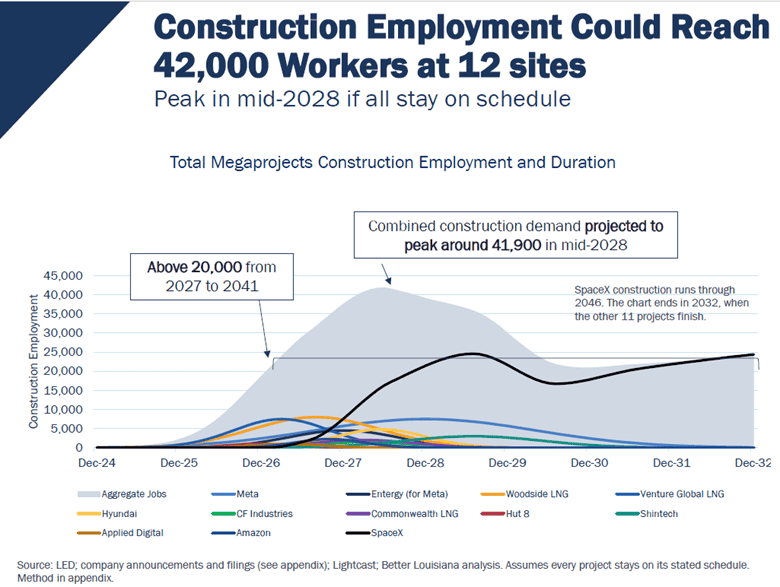
Louisiana faces a critical shortage of skilled workers as twelve major industrial and technology projects totaling $282 billion move toward construction.
These massive investments, announced over the last year, are expected to create 7,550 permanent jobs once operational.
The pressure to find qualified labor will be heaviest in Lafayette, Lake Charles, and Monroe. These three regions are expected to absorb 81% of the total projected peak demand for construction workers.
Despite carrying the vast majority of the workload, these areas currently hold only 17% of the state’s existing industrial construction workforce. Even if every available local worker were assigned to these sites, the regions would still face a deficit of nearly 19,000 workers.
Baton Rouge currently maintains the state’s largest industrial construction workforce, but its ability to support the boom is uncertain. The central question for planners is how many workers will remain in Baton Rouge if the demand in other regions becomes too lucrative to ignore.
| Region | Share of Projected Peak Demand | Share of Existing Workforce |
|---|---|---|
| Lafayette, Lake Charles, & Monroe | 81% | 17% |
| Baton Rouge | Not specified | Largest in state |
The challenge is not merely a matter of raw headcount; the specific technical requirements of these projects create a specialized skills gap. Different industries within this boom require vastly different trades.
Data centers are driving a surge in demand for HVAC workers, while the expansion of Liquefied Natural Gas (LNG) facilities relies heavily on a steady supply of pipefitters. Across nearly every project type, electricians remain one of the most critical and highly sought-after occupations.
While Louisiana has recently implemented measures to ramp up vocational training, significant gaps persist in several high-demand, highly-skilled fields.
Attracting massive capital investments is only the first step in a much longer economic cycle. To actually realize the potential of this $282 billion influx, Louisiana must expand its workforce and prepare local communities for the physical reality of rapid industrial growth.
Success depends on building stronger partnerships between employers, educators, and training providers to ensure the state’s people are ready to fill the roles being created.
Worth a look

Moving to Virginia City NV: Cost of Living and Housing – Nevada Real Estate Group
Eight houses sold in historic Virginia City over the 12 months ending September 30, 2026, according to data...

NDOT Plans to Install Traffic Signals at Omaha Intersection
The Nebraska Department of Transportation plans to install full traffic signals at the intersection of 222nd Street and...

Western Michigan Sweeps Final MAC Volleyball Player of the Week Awards
Western Michigan University volleyball players Leah Richmond and Gabby Weihe swept the final Mid-American Conference Player of the...

Boston Is a Medical Powerhouse. Why Is It so Hard to Get Primary Care?
In a column for The Boston Globe, Olivia Yarvis argues that Boston's status as a premier medical capital...