
The Madison County Board voted 16-10 on Wednesday to table an ordinance that would have prohibited the retail sale of alcoholic beverages in bottles smaller than six ounces within unincorporated areas of the county.
The decision follows concerns from board members regarding the fairness of the measure and its potential economic impact on small businesses located outside of city or village boundaries.
Under the original proposal, the ban would have taken effect immediately upon passage.
The ordinance was based on a suggestion from Board Chairman Chris Slusser, which said that the sale of single-serving alcohol can “lead to illegal public parking, public drunkenness, littering on both public and private property (including, but not limited to, sidewalks, streets, alleys, bike paths, parking lots, parks and other public areas) and are related to criminal activity.”
During the meeting, several residents and business owners provided testimony. Amber Ronk, who owns two small businesses including Curly’s Corner Market in Mitchell, spoke against the restriction. Ronk argued that the ordinance would penalize her businesses while allowing competitors located within municipalities to continue selling the products.
“My business should not be punished for another person’s irresponsible actions,” Ronk said. “But I never expected to be financially punished by my own county government for legally operating my businesses.”
“My businesses would be prohibited from selling them while competitors down the road could continue,” Ronk said. “How was that fair?”
Ronk also said that she had not been officially contacted regarding the proposal and raised concerns about the fate of inventory already purchased.
“No letter, no phone call, no opportunity to explain my financial consequences,” Ronk said. “And now you’re considering making this ban effective immediately. What happens to the inventory I’ve already legally purchased?“””
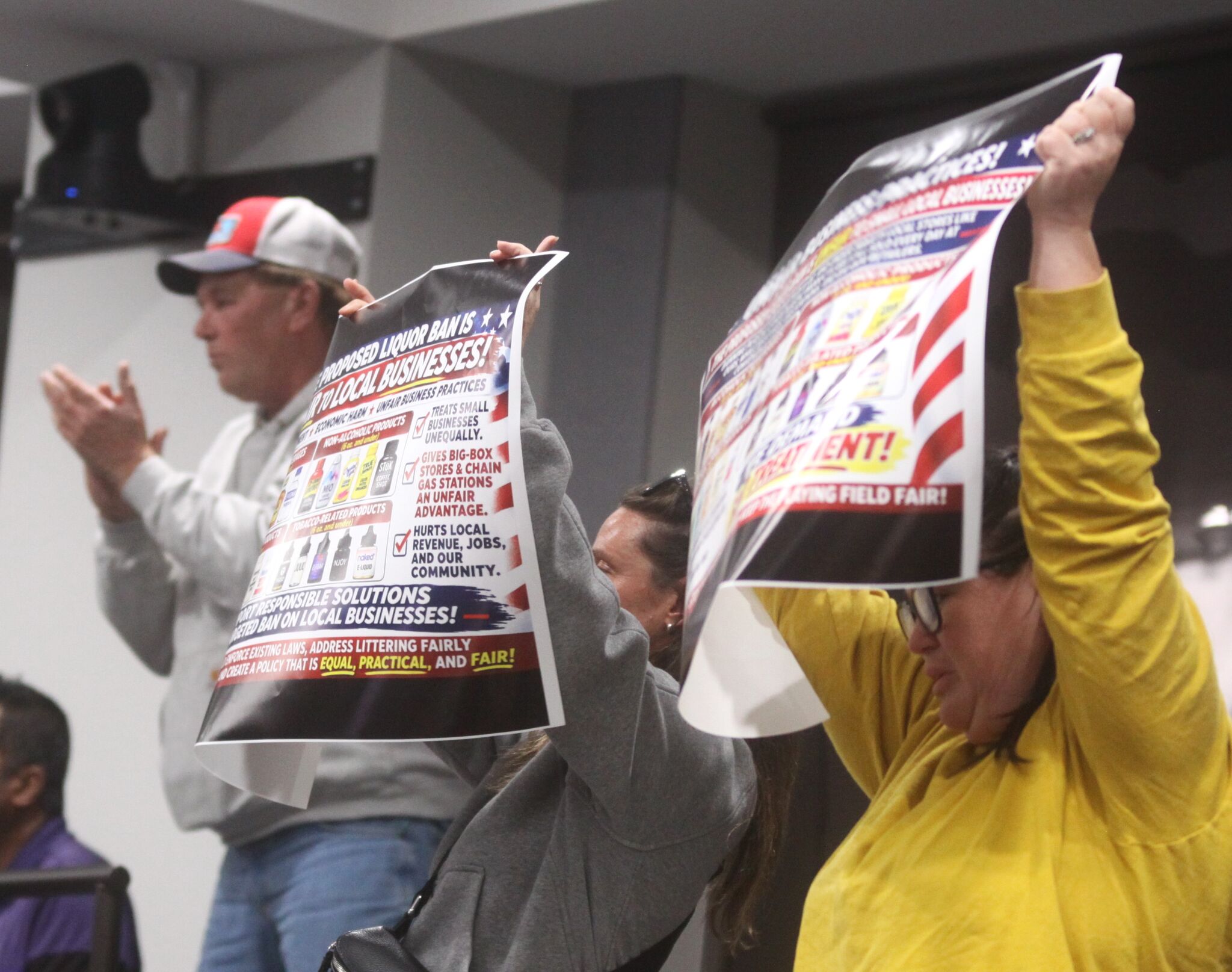
“That’s real money invested in my businesses,” Ronk continued. “Why should I suffer financially when I’ve done absolutely nothing wrong?”
According to Lamothe, the questions from Ronk addressed whether an economic impact study had been done, which businesses would still be allowed to sell the products, if there was evidence this would reduce litter rather than redirecting drinkers, if owners were invited to provide input on other solutions, and why businesses should bear the burden of irresponsible people not disposing of bottles properly.
Wheat said that while eliminating the bottles may not stop people from drinking, it would reduce community trash.
“These display bottles, they become the most frequent problem I’ve seen in the past four years,” Wheat said. “Whatever product is in these bottles is causing a trash issue because they’re everywhere. They’re in your parks, they’re in parking lots, local schools, sporting events.”
“People who drink are not going to stop drinking because these bottles are eliminated, but it will curtail a large amount of trash in our community,” Wheat added.
The ordinance targets specific licenses
These establishments, located in unincorporated areas of the county, would be prohibited from selling liquor containers smaller than six fluid ounces.
The Public Safety Committee had previously given the change a unanimous approval in early November. If the measure were to pass, the restrictions would take effect immediately.
Board members weigh the fairness
Bill Stoutenborough of Alton argued that the restriction was inequitable because residents in incorporated cities also contribute to the littering problem.
Stoutenborough suggested that making specific business owners liable for trash was problematic when other sectors, such as fast food establishments, are not held responsible for the paper and plastic litter they produce. He said that while some municipal officials in Wood River are considering similar legislation, he had hoped the City of Alton would act to eliminate this type of waste.
The Madison County Board, organized under the township form of government with 26 district-elected members, functions as the legislative branch responsible for adopting all ordinances for the governance of Madison County. The Board passes all ordinances, rules and regulations to implement the powers granted to counties, granting it the authority to regulate liquor sales in unincorporated areas through measures like the proposed ban on containers smaller than six ounces.
Board Chairman Chris Slusser, elected at large, recommended the ordinance based on concerns that small bottles “lead to illegal public parking, public drunkenness, littering on both public and private property…
Board member Bill Stoutenborough of Alton suggested tabling the legislation, arguing that it would be unfair to penalize only those businesses in unincorporated areas since people in cities also contribute to littering. Stoutenborough said that the decision to table the ordinance, rather than postpone it, means a formal motion will be required to bring the legislation forward a second time, or it could die as presented.
Keep reading

Historic Columbia River Highway: Oregon’s First Scenic Roadway
The Historic Columbia River Highway runs from The Dalles to Troutdale along the Columbia River Gorge, a route...

Oregon Running Backs Davison and Hill Questionable for Cascade Clash Against Washington
Oregon's top two running backs, Jordon Davison and Dierre Hill Jr., are listed as questionable for Saturday's Cascade...

Larry Kine Submits Revised 560-Acre Development to City of Eagle
A revised 560-acre development near Shadow Valley Golf Course is seeking approval from the city of Eagle after...

DHS Releases Body-cam Video of Long Beach Officer Telling ICE Agents “On Your Own”
Article The Department of Homeland Security released body-camera footage Wednesday showing a Long Beach police officer telling federal...