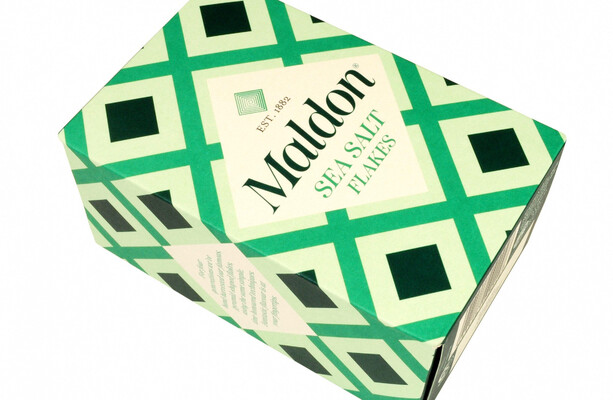
Maldon Salt, the premium British brand famed for its pyramid-shaped flakes, incorporates imported German rock salt into its production process at its Essex facility.
An investigation by The Observer revealed that the company has been importing tonnes of rock salt from German producer K+S to bolster its brine levels, a practice that has persisted while the brand maintained its reputation for artisanal, locally-harvested sea salt.
The Bottom Line:
- Production Efficiency: The “salt-on-salt” method utilizes imported rock salt to increase brine concentration, significantly reducing the energy intensity required for the evaporation process compared to using seawater alone.
- Price Disparity: Retail pricing for the 250g box remains high—listed at €4.65 in Tesco Ireland and €4.70 in SuperValu—despite the inclusion of lower-cost, industrially mined rock salt.
- Regulatory Standing: Essex trading standards and the UK’s Food Standards Agency reviewed the production methods in 2019 and 2020, concluding that no specific legal parameters were breached regarding the “sea salt” label.
The Salt-on-Salt Production Mechanics
The core of the issue lies in the manufacturing technique employed at the Goldhanger site. According to The Observer, the company uses a “salt-on-salt” process where mined rock salt is dissolved into water drawn from the Blackwater Estuary. This increases the salinity of the brine, which improves the efficiency of the crystallization process.
Revealed: how Maldon sea flakes are made using imported German rock salt An investigation has found that tonnes of mined rock salt are being poured into the production line of one of Britain’s most popular artisanal brands ✍️ @JonUngoedThomas https://t.co/zFjDxiC4Uv
Residents observing the factory reported seeing forklift trucks moving large, white one-tonne bags branded with the K+S logo directly onto the production line. While the company initially leaned on marketing imagery of traditional, manual harvesting, it updated its website following the investigation to explicitly reference its “long-established salt-on-salt process.”
Regulatory Oversight and Labeling
The tension between marketing and manufacturing has drawn scrutiny from local residents who argue that consumers lack transparency regarding the product’s true origins. However, the regulatory environment in the United Kingdom provides little recourse for these concerns. The Journal reported that officials at Essex trading standards determined there were no specific legal definitions that would invalidate the “sea salt” description, as the rock salt itself is of geological marine origin.
The company maintains that its methods have been consistent for over a century. “Maldon salt is 100% British and every flake is produced at our salt works in Maldon, as it has been for the last 135 years,” the company said, as reported by The Observer.
Market Impact and Consumer Value
For the average consumer, this revelation highlights the opaque nature of artisanal food labeling. While the brand carries a significant premium—with The Observer noting a 250g box retails at £11.40 per kg—the reliance on imported, industrially mined rock salt suggests a strategy focused on margin optimization through energy reduction rather than purely traditional harvesting.

This discrepancy between the “bucolic” branding and the industrial reality of the supply chain creates a potential risk for brand equity. Investors and market analysts often monitor such “origin-story” shifts, as they can lead to regulatory tightening or consumer backlash if perceived as deceptive. As of November 16, 2026, the company continues to defend its labeling compliance while facing ongoing public questions regarding transparency.
The question of whether the “sea salt” label requires further legislative definition remains open, as no new enforcement actions have been announced by the Food Standards Agency following the recent reports. The Journal noted that it has contacted the company for further comment on the supply chain findings.
Disclaimer: The information provided in this article is for educational and market analysis purposes only and does not constitute financial, investment, or legal advice. Always consult with a certified financial professional before making investment decisions.
Keep reading

Kickoff Time Announced for Arizona-Kansas State Matchup
Arizona will go on the road to face Kansas State for a 5 p.m. MST kickoff Nov. 21,...

VA Medical Center Seeks Construction Administrator in Cheyenne, WY
Modernization work at the Cheyenne Veterans Affairs Medical Center requires a construction administrator to support an Electronic Health...

West Virginia’s Latest Disaster Gives Houston an Opportunity to Bounce Back
The Houston Cougars are staring down a critical juncture in their 2026 campaign, facing the reality of a...

Utah Jazz Face Second-Longest Losing Streak in Franchise History
The Utah Jazz lost 110-102 to the San Antonio Spurs in Salt Lake City on Sunday, extending their...