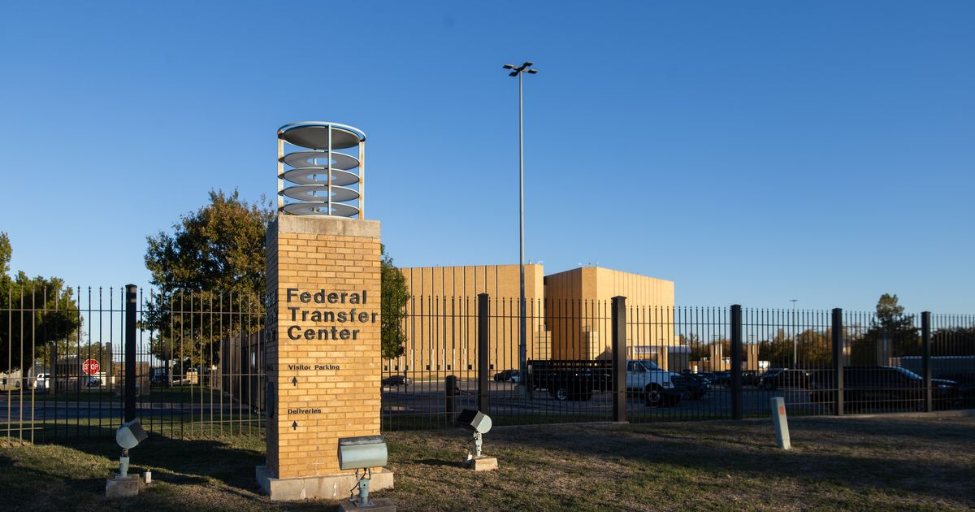
On Nov. 4 the Oklahoma City Federal Transfer Center held 1,403 prisoners — 31% above its 1,072-person design capacity — while a planned second airlift hub in Kansas City remains stalled.
- Oklahoma City FTC population jumped by 195 prisoners in 20 days from Oct. 15 to Nov. 4.
- An April 2024 audit found the prior 12-month average was 1,269 — 18% above capacity.
- U.S. Marshals Service says ICE enforcement expansion has made detention beds near Kansas City International Airport hard to secure.
- The Marshals Service requested $152 million and 533 positions for fiscal 2027 to support immigration enforcement.
The Marshals Service told Congress that immigration-related arrests create immense pressure on its operations and that without additional funding it could become a “bottleneck” in the federal criminal justice process, according to its fiscal 2027 budget justification.
The Marshals Service said the pressure extends beyond Kansas City and affects detention capacity nationwide.
The Federal Transfer Center, run by the Federal Bureau of Prisons, temporarily houses prisoners awaiting transport on aircraft operated by the Marshals Service’s Justice Prisoner Air Transportation System. JPATS’ principal Air Fleet Operations Center sits at Will Rogers World Airport alongside the detention infrastructure supporting the FTC. Delayed movements have consequences beyond crowding. The same investigation found five of seven prisoners who died by suicide at the center during fiscal 2014–2021 had been housed alone, though the report did not establish that prolonged confinement caused those deaths.
The Marshals Service then turned to the Greene County Jail in Springfield, Missouri. In February 2025 the jail began accepting ICE detainees under an amended federal detention agreement. By August 2026, the ICE population had reached 413, according to KSMU public radio.
Oklahoma City’s airlift also depends on a 2013 detention agreement with the Grady County Jail in Chickasha, which listed an estimated 330 federal beds. Even as ICE’s growing detention demands complicate the Kansas City hub, JPATS has offered to renew a formal transportation partnership with ICE. ICE stopped participating in JPATS as a regular paying customer in 2011.
Worth a look

NWS: Huntsville Cold Front Tuesday, High Near 52, Frost Risk; Sun Wed, Rain Thu
A cold front will drop temperatures across the Huntsville forecast area Tuesday, with a high near 52 degrees...

Four Westside Atlanta Churches Feed 13,000 via Thanksgiving Meal Bundles
Four Westside Atlanta churches distributed 1,000 Thanksgiving meal bundles on Saturday, feeding an estimated 13,000 residents through the...

Broncos Activate Tyler Badie From IR for Friday’s Game
The Denver Broncos designated running back Tyler Badie for return from injured reserve Tuesday, opening a 21-day practice...

Jacksonville Pharmacy Tech Gets 7 Years for Stealing, Selling Pills; 2 Suspects Still Wanted
A Jacksonville pharmacy technician was sentenced in October to seven years in prison for stealing hundreds of oxycodone...