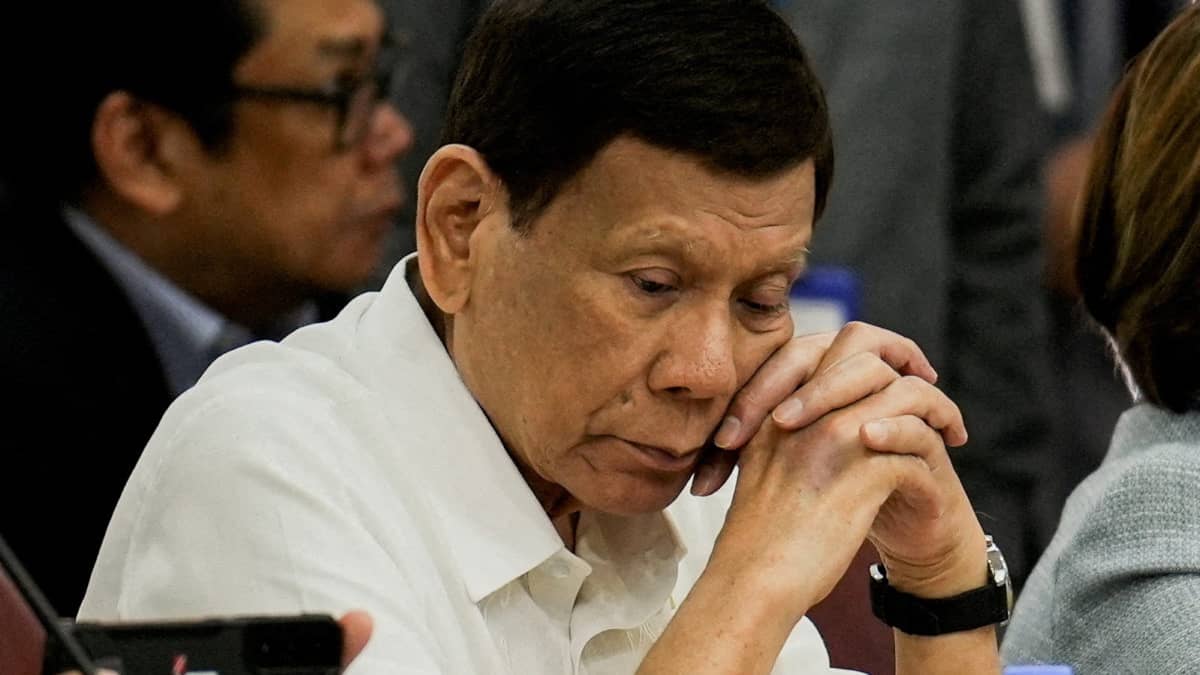
The Supreme Court dismissed the consolidated habeas corpus petitions challenging former President Rodrigo Duterte’s arrest and transfer to the International Criminal Court, ruling 9-4 that the issue is moot because he is already in ICC custody in The Hague.
The decision, penned by Associate Justice Japar B. Dimaampao and promulgated on Nov. 11 but released Tuesday, held that a writ of habeas corpus is a domestic remedy enforceable only within the Philippines. Since Duterte is detained in the Netherlands, Philippine courts cannot exercise authority over his person, Philippine News Agency reported.
- Vote: 9 justices dismissed the petitions; 4 dissented; Justice Samuel Gaerlan was on official business.
- Petitioners: Duterte’s children — Rep. Paolo Duterte, Davao City Mayor Sebastian Duterte, and Veronica Duterte.
- ICC trial on three counts of crimes against humanity is scheduled to begin Nov. 30.
- The court stressed that the dismissal does not validate the arrest or transfer; other remedies remain open.
Territorial limits of the writ
The high tribunal explained that habeas corpus examines the legality of detention prior to transfer to a court. Because Duterte’s arrest and turnover were completed in March 2025, and he is now participating in ICC proceedings, issuing the writ “would serve no practical purpose here.”
The Court said: “Significantly, [Duterte] is not just beyond the Court’s coercive powers, but also stands accused before an international tribunal that has assumed jurisdiction over his person.”
Philippine officials named as respondents no longer have custody or control over Duterte, the Court added. Any directive to them “lacks any practical value.”
Dissenting views
Associate Justice Antonio T. Kho Jr. wrote that the government cannot surrender a Filipino citizen to a foreign tribunal — an “extraordinary rendition” — without a valid domestic law and prior court authority, calling the surrender unconstitutional.
Associate Justices Amy Lazaro-Javier and Henri Jean Paul Inting said the petitions were not moot because they challenge the actions of Philippine officials at Villamor Air Base, not the ICC’s subsequent custody.
“The legality of those acts is a separate question from the custody he is now under at The Hague,” said Israelito Torreon, counsel for Sen. Ronald “Bato” Dela Rosa, who also faces an ICC warrant. Torreon warned the ruling could become a “guide for the future” where speed of removal puts judicial review out of reach.
What the ruling does not decide
The Supreme Court emphasized that dismissing the petitions does not mean Duterte’s arrest and transfer were lawful or that his constitutional rights were not violated. Claims for compensation or liability must be pursued through appropriate legal proceedings, not habeas corpus.
The Court also noted it was not ruling on the propriety of Duterte seeking relief before the ICC, saying related issues are better addressed in a separate pending case, G.R. No. 278747.

Duterte arrested, flown to The Hague; children challenge warrant
Duterte was arrested on March 11, 2025, upon arrival from Hong Kong based on an ICC warrant for crimes against humanity linked to his war on drugs. He was flown to The Hague the same day. His children filed the petitions the following day, arguing the ICC warrant could not be enforced because the Philippines had withdrawn from the Rome Statute.
The Office of the Solicitor General argued the petitions were moot and that the arrest complied with international obligations, including Republic Act No. 9851 and the Philippines’ Interpol membership.
Duterte made his first in-person appearance at the ICC on Sept. 16. His trial on three counts of crimes against humanity for murder and attempted murder is set to open on Nov. 30.
More on Rodrigo Duterte
Worth a look

Later-Born Generations Enter Old Age With Better Memory and Slower Decline, Study Finds
Later-born generations reach old age with stronger memory and lose it more slowly, a study of roughly 219,000...

Pahalgam Hits Season’s Low of -4.6°C as Kashmir Valley Shivers Under Intense Cold
Pahalgam dropped to minus 4.6°C on Monday, the coldest night recorded in the Kashmir Valley this season, Kashmir...
People treated for traumatic brain injury
People treated for traumatic brain injury after electric-scooter crashes missed a median of two months of work and...

72 Orangutans Rescued from West Kalimantan Wildfires Since August, Officials Say
Conservation teams rescued 72 orangutans from wildfires in West Kalimantan between August and late November, a toll that...