
A new monument honoring Black Marylanders who fought in the Revolutionary War was dedicated Nov. 1 on the east front of the Maryland State House in Annapolis, replacing a statue of Chief Justice Roger Taney that stood there for 145 years.
- The monument, “Black Patriots: The Pursuit of Transcendent Liberty,” is the first at any U.S. state capitol dedicated to Black Revolutionary War soldiers.
- It commemorates at least 150 Black Marylanders — free and enslaved — who served, a number the Maryland State Archives calls a conservative estimate.
- The dedication occurred on the 162nd anniversary of the abolition of slavery in Maryland.
- Gov. Wes Moore, the state’s first Black governor, traced his own ancestry to a Revolutionary War soldier at the ceremony.
Nine years after Taney’s removal
The Taney statue, honoring the author of the Dred Scott decision that denied citizenship to Black Americans, was removed in 2017 with bipartisan support after the deadly white nationalist rally in Charlottesville, Virginia, The Banner reported. The east front remained empty until this month.
“How fitting that today we dedicate a monument to the individuals whose own descendants were among those who were persecuted by Taney’s decision,” Senate President Bill Ferguson said at the dedication ceremony.
Two figures on the hill
The monument comprises two bronze statues by California-based artist Branly Cadet, installed along the steep hill leading to the State House, which dates to 1779 and is where George Washington resigned his commission on Dec. 23, 1783.
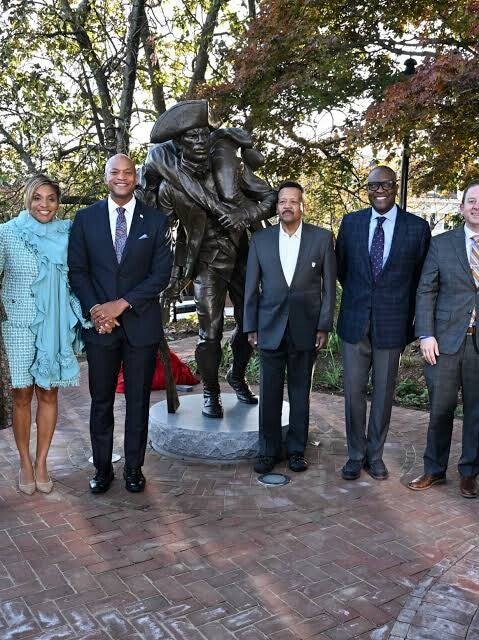
At the foot of the hill, a Black soldier grimaces as he carries a wounded comrade on his shoulders. Higher up, near where Taney once sat, a washerwoman holds a bucket in one hand and points toward the distance with the other. Stones at the female figure’s feet represent the riverbank where Black women laundered uniforms, The Banner reported.
“They stood for greater freedom, for greater justice, for greater harmony. They stood for the possibility of a greater nation,” Cadet said during the unveiling.
Thomas Carney’s story drives the design
The soldier statue depicts Thomas Carney, a free Black Marylander from the Eastern Shore born in 1752 or 1754, according to Revolutionary Maryland. Carney enlisted in 1777 or 1778, served in the Maryland Line’s 5th and 7th Regiments, and fought at the Battle of Germantown and the Siege of Ninety Six in South Carolina.
According to historical accounts, Carney carried his wounded commanding officer, Maj. Gen. Perry Benson, off the battlefield at Ninety Six, saving his life. He was promoted to corporal — one of the few known Black soldiers to hold that rank during the war — received a pension in 1818, and died in 1828, Revolutionary Maryland reported.
Steven X. Lee, who teaches history at Stevenson University as an adjunct professor and established the Benjamin Banneker Historical Park and Museum, devoted over eight years to championing the monument after delving into Carney’s story. He published “The Story” in 2022 to create teaching materials he said schools lacked.

“It was a very famed story, and I think conceptually also I really appreciated how it presented the added burden that I would say Black patriots had to carry,” Cadet told The Banner.
A broader historical reckoning
An estimated 5,000 to 8,000 Black Patriots fought in the Continental Army, serving in integrated regiments after George Washington lifted an initial enlistment ban in 1775 due to manpower shortages, according to Revolutionary Maryland. By the 1781 siege of Yorktown, a French observer estimated the American army was roughly one-quarter Black.
In 2023, the Maryland State House Trust commissioned the monument to mark the 250th anniversary of the Declaration of Independence. The Board of Public Works approved more than $400,000 for the project; Cadet was paid nearly $312,000, WTOP News reported, citing Maryland Matters.
“This is the first and only monument to Black Revolutionary War soldiers at any state house in our nation,” House Speaker Joseline Peña-Melnyk said at the ceremony.
Personal histories surface
Among the roughly 50 officials and spectators at the Nov. 1 unveiling was Aretha Williams, a Maryland photographer and artist who traced her ancestry to Charles and Walter Proctor, two young Black Marylanders who fought in the war. Their names appear on freeafricanamericans.com, a genealogical database compiled by researcher Paul Heinegg.
Seeing the monument provided “a beacon of hope,” Williams told The Banner.
Gov. Moore shared the story of Prince Ames, his fifth great-grandfather, who fought at Lexington, Concord, and Bunker Hill with the Massachusetts militia.
“For nearly six years, he fought for a country and a cause that did not include him,” Moore said. “But he believed that perhaps one day, just maybe, it would include his children, maybe even his children’s children.”
The monument was created by California-based sculptor Branly Cadet, whose public commissions include the Octavius V. Catto Memorial unveiled outside Philadelphia City Hall in 2017 — the first monument to an African American on Philadelphia public property — and the Adam Clayton Powell Jr. statue in Harlem.
Cadet also modeled the Sandy Koufax and Jackie Robinson statues installed at Dodger Stadium in Los Angeles in 2022, and a memorial to African American community activists in Montgomery, Alabama, honoring their work documenting lynching victims.
Lee plans murals honoring Black Revolutionary War soldiers
Lee said his next project is securing murals across Maryland to honor Black Revolutionary War soldiers. “The whole journey was about Maryland, and I was so proud of my state,” he told The Banner.
Florida Cities Cut Services After Amendment 3 Passed
Florida voters approved Amendment 3 this month, expanding the homestead exemption and setting off immediate service cuts across...
Listen Center Assault Suspect Declared Incompetent; Cases Paused for Outpatient Treatment
A Windsor County judge signed a 90-day order of non-hospitalization for Peter Zendran on Nov. 9, leaving five...

UK Labour Market Risks Deep Freeze as Energy Bills and Mortgage Rates Squeeze Workers
UK labour market faces deep freeze as energy costs and mortgage rates squeeze workers Rising energy prices and...

Kentucky Beats Louisville 24-21 to Close Regular Season
Kentucky beat Louisville 24–21 on Saturday at Kroger Field, handing the Cardinals their fourth loss of the season...