
Topeka Mayor Spencer Duncan released a $22,000 independent workplace review Tuesday confirming employee retaliation fears and outlined 22 recommendations from the findings.
- Fisher & Phillips LLP conducted the nine-month review after staff complaints reached the mayor’s office in February.
- The investigation cost $22,000 from the city’s general fund and produced 22 recommendations.
- Duncan said the review found workplace culture concerns, fear of retaliation, and personnel matters bypassing management to elected officials.
- Interim City Manager Michael Webb said the independent review has shown that city personnel need to refocus on planning and preparation.
Law firm conducted nine-month review costing $22,000
Duncan announced the third-party review in February after concerns were brought forward by city workers and City Council members. The Kansas City-based law firm Fisher & Phillips LLP conducted the investigation over nine months at a cost of $22,000 drawn from the general fund. WIBW reported the city employs 1,100 people.
Key findings
Duncan summarized the investigator’s conclusions at a 10 a.m. news conference in City Hall on Nov. 24. “She identified workplace culture concerns in part of our organization,” Duncan said. “She found a fear of retaliation exists in some areas. Whether or not that fear is warranted, the fact that it exists is something we must fix.”
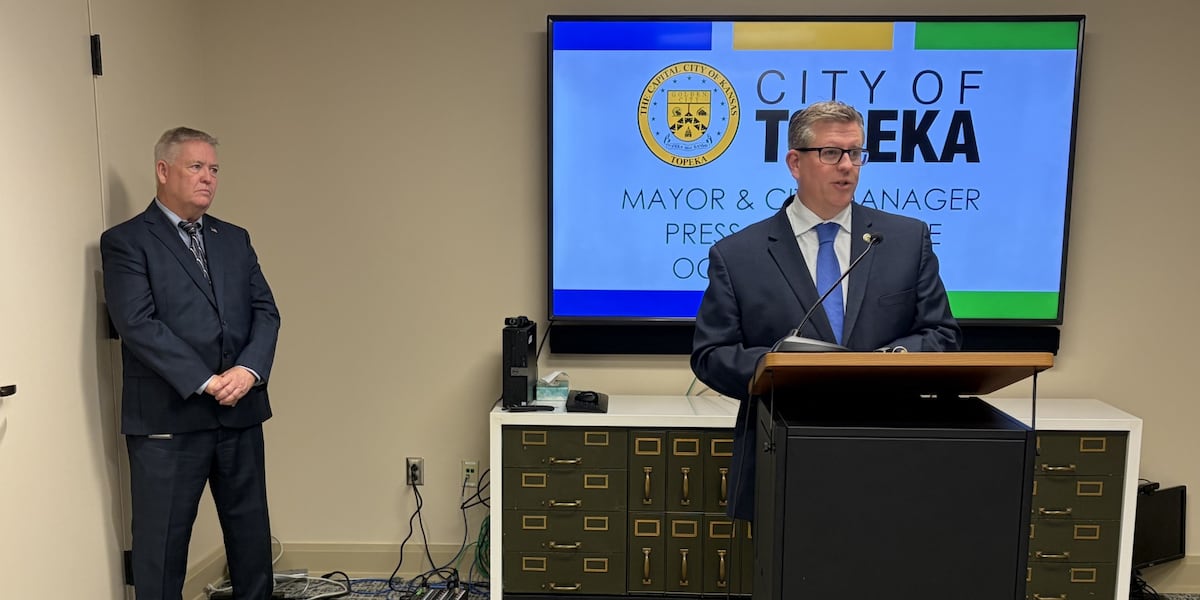
The review also found confidentiality was broken while the investigation was underway as employees shared what was said in interviews, and that the Human Resources department faces the same problem in its own investigations.
Some concerns raised were “simply accusations rather than formal complaints or formalized through any process, including the union process,” Duncan said. The investigator also raised concerns about personnel matters being taken around management to elected officials “often without the full picture and without using the processes outlined in our policies and union agreements.”
Specific cases examined
The investigation looked into 15 categories of concerns. The cases included overtime issues that led to an employee suspension; pay disparity issues investigated with “appropriate action taken”; union funds theft concerns dismissed as “not a city issue” because no record was submitted to HR and union funds are held by the union; an inappropriate off-duty Facebook post by a staff member referred to the Shawnee County Sheriff’s Office that remains active; and contractor selection concerns never formally submitted to HR.
The investigation also found that concerns over a former city employee were not made during that employee’s employment and the investigation found evidence contradicting the stated concerns.
WIBW reported the review concluded workplace complaints were handled by the city in a “thorough” and “well-documented” manner.
Twenty-two recommendations
Duncan outlined 22 recommendations stemming from the findings and his own observations. They include:
- Task the legal department to further review favorable treatment and contractor selection concerns raised during interviews.
- Engage an outside facilitator for the Utilities Department to review operations and determine root causes.
- Strengthen anti-retaliation and workplace culture training.
- Improve contractor-use policy with clearer documentation, separation of ordering and approval duties, and regular invoice verification.
- Strengthen conflict of interest disclosures for staff involved in contractor selection or hiring.
- Restore communication through regular meetings between supervisors and field staff and direct senior leadership engagement with crews.
- Establish respectful workplace standards for supervisors and managers with annual training and accountability.
- Realign HR to report directly to the City Manager’s Office.
- Separate the HR director and investigator roles; the HR director should not conduct investigations unless the city manager approves an exception.
- Create a dedicated HR manager position for public safety departments.
- Build a culture of cross-training across departments.
- Strengthen investigation standards and timelines.
- Clarify interview rights during investigations.
- Use third-party investigators for sensitive cases involving the city manager, HR staff, or conflicts of interest.
- Formalize employee check-ins at 30 and 90 days after a complaint is resolved.
- Strengthen performance evaluation practices for consistency and timeliness.
- Move forward with hiring an independent auditor, as already determined by the Governing Body.
- Adopt a formal protocol for how the mayor and council members refer staff and personnel concerns.
- Reaffirm confidentiality standards with standard notices, updated Personnel Manual language, and a Governing Body rule for executive session discussion of personnel matters.
- Strengthen complaint intake and tracking with consistent documentation.
- Establish an anonymous third-party fraud, waste, and abuse hotline reporting to the independent auditor once that position is filled.
- Task the interim city manager to evaluate the city’s leadership structure and operations and report findings to the Governing Body by the end of February 2027.
Duncan acknowledges mixed reactions to investigation results
“I am aware that these results are going to land very differently with different people,” Duncan said. “For some, these conclusions and next steps will not go far enough. For others, they will have seemed to go too far. I understand both of those reactions. But my goal, as always, is to fix real problems and make the city a great place to work.”
Duncan said the review does not indicate individuals who need to be fired or that the city needs to “clean house” with its employees, WIBW reported. “Most of our employees already live up to these standards every day. But if there are those who are not committed to these same goals, quite honestly, this just may not be the place where you should be working,” Duncan said.
Webb said the report shows city personnel need to refocus on planning and preparation. “People are calling saying, ‘my pothole needs to be fixed, my waterline is broke, my whatever is happening,'” Webb said. “And oftentimes we’re running to do the response work, and we forget that we need to do the planning and preparation work and so, unfortunately, and it’s not unique to this organization, sometimes our training, ongoing training programs, fall behind.”
Spencer Duncan, a lifelong Topekan, brings a background in journalism and government affairs to the mayor’s office. He spent five years as a reporter with The Topeka Capital-Journal and later served as Government Affairs Director for the League of Kansas Municipalities, representing cities statewide, while also founding the government relations firm Capitol Connection in 2005.
His municipal experience includes serving on the Topeka City Council beginning in 2019, chairing the Policy and Finance Committee for most of his tenure, and serving as Deputy Mayor in 2022. He was sworn in as Mayor in 2026.
Duncan said many recommendations can be implemented immediately while others will need input from the Governing Body. Duncan, Deputy Mayor Michelle Hoferer, and Councilman David Banks were involved in selecting the investigator, but the City Council did not weigh in during the process.
“Everybody was excluded in the effort to get a very unbiased, productive report,” Duncan said. “And I don’t know if council members may like some of these recommendations (or) they may dislike others. That’s completely their prerogative, and we’ll continue to have those conversations.”
Keep reading

Predators, MNPD Deliver Thanksgiving Meals to 150+ Nashville Families
Over 150 Nashville families received Thanksgiving meals this week as the Predators and Metro Nashville Police Department continued...

Bethune-Cookman Wildcats face Richmond Spiders Wednesday
Bethune-Cookman's men's basketball team will face the Richmond Spiders on Wednesday at 6 p.m. EST at the Robins...

Wisconsin Confirms Third Measles Death as Cases Rise to 920, State Leads Nation
Wisconsin confirmed its third measles death of 2026 on Tuesday, an adult in Lafayette County, as cases rose...

PNM Seeks $172.2M Revenue Increase, Low-Income Discounts and Data Center Tariff
Public Service Company of New Mexico filed a 2027 Rate Review application with the state Public Regulation Commission...