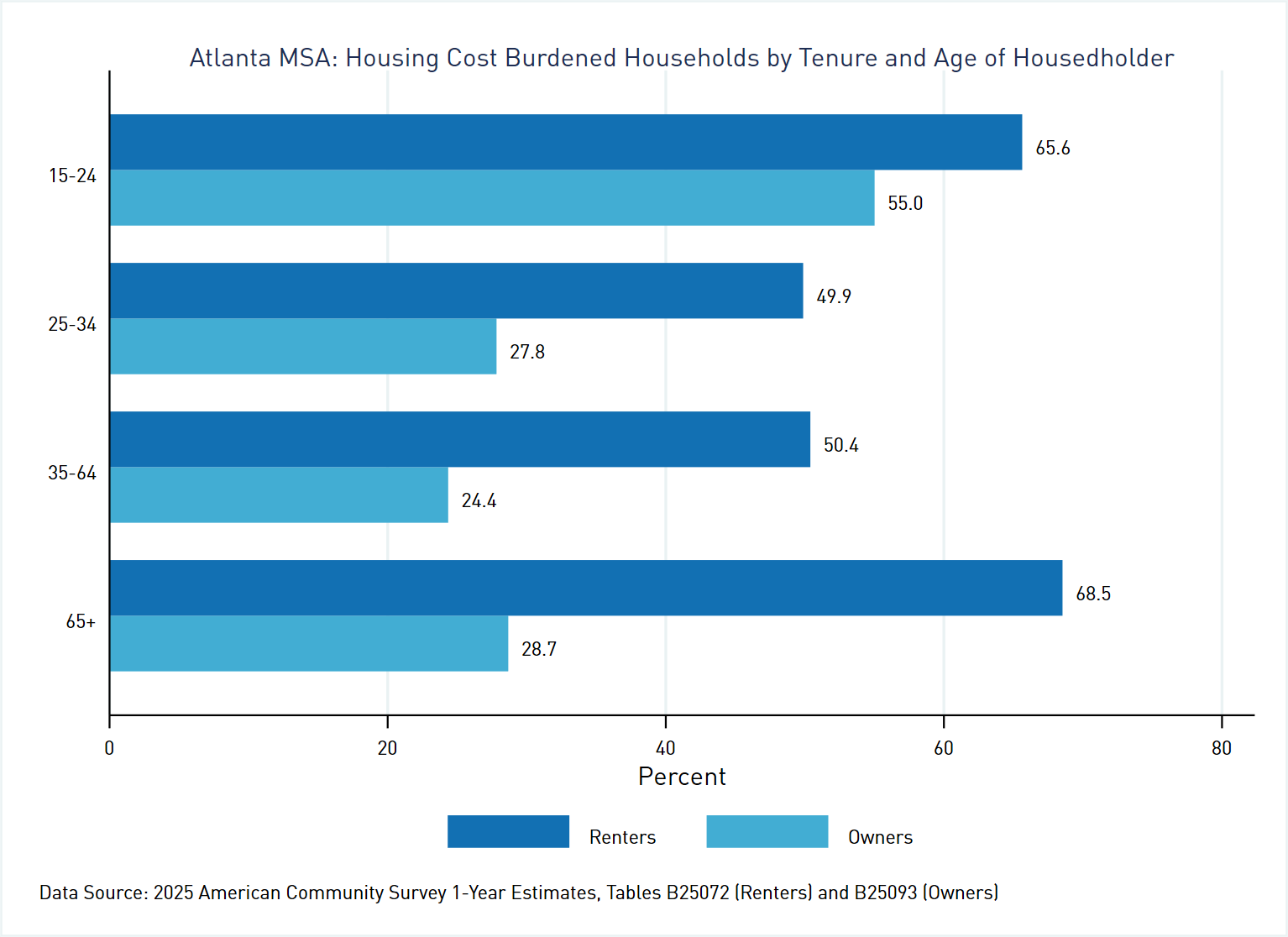
Younger householders starting out and older householders on fixed incomes show the highest cost-burden rates across both tenure types.
Older adults who rent are the most likely of any group to be cost-burdened, while older owners are only marginally more burdened than middle-aged owners, ARC reported.
ARC analysis of American Community Survey data shows the share of cost-burdened owners in the Atlanta MSA has moved more dramatically than the renter share since 2005. The owner rate peaked at 34.3% during the Great Recession in 2010, then fell steadily to a low of 19.4% in 2019 before rising each of the last three years to reach 26.1%.

The commission said the 2010s decline was driven by low interest rates that kept ownership affordable through purchases and refinances, not by stable home prices. The ratio of median home value to median household income climbed from 2.89 in 2013 to 4.43 in 2023, meaning values rose about 1.5 times faster than incomes over the decade.
Results were presented Nov. 4 at the ARC’s State of the Region event, where the commission also unveiled its Opportunity Rising initiative aimed at using data to identify barriers to upward mobility.
In a separate survey released last week, 30% of respondents named housing affordability the biggest problem facing metro Atlanta, topping traffic at 22% and the economy at 16%, Axios Atlanta reported. The 2026 Metro Atlanta Speaks survey, conducted in August by Kennesaw State University’s A.L. Burruss Institute, polled 4,136 adults across the 11-county region.
Fifty-one percent said housing costs greatly affect their economic mobility, while 38% cited a lack of job opportunities. Thirty-five percent said they are doing worse economically this year, up from 29% in 2025.
“What stands in the way of getting ahead: housing they can afford, jobs they can reach, and connections across income lines,” said Andre Dickens, mayor of Atlanta and ARC board chair, at the Nov. 4 State of the Region event.
ARC CEO Anna Roach announced the Opportunity Rising initiative at the same event, describing it as a collaborative effort to use data to understand barriers preventing residents from ascending the economic mobility ladder. The initiative follows the commission’s Housing Forward 2035 strategy, released in September, which calls for building 367,000 homes by 2035 and preserving roughly 104,000 affordable units at risk of loss to redevelopment.
The strategy targets 51% of new homes as affordable.
“Agreeing on what success looks like for children, families and communities, and finding ways of working together to achieve it,” Roach said of the initiative’s aim.
Keep reading

Hugh Jackman’s West Village Triplex Goes Into Contract After $10M Price Cut
Hugh Jackman and his ex-wife Deborra-Lee Furness have found a buyer for their West Village triplex at 176...

Lindenwood Opens Stony Brook MTE vs. New Haven, Then Faces Seawolves
Lindenwood opens a two-game trip at the Stony Brook MTE against New Haven on Tuesday, then faces the...

UL Lafayette Student Wins $10K for Cement-Free Brick From Bagasse Ash
University of Louisiana at Lafayette civil and environmental engineering student Atif Khan won the B.I. Moody III College...

San Jose State Scored First, but Loyola Went Nearly Four Minutes
Ryan Agarwal led Loyola with 17 points on 5-of-10 shooting, including three 3-pointers, per Loyola University Chicago Athletics....