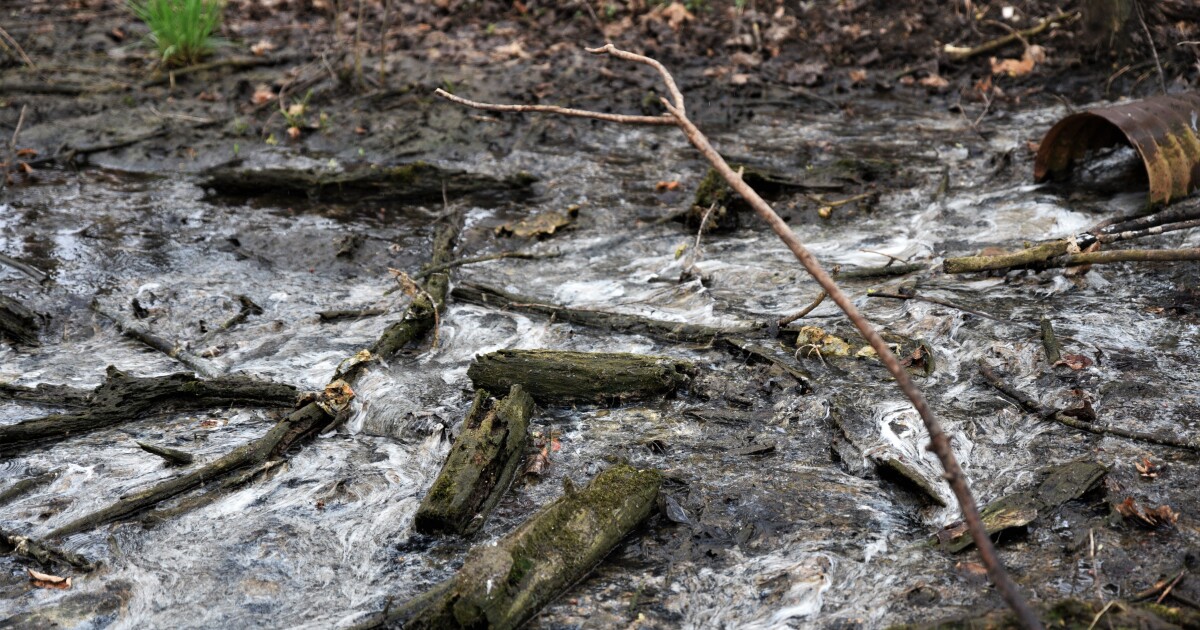
“Put a wad of toilet paper in your toilet and flush,” Rick Throop told the cottage owner near Algonac. Moments later, it was floating downstream in the St. Clair River.
That cottage had no septic system at all — just a pipe straight to the water — and it is far from alone. Michigan has up to 330,000 failing or nonexistent septic systems discharging billions of gallons of sewage each year into the state’s 76,000 miles of rivers and streams, Bridge Michigan reported.
Combined with urban sewer overflows and farm runoff, the pollution helps make roughly 75 percent of those waterways unsafe for swimming, likely sickening thousands of people annually.
Michigan is the only state without a uniform septic code. In much of the state, officials do not even know where the systems are, let alone which ones are failing.
“Nobody wants to be the bad guy,” said James Lower, a former Republican state representative who partnered with Democrat Abdullah Hammoud on a failed 2018 effort. “The consequence, of course, is that there’s quite a bit of sewage going into our groundwater and surface water. It’s just a fact. And it’s unfortunate.”
A patchwork that guarantees pollution
Septic systems were designed as temporary fixes for sparsely settled areas. Today Michigan has about 1.3 million of them, more than all but five states. When they work, solids settle in a tank and liquids percolate through soil that filters pathogens. When they fail — or sit too close to the water table — wastewater leaches into aquifers, lakes and streams.
“We have decades of data now that says that’s going to cause water quality problems,” said Joan Rose, a Michigan State University microbiologist whose research has traced human feces to waterways near septic systems.
Without a statewide standard, 33 counties — including heavily populated Macomb and Genesee — allow drainfields closer to the water table than the 36 inches experts recommend. Other localities permit systems on lots too small to absorb the load. Seventy of 83 counties lack inspection programs for aging systems, and many homeowners do not realize they own one.
“Failure isn’t always something you can see from the ground surface,” said Sara Heathman, an environmental quality specialist with the Michigan Department of Environment, Great Lakes and Energy, which has long pushed for a statewide sanitary code requiring periodic inspections.
When inspections happen, the findings are grim
In Lyon Township near Higgins Lake, a short-lived program uncovered health-code violations at a majority of residences. Similar backlash ended programs in Barry and Eaton counties.
That voter resistance makes legislators wary. The latest bill, sponsored by Sen. Sam Singh, D-East Lansing, would require systems older than 20 years to be inspected once a decade, with a $50 fee to fund administration. It has not reached the floor with weeks left in the session.
“I appreciate the concept of what we’re trying to achieve: Cleaner water, cleaner Michigan,” said Sen. Michelle Hoitenga, R-Manton. “I just didn’t feel that there was any way for me to support something that the people I represent were in such opposition to.”
$2.2B cost leaves loan gap
Replacing every failing system could cost $2.2 billion or more — up to $15,000 per job. Routine pumping runs $600. Twelve percent of Americans cannot cover a sudden $400 expense.
“Money gets tight … the first thing people are going to look at is, do I put food in the fridge or pump my septic?” Throop said.
Lawmakers authorized a $35 million low-interest loan program in 2024. Michigan Saves, the nonprofit administrator, has helped roughly 475 homeowners — but rejected nearly as many because they were too cash-strapped to qualify for a loan.
“It happens quite frequently, and it’s heartbreaking,” said Nishaat Killeen, a programs director with Michigan Saves. Grant funding for the neediest homeowners would close the gap, she said, but further appropriations have stalled amid tight budgets and anti-tax sentiment.
Real estate agents and local officials push back
Earlier bills mandated point-of-sale inspections; real estate agents objected, arguing failed systems would slow transactions. They favored periodic inspections instead. Singh’s bill reflects that shift, but local government and health-department lobbies say they need more money to run inspection programs and fear reprisals from angry homeowners.
“It very well could be a safety issue for the inspectors,” said Kevin Green, environmental public health director for the Calhoun County Public Health Department. He suggested starting with highest-risk systems near lakes and rivers, then expanding oversight while mapping the state’s septic inventory.
Environmental advocates counter that a narrow scope would leave hundreds of thousands of failing systems polluting. It would not have helped Jennifer and Ken Kilgore, who bought a 47-year-old home in Lapeer County this year only to find sewage oozing onto the lawn. They face a $14,000 replacement bill.
“I’m just shocked it’s not a thing,” Jennifer Kilgore said, “because everybody’s on a septic field out here.”
While Ohio, Iowa, Massachusetts and now Washington have adopted inspection mandates, Michigan’s Legislature heads toward another year-end without a code. “Inaction wins the day,” Singh said.

Democrats Nominate Hakeem Jeffries for Speaker, Paving Way for First Black Lawmaker to Hold Gavel
Democrats voted 251 to 11 on Wednesday to nominate Hakeem Jeffries for speaker, positioning the New York representative...

APS Demonstrates Visitor ID Scans, Panic Badges at 142 Campuses
Albuquerque Public Schools demonstrated its expanded safety infrastructure Wednesday at Cibola High School, showcasing visitor management software and...

New Jersey Republicans Propose Oct. 7 Antisemitism Remembrance Day, Urge Congress to Pass Jewish American Security Act
New Jersey Republicans filed two resolutions Monday to enshrine Oct. 7 as a permanent day of remembrance and...

Man Utd Carrington Upgrade Could Stall Over Friends of Carrington Moss Bat Objection
Manchester United's £50 million Carrington overhaul could stall over eight floodlight poles and the bats that forage beneath...