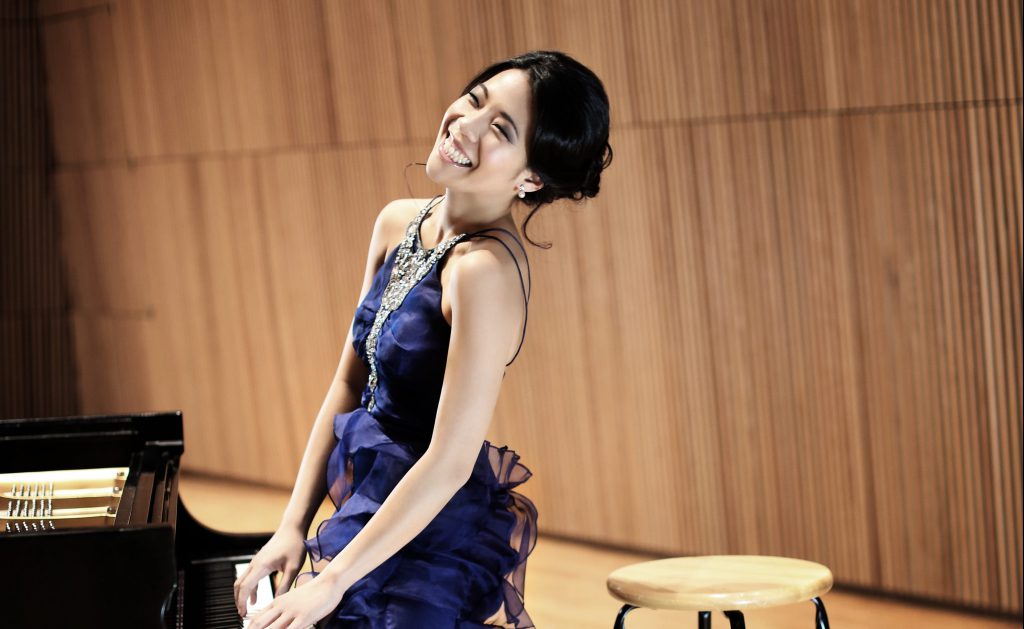
Milwaukee Musaik brings pianist Joyce Yang back to the city for a fundraising concert Sunday, Nov. 22, at 1:30 p.m. at the Wisconsin Conservatory of Music.
The program pairs Johannes Brahms’s Piano Trio in B major, Op. 8 — performed in the revised version the composer finished 35 years after the original — with Louise Farrenc’s Sextet for Piano and Winds, a work written in 1851–52 that blends a traditional wind quintet with piano.
Violinist Jeanyi Kim, a Milwaukee Symphony Orchestra member and Musaik organizer, said the ensemble programs what it can afford and relies on musician volunteers to handle everything from repertoire selection to usher recruitment.
“She’s basically always back by popular demand,” Kim said of Yang. “And she has just a wonderful rapport with musicians and the audience in Milwaukee. And it’s mutual.”
Yang has built a long relationship with Milwaukee audiences through years of guest appearances with the Milwaukee Symphony Orchestra, including a five-year cycle of all five Rachmaninoff works for piano and orchestra with former music director Edo de Waart. Her 2023–24 appearance with Musaik gave local musicians a chance to hear her in the more intimate chamber-music setting.
“There’s a clarity and a singing quality about it amidst the grandeur,” Kim said, describing Yang’s playing. Beyond technique, Kim values the pianist’s generosity, flexibility and intellectual curiosity.

Musaik operates as an artist-run organization — the third incarnation of the Milwaukee Chamber Orchestra — giving MSO members an outlet for chamber repertoire rarely heard on mainstage programs. Without paid administrative staff, the musicians manage logistics Kim likens to planning a wedding. The fundraiser aims to sustain that model and future collaborations with guest artists.
Brahms completed the B major Trio in 1854 at age 20, then substantially revised it in 1889. “Even the first two notes of the piano already just give you an idea of the richness, the soaring beauty of the melody that people just want to drink in and hear over and over again,” Kim said.
“The rich harmonic language, lush and warm melodies, the intricate interplay and conversation between the three instruments and the dramatic and virtuosic intensity throughout make it such a rewarding experience to play his music.”
Farrenc, a pianist and composer who studied with Anton Reicha, broke barriers in her own era. She was appointed professor of piano at the Paris Conservatory in 1842 and, after the successful premiere of her Nonet in 1850, pressed for and won salary equality with male colleagues. At a time when opera dominated Parisian musical life, she committed herself to instrumental music.
Her Sextet explores the coloristic possibilities of winds and piano. “At times, her music reminds me of Beethoven,” said flutist Sonora Zinninger. “And other times it’s very lyrical, reminds me of the music of Schumann.” Zinninger described the outer movements as stormy, contrasting them with a graceful Andante whose pastoral character evokes Beethoven’s Sixth Symphony — the peace after the storm.
Joyce Yang, born in 1986 in Seoul, Korea, earned the silver medal at the 2005 Van Cliburn International Piano Competition at age 19, becoming its youngest competitor. She also received the chamber music and new work prizes at that event.
Yang moved to the United States in 1997 to study at Juilliard’s pre-college division and graduated with a bachelor of music degree in 2010, winning the Arthur Rubinstein Prize. In 2017, her album with violinist Augustin Hadelich earned a Grammy nomination for Best Chamber Music/Small Ensemble Performance.
The intimate ballroom setting of the Conservatory offers a close-up view of the interplay among Yang and the Musaik musicians.

South Dakota CSW-PIP Supervisor Rules: License, CE, and Board Approval
To supervise a candidate for the certified social worker in private, independent practice (CSW-PIP) license in South Dakota,...

Topeka Firefighters Raise $30,000 for Muscular Dystrophy Association Through Fill the Boot Campaign
Topeka firefighters presented the Muscular Dystrophy Association with a $30,000 check Thursday, the proceeds of three September days...

Jazz Snap 12-Game Skid vs Clippers, Then Beat Lakers Behind George’s 30-Point Double-Doubles
The Utah Jazz snapped a 12-game losing streak Tuesday night with a 132-107 blowout of the Los Angeles...

Central Arkansas Falls to Tarleton State in Five Sets, Ends Season in UAC Quarterfinals
Central Arkansas fell to Tarleton State in five sets Thursday at Little Rock's Jack Stephens Center, ending the...