
Minneapolis staff will plant 380 trees in a space roughly the size of six parking spaces this Saturday morning.
The project, part of the Minneapolis City Trees program, utilizes a dense reforestation technique to rapidly expand the local urban canopy. By planting native vegetation in high-density clusters, the city aims to build a resilient mini-forest that matures significantly faster than traditional plantings, Audacy reported.
The event takes place Nov. 14 from 9:30 a.m. to 12:30 p.m. at the First Unitarian Church, located at 900 Mt. Curve Ave. in south Minneapolis. This specific initiative relies on the Miyawaki method, a reforestation strategy developed in Japan that emphasizes biological competition to accelerate growth.
To achieve the desired density, workers will pack hundreds of saplings into a concentrated area. This proximity forces the plants to compete for essential resources like sunlight and nutrients, which triggers a biological drive to grow upward more aggressively.
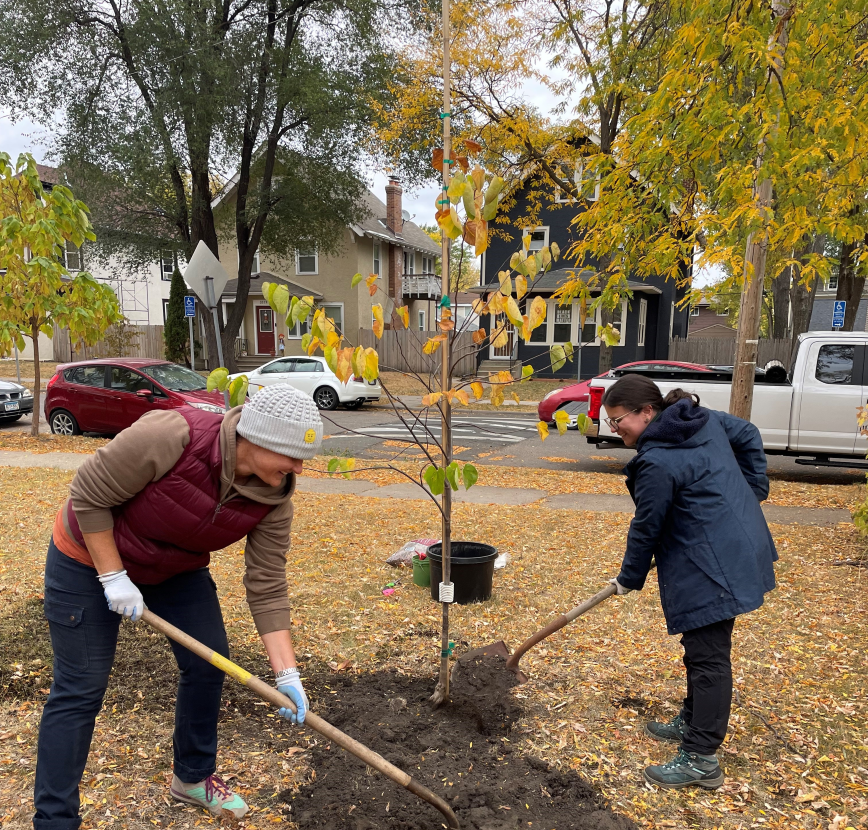
“The idea is that you plant lots of native trees and vegetation really closely together, so densely that you can fit like 350 trees in an area as small as six parking spaces,” Sydney Schaaf, the program manager, told Audacy.
If the biological process follows the expected trajectory, the dense cluster should develop into a fully mature mini-forest within 20 to 30 years. This timeline accelerates growth compared to conventional forestry models, where similar canopy coverage might take much longer to establish in an urban environment.
The program seeks to address several environmental and civic needs through these concentrated pockets of greenery. Beyond the primary goal of combating climate change by expanding the city’s tree canopy, the vegetation serves multiple ecological and social functions.

“And there is just lots of other benefits to planting trees beyond climate change as well,” Schaaf told Audacy. “They provide habitat for wildlife, they help collect stormwater, they have mental health benefits.”
Urban heat islands—areas where concrete and asphalt trap heat—are a growing concern for city planners. By increasing the canopy, cities can naturally lower surface temperatures and reduce the energy required for cooling. The root systems and soil of these mini-forests also assist in managing stormwater runoff, a critical component of urban infrastructure management.
More details regarding the City Trees program are available through the official Minneapolis municipal website.
The planting session begins at 9:30 a.m. on Saturday.
Keep reading

Sandia High Celebrates Declaration of Independence 250th Anniversary
Sandia High School students moved history from textbooks to the campus to mark the 250th anniversary of the...

Carson Hocevar Leads NASCAR Online Merchandise Sales
Carson Hocevar finished the 2026 NASCAR season as the top-selling driver on the league's official online store, outperforming...

Nevada Faces Northern Illinois With Three Requirements for Victory
Nevada faces Northern Illinois at Huskie Stadium on Saturday, entering the matchup as a 7.5-point favorite. The Wolf...

Atlantic Asphalt Tanker Allides With American Heritage in New Orleans
Thirty-two people were hospitalized following a major vessel accident on the Mississippi River on Friday afternoon, according to...