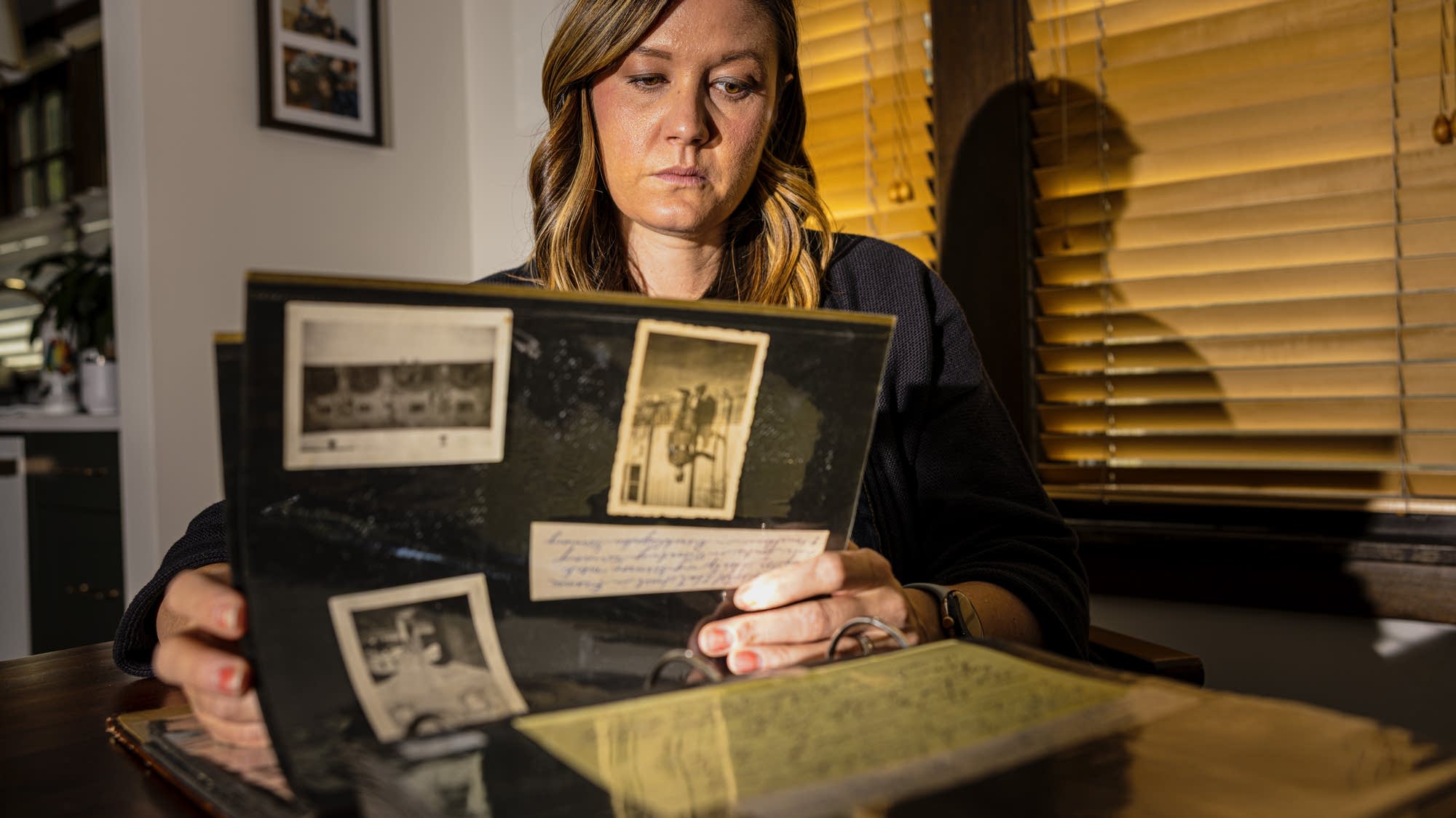
A Minneapolis woman inherits a plaque of German World War I sabers and a photograph of her grandfather in front of Hitler’s Bavarian retreat, unspooling a family archive of liberation and loss, MPR News reported.
Morgan Atchison grew up knowing her grandfather, Robert Wermes, as a proud veteran who carried his discharge papers in his wallet. Drafted from Iowa at 20, he drove tanks with the 14th Armored Division across Germany in 1945. The division earned the name “The Liberators” for freeing hundreds of thousands of concentration camp prisoners and Allied soldiers.
When Atchison inherited the wooden plaque recently, she found a note in her grandfather’s cursive on the back. It identified the crossed blades as German World War I cavalry sabers found in a Munich warehouse in June 1945. “Nice souvenir,” he wrote. Beside them sat a photograph: Wermes in 1945, standing in front of Hitler’s house at Obersalzberg.
A binder of witnesses
The deeper archive lives in a thick binder of black-and-white prints, each captioned in Wermes’ hand. Bombed villages, fellow soldiers on mountain peaks, castle ruins. One page stops Atchison cold. Two men stand side by side, one noticeably shorter. The caption reads: “The man on the right is a Polish DP.”
DP stood for displaced persons, prisoners unable or unwilling to return home. She reads the next line aloud, her voice catching: “Shorty was a slave laborer that had to slide the Jews on pallets in the ovens.”
“Just to be in that moment and understand — like, we’ll never understand what they went through and what they saw,” Atchison said.
The long return
The albums don’t end in 1945. Wermes went back to Europe 17 more times, retracing his steps, revisiting villages and families he had stayed with during the war. Atchison believes those reunions were what he was proudest of.
“He saw a lot, and he knew it probably didn’t take much to help somebody,” she said. “He would even pick people up give them rides to the grocery store, because he knew people just needed help.”
Also in the collection: a Nazi officer’s dagger and an old bazooka missile, the latter now hanging in the garage because Atchison didn’t want it in the house. She has explored donating the saber plaque to a museum but hasn’t found the right fit.
Obersalzberg, a mountainside settlement above Berchtesgaden in Bavaria, was once a salt-mining center dating to the 12th century before becoming a retreat for artists and intellectuals in the late 19th century.
Adolf Hitler first visited in 1923 and later transformed a rented chalet into the Berghof, his primary mountain residence, while Nazi leaders seized surrounding land to create a restricted compound. Most Nazi-era structures were demolished in the 1950s, and the Dokumentationszentrum Obersalzberg museum opened in 1999 to document the site’s history.
“I miss his voice and his laugh,” Atchison said. “I don’t know how to replace that.”
Related reading

UConn Board Extends Maric Presidency; Contract Terms Unfinished
House Speaker Matt Ritter was expected to take the job; instead, Radenka Maric is staying, Hartford Business Journal...

Patricia Smith Grows Llama Butterfly from Pop-Up Markets to City Creek Boutique
Small businesses make up 99.9% of all U.S. businesses, employing nearly 46% of Americans, a scale that turns...

Gov. Spanberger Unveils Housing Package Targeting Transit, State Land
Virginia Gov. Abigail Spanberger unveiled a legislative package Wednesday aimed at preserving and expanding affordable housing across the...

Westborough Police Chief Todd Minardi Found Drunk in Cruiser, Globe Reports
Westborough Police Chief Todd Minardi spent more than 24 hours parked outside a Shrewsbury liquor store in his...