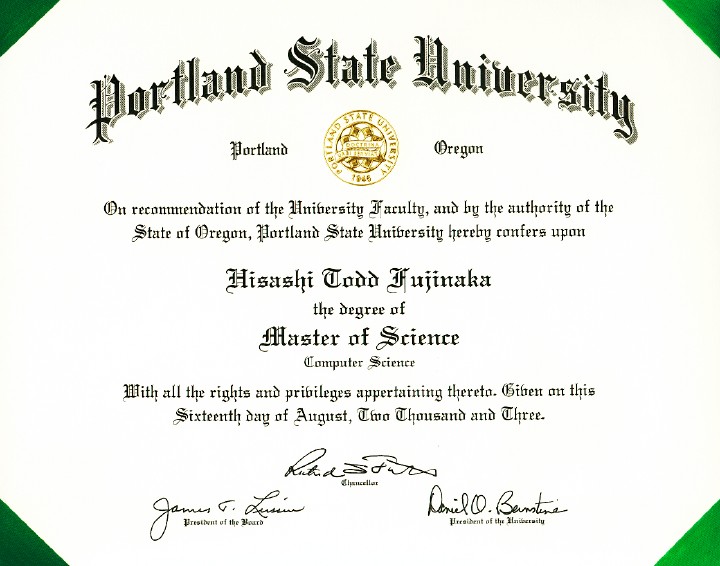
Portland State University lets computer science undergraduates bank up to 18 graduate credits at undergraduate tuition rates before they even collect a bachelor’s diploma.
The department’s Bachelor’s + Master’s pathway — known on campus as the B+M — opens the door for students who have cleared 16 upper-division credits with a 3.3 GPA to start a master’s degree that can finish in a single extra year, the Department of Computer Science confirmed. Credits taken as 500-level courses during the senior year count toward both degrees, effectively chopping a semester or two off the usual graduate timeline.
That tuition arbitrage is the program’s quiet engine. Post-baccalaureate students are charged graduate rates per university policy, but standard undergraduates pay the lower undergraduate rate for those same 500-level seats — a difference that can run thousands of dollars per term. “Graduate credits taken in a student’s senior year will be applied to both degrees,” the department says, framing the savings as a structural feature rather than a loophole.
Advising is split deliberately. The undergraduate advisor ([email protected]) maps junior- and senior-year course plans and handles DARS exceptions so 500-level work satisfies bachelor’s requirements. The graduate advisor ([email protected]) reviews B+M applications, steers course selection toward eventual master’s requirements, and processes the second set of DARS exceptions once the student matriculates into the MS program. Both offices coordinate during the senior year to prevent credit collisions.
The 4/5xx trap
One administrative detail separates a smooth transition from a wasted semester: dual-listed 4/5xx courses must be taken under the 5xx number. Enrolling in the 4xx version — even for the same classroom, same instructor, same syllabus — means the credits will not transfer to the master’s degree. The department stresses the point in bold on its advising page, and both advisors flag it during enrollment clearance.
Applications are reviewed on a rolling basis with decisions typically returned within two weeks. The optimal window, the department says, is by the end of winter term junior year, giving enough runway to complete six 500-level courses before graduation. Students must formally apply to the MS program within one academic year of receiving the BS or the shared credits expire.
What the five-year map looks like
The department publishes a sample curriculum that front-loads the heavy lift. First-year students take calculus through MTH 252Z, a lab science sequence, and the introductory programming trio CS 161, 162, 163. By third year they are in upper-division cores — CS 302, 314, 333, 350 — plus a writing course and cluster requirements.
Fourth year folds in CS 358, a math elective, and the first 500-level courses. Fifth year, the standalone master’s year, is left open for thesis or project work and remaining graduate electives.
“Students apply to the BS + MS program after completing 16 credits of upper-division CS courses, typically by the end of winter of their junior year and before the beginning of their senior year in order to have adequate time to take six 500-level courses before graduating,” the department advises.
The program waives the MS application fee and the recommendation-letter requirement. Everything else, from the statement of purpose to the final transcript, still lands on the graduate admissions desk.
For a student who hits the 3.3 threshold early, the B+M turns a six-year bachelor’s-plus-master’s slog into a five-year sprint with a tuition discount baked in. The catch is purely logistical: miss the 5xx enrollment code, miss the one-year matriculation deadline, or miss the advising window, and the savings evaporate.
Worth a look
Washington State Beats Hawaii 79-63 for First Division I Win at Angel of the Winds Arena
Washington State beat Hawaii 79-63 Wednesday night at Angel of the Winds Arena in Everett, securing the program's...

Ky. AG, UofL Foundation Seek to Rewrite Dead Donors’ Wills; Judges Split on Race Restrictions
Kentucky Attorney General Russell Coleman and the University of Louisville Foundation asked judges to rewrite the wills of...

The Company Said the Core Problem for New York Businesses Is Rarely Too Little Marketing
The company said the core problem for New York businesses is rarely too little marketing; it is marketing...

Illinois Names Jennifer Soble First State Public Defender
Illinois named Jennifer Soble its first state trial-level public defender Wednesday, entrusting a veteran advocate who helped free...