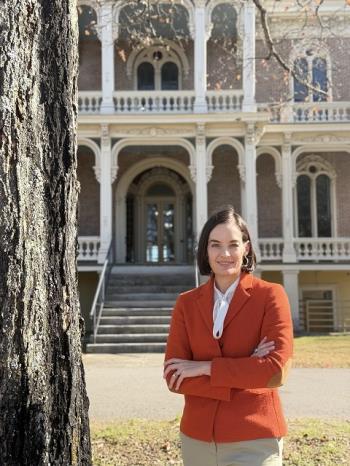
“As SHPO and Executive Director, I’m looking forward to renewing our office’s existing relationships and to building new ones across the state,” Miranda Christy Montgomery said Friday.
The Tennessee Historical Commission confirmed the appointment the same day, making her the first woman to lead the agency in its permanent capacity.
Montgomery steps into the dual role of Executive Director and State Historic Preservation Officer after serving in an interim capacity since her 2025 appointment as SHPO, the commission announced. She first joined the agency in 2023 as Senior Historic Preservation Attorney within the Department of Environment and Conservation’s Office of General Counsel.
The move formalizes a transition that has been underway for months. Montgomery, a partner for six years at Dodson Parker Behm & Capparella, PC, built a practice spanning finance, real estate, nonprofit organizations, conservation and historic preservation before entering state service.
Her earlier career included a director role at UBS and associate work at Stites & Harbison focused on conservation easements and deeds protecting historic sites, farmland and scenic viewsheds, the commission reported.
“Our office has a variety of tools that can assist preservation efforts in all types of Tennessee communities — no matter the size — and I’m ready to get to work fostering those connections to strengthen preservation throughout our state,” Montgomery said.
Her academic background blends theology and law: a B.A. in Religion and Philosophy from Kentucky Wesleyan College, an M.A. in Theological Studies from Vanderbilt University, and a J.D. from the University of Tennessee. The Nashville Business Journal has recognized her as a Woman of Influence, Best of the Bar, and Forty under 40 honoree. She lives in Pegram with her husband and daughter.
The Tennessee Historical Commission traces its roots to a 1919 committee formed to memorialize World War I events, later expanding its scope to preserve battlefields and historic sites statewide. After a decade of dormancy following its first chairman’s death in 1929, Governor Prentice Cooper revived it in 1940.
A 1942 partnership with the Tennessee Historical Society launched the Tennessee Historical Quarterly, still published today. The historic marker program began in 1951 and has since erected approximately 2,000 markers across Tennessee.
Designated the State Historic Preservation Office after the National Historic Preservation Act of 1966, the commission has operated since 1994 from the restored Clover Bottom Mansion, an 1850s Italianate house listed on the National Register. The grounds include two restored c.
1858 slave cabins, a carriage house and horse barn, over 150 native trees and a public walking trail. As of 2025, a professional staff of 20 administers federal and state programs, including the National Register, Section 106 review, historic tax credits, cemetery preservation and the Tennessee Wars Commission.
The commission’s mandate is broad, covering the protection, preservation, interpretation and administration of historic places; encouraging inclusive study of Tennessee history; marking important locations, persons and events; assisting publication projects; reviewing undertakings that could affect historic properties; and nominating eligible properties to the National Register of Historic Places under the National Historic Preservation Act of 1966.
Related reading

Kreiss-Tomkins Names Budget Director, Chief of Staff in First Alaska Administration Picks
Alaska Governor-elect Jonathan Kreiss-Tomkins named his first three senior aides Wednesday, installing a veteran fiscal analyst to run...

Olukayode Taiwo Arrested in Connecticut for Philadelphia Abduction, Shooting
U.S. Marshals and Newington police arrested Olukayode Taiwo, 26, Thursday at an apartment complex in Newington, Connecticut, ending...

IEEE Senior Member Brings AI Tools to Eastern Colorado Farmers Through Extension Work
Seven competitive grants totaling more than $250,000 now back the work of a Colorado State University extension specialist...

Mayor Mamdani Announces Disbanding SRG That Arrested Him Twice
Mayor Zohran Mamdani announced Monday that he is disbanding the NYPD's Strategic Response Group, the same elite tactical...