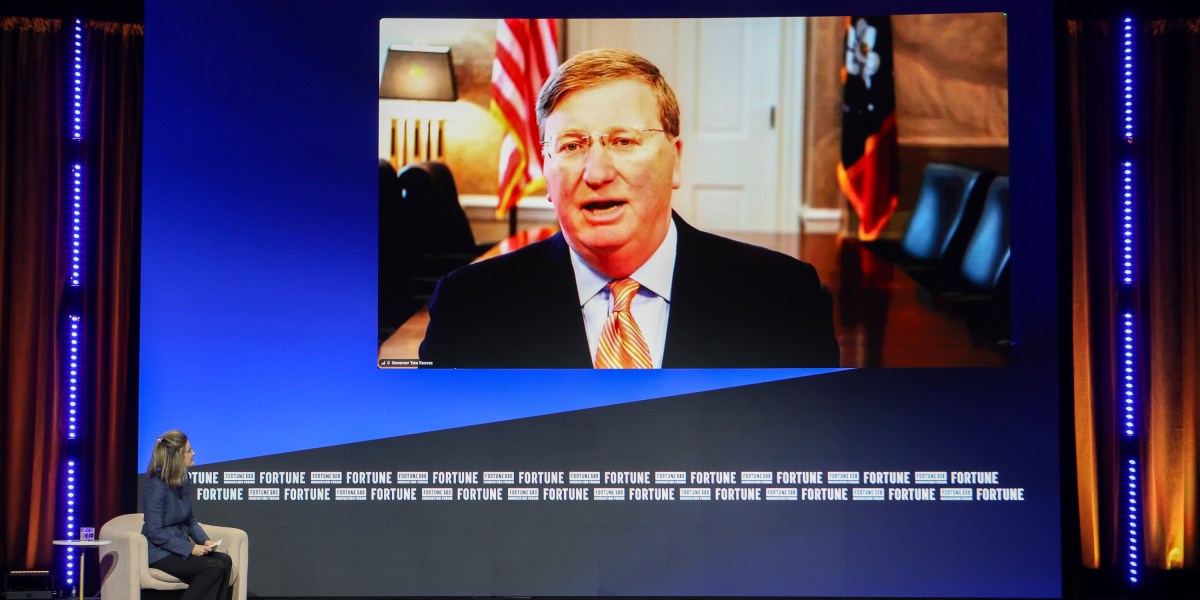
Voters opposed data center expansion in 52 of 53 local ballot measures this month, yet Republican Mississippi Gov. Tate Reeves told the Fortune 500 Innovation Forum in Detroit on Tuesday that many Americans don’t realize how often they rely on the infrastructure.
“And if the answer is yes, then you have used a data center today, and everybody in America uses data centers regularly,” Reeves said, describing how he asks audiences to check their phones for GPS use. “And so, in terms of necessity and the need for everyday American citizens, it is without question that there is going to be a need to keep this data.”
The disconnect is stark. Mississippi hosts 38 data center projects, 17 of them operational, and landed a $25 billion Amazon commitment this year. Studies have overwhelmingly demonstrated that Americans resist local data center construction because of environmental worries and the prospect of rising utility bills and electricity prices, Fortune reported.

Reeves frames the buildout as a security imperative. He pointed to litigation between the NAACP Mississippi State Conference and xAI, where the civil rights group alleged gas turbines powering an xAI facility lacked Clean Air Act permits. The Department of Justice moved to dismiss the suit, arguing a shutdown would threaten “national, economic, and energy security” because the Department of Defense requires continuous data center operations for AI capabilities.
A federal judge denied that motion last month, ruling the Clean Air Act claim did not unconstitutionally supplant executive authority. “Both the Department of War and the Department of Justice have gone on record saying how important certain data centers are to America’s ability to protect itself and to our national security, and I take them at their word,” Reeves said.
The governor echoed a theory promoted by investor Kevin O’Leary and President Donald Trump: that foreign adversaries are seeding negative social media narratives to slow the U.S. AI race.
“I believe that there is no doubt that, particularly in social media circles, that there is a concerted effort by some of our adversaries to make data centers unpopular,” Reeves said. “And I think they’ve been relatively successful at doing so.”
“Anyone who doubts it should just show up to any of the communities where people are actually fighting data centers,” said Ben Green, assistant professor of information at the University of Michigan, speaking to Fortune earlier this year.
“Show up to a town hall, show up to a city council meeting, and you will just very clearly see that these are people who live in this community [and] are clearly very upset about this.”
Policy experts have rejected the theory — which its backers have supported with scant evidence — as a way of scapegoating China, the U.S.’s predominant rival in the AI race.
Reeves acknowledged constituent concerns about water use and noise pollution, suggesting locating the AI infrastructure in industrial parks could address these issues. “We look at all of the questions that are out there surrounding data centers, and we try to make good, sound, rational decisions based upon the facts that we have available to us,” he said.
“What I’ve said to the people of Mississippi is, all of these questions that are being asked are absolutely legitimate, and every single one of those questions deserves an answer.”
Keep reading

Cavaliers Sign Zack Austin to Two-Way Contract, Waive Riley Minix
The Cleveland Cavaliers signed forward Zack Austin to a two-way contract, replacing Riley Minix on the roster's developmental...
Tennessee Tech Beats UNC Asheville 98-77 Behind 26 Turnovers
Tennessee Tech used 26 UNC Asheville turnovers to fuel a second-half surge and secure a 98-77 victory at...

South Dakota High School State Volleyball Tournaments Begin Thursday in Sioux Falls
The South Dakota High School State Volleyball Tournaments tip off Thursday at the Denny Sanford PREMIER Center in...
Pennsylvania Game Commission Seeks Public Help Identifying Crossbow Hunter in Wilkinsburg Neighborhood
Residents on a quiet Wilkinsburg street are asking how a hunter with a crossbow ended up chasing a...