
Missy Mazzoli’s operatic adaptation of George Saunders’ novel “Lincoln in the Bardo” premiered at the Metropolitan Opera this fall, marking the first world premiere by a woman in the company’s history. The production preserves the novel’s fragmented, multi-voiced structure while translating its exploration of grief into a score that blends spectral atmosphere with theatrical lyricism.
Saunders’ 2017 novel assembles 108 chapters of historical documents, invented reminiscences, and overlapping dialogues from spirits inhabiting a cemetery. The work makes “a kind of music out of these competing perspectives—a fugue of interruptions, repetitions, and irreconcilable testimonies,” The New York Review of Books reported.
Its central figure is Willie Lincoln, the eleven-year-old son of Abraham and Mary Todd Lincoln, who died of likely typhoid fever in February 1862, less than a year into the Civil War.
First woman to premiere at the Met
The distinction arrived nearly a century and a half after the company’s founding. The review said that regarding Mazzoli’s achievement “as simply a belated correction confuses its social importance with the artistic merit of her work.”
From polyphonic novel to operatic stage
The novel’s dispersed story lines become “a conventional drama of revelation” in the opera, centered on Willie’s departure from the bardo—a term borrowed from Tibetan Buddhism describing a purgatory populated by people who cannot abandon their attachments.
Characters include Vollman, who died before consummating his marriage; Bevins, a young man who killed himself after a queer romantic disappointment; and the Reverend, who has glimpsed his afterlife and chose to remain. The dead believe themselves ill, their coffins mere “sick-boxes” for temporary accommodation.
Saunders’ competing accounts of a White House reception held while Willie lay dying upstairs “expose the fragility of the historical record.” Witnesses disagree about the atmosphere, the weather, and the president’s appearance. Their testimony accumulates without producing certainty. The novel draws emotional force from the contradiction of a man charged with preserving a nation yet incapable of preserving his child’s life.
Mazzoli’s musical language
The composer’s scores “create worlds that seem recognizable and then, almost imperceptibly, become strange, even surreal.” Her music occupies territory between spectral atmosphere and theatrical lyricism, retaining “one of opera’s oldest assumptions: that there are emotional states for which speech is insufficient.”
In previous works— Breaking the Waves (2016), Proving Up (2018), and The Listeners (2022)—Mazzoli explored the shifting boundary between private experience and collective belief, where suffering acquires spiritual significance and the promise of transcendence carries the threat of annihilation.
For Lincoln in the Bardo, her palette includes postminimalist repetition, electric guitars, industrial percussion, unstable tonalities, remembered folk music, and kazoos. The opera’s opening sonorities—dissonant clusters, faintly metallic percussion, a moaning violin—drop the audience into “an atmosphere of perpetual activity already in progress.” Glissandi and sliding choral textures produce “an impression of voices momentarily escaping their bodily limits.”
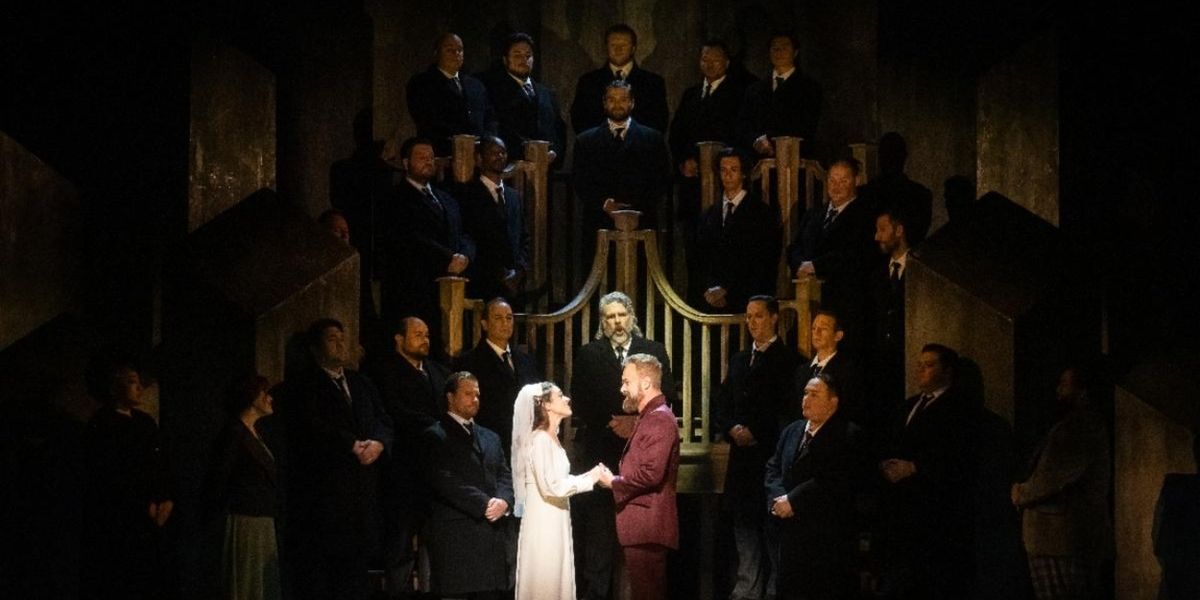
Met orchestra reveals Mazzoli textures but struggles with balance
The Met orchestra under Yannick Nézet-Séguin allowed Mazzoli’s intricate textures to emerge without sacrificing underlying musical structure, though the balance between singers and instrumental ensemble was not always ideal. The company’s theatrical resources permitted the composer to juxtapose intimate vocal writing with choral lusciousness, constructing “a surreal environment of almost inexhaustible musical variety.”
Yet those resources encouraged inflation. The score, “particularly in its overwrought first act, contains passages that seem to exist because Mazzoli discovered an attractive musical motif rather than because the drama requires it.” Royce Vavrek’s libretto preserves much of Saunders’ humor and verbal eccentricity, but the sheer quantity of text occasionally leaves the music struggling to establish its own dominance.
With all live performances sold out, the Metropolitan Opera is streaming “Lincoln in the Bardo” on YouTube for free this Saturday. https://t.co/1MiSStGgg6
Lincoln’s contained grief
Peter Mattei’s Lincoln was “not a figure of operatic grandeur; he was a man whose public authority was irrelevant to the one thing he most desperately wished to change.” Mazzoli’s vocal writing for him avoids the extravagance given to the surrounding ghosts; his phrases search for an uninterrupted line, suggesting “the terrible discipline of a man accustomed to imposing order on circumstances that resist it.”
In the second act, Lincoln’s soliloquy becomes the opera’s emotional center—”almost unbearably ordinary, a father’s intimate address to a child who can no longer answer.” Mattei’s carefully measured phrasing and refusal of theatrical excess “intimated grief without the familiar operatic machinery of sobbing, broken phrases, or histrionic dynamic contrasts. The sorrow remained heartbreakingly contained.”
Whether Lincoln actually returned to the crypt at Georgetown’s Oak Hill Cemetery, opened his son’s coffin, and held his body—an account that has passed into legend—remains uncertain. The opera, like the novel, derives force from the dramatic possibilities of that contradiction.
More on Metropolitan Opera
Watching it live now on YouTube. Was not expecting this character’s boner. https://t.co/ksUrqlfW9i pic.twitter.com/n97RpnNgIg
TY! https://t.co/QzCwXIw0Qk
Good morning. Did you know the new opera “Lincoln in the Bardo” by Missy Mazzoli is available to stream on YouTube through November 18 live from the @MetOpera . https://t.co/rb36hhdGwU
Watch the Met Opera’s “Lincoln in the Bardo” free online tomorrow. https://t.co/ym4KCJakuS
Related reading
New Jersey Governor Mikie Sherrill’s Congressional Letter Sparks 2028 Presidential Speculation
New Jersey Governor Mikie Sherrill sent a policy agenda to the state's incoming congressional delegation this week, a...

Oklahoma Business Owner Sentenced to 9 Years for $3.5M Pumpjack Theft in New Mexico
An Oklahoma business owner received prison sentences in two New Mexico counties after entering a no contest plea...

Wake Forest Beats Mississippi State 78-71 in Battle 4 Atlantis
Mississippi State fell 78-71 to Wake Forest on Wednesday in the Battle 4 Atlantis Championship Bracket at Imperial...

L’OFFICIEL USA Reports Hotel Openings and Art Renovations in Fashion Capitals Ahead of 2027
Fashion capitals are rolling out a wave of hotel openings and art-driven renovations ahead of the 2027 season,...