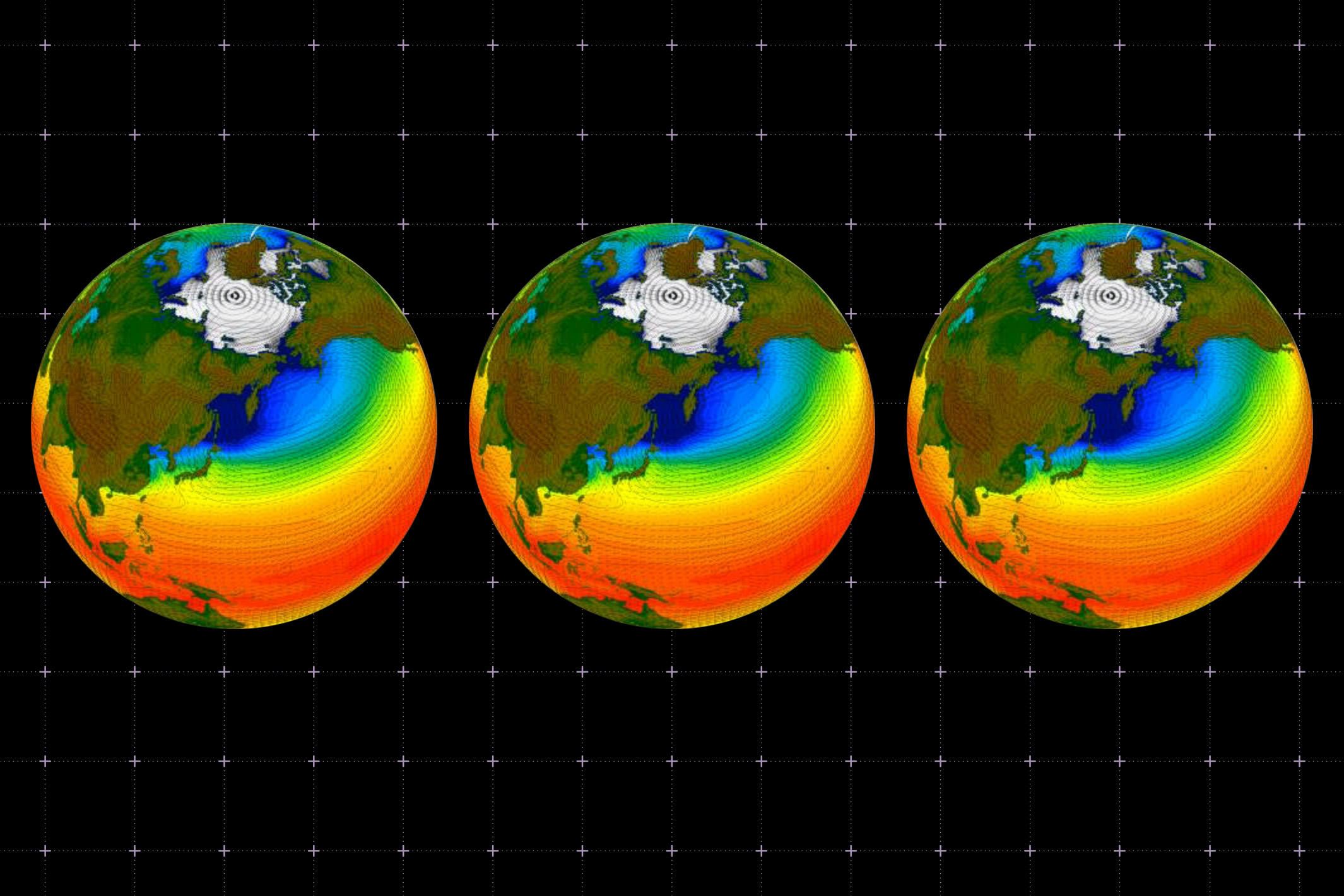
Accurate long-term climate projections are essential for planning decisions that enhance power grid resilience, protect public health, and maximize agricultural yields.
While traditional earth system models take months to run on supercomputer clusters, specialized artificial intelligence tools known as climate emulators can simulate future impacts in a matter of seconds. However, these emulators have historically struggled to adapt when confronted with unfamiliar or novel scenarios.
To overcome this limitation, the MIT team engineered a training algorithm that generates optimized synthetic climate data rather than relying strictly on smooth, realistic emissions trajectories. By introducing high-frequency variations, oscillations, and rapid spikes—such as artificially inflating carbon dioxide emissions or sharply cutting methane—the technique forces the emulator to extract significantly more information about the underlying system.
“Climate emulators are especially well-suited for modeling policy-relevant scenarios. By using our method to generate optimized training data for an emulator, we can speed up the production of much more reliable emulators, so we can better trust their outputs for making policy decisions,” said Christopher Womack, who is now a postdoc at ETH Zurich.

The research paper details how traditional emulators fail when tasked with evaluating local pollutant control policies that occur alongside rising global emissions. By contrast, the newly optimized models successfully capture these complex regional interactions while utilizing only a fraction of the data typically required.
“In the future, we are definitely going to see climates and scenarios we haven’t seen before. "If we can simulate these different scenarios more reliably, we can provide more accurate information to the stakeholders who need it," said Noelle E. Selin, a professor in the MIT Institute for Data, Systems, and Society and EAPS, and director of CS3.”
The technique requires running a full-scale earth system model just once to calibrate the error threshold, dramatically cutting down production times that typically span months or years.
“Because the process of training an emulator can take months or even years, the emulators we have are usually out-of-date. "By cutting down that production time, I think this technique will speed up the delivery of updated tools to researchers and practitioners," Selin added.”
Keep reading
NMHU Students Excel at Business Ethics Workshop and Case Competition
“The event was a wonderful opportunity for students to apply their knowledge,” Zollner said, as New Mexico Highlands...

Three UNL Faculty Receive National Awards for STEM Equity Leadership
Three faculty researchers at the University of Nebraska–Lincoln received top national honors from the Association for Women in...

Gov. Gianforte Announces 77 Recipients of 2026 Montana Governor’s Veteran Commendation
Seventy-seven Montana veterans received the 2026 Montana Governor’s Veteran Commendation on Monday during a Veterans Day ceremony in...

New $25M Housing Fund Aims to Create 5,000 Affordable Units in KC
Kansas City launched a new $25 million regional housing fund on Tuesday at Union Station, aiming to expand...