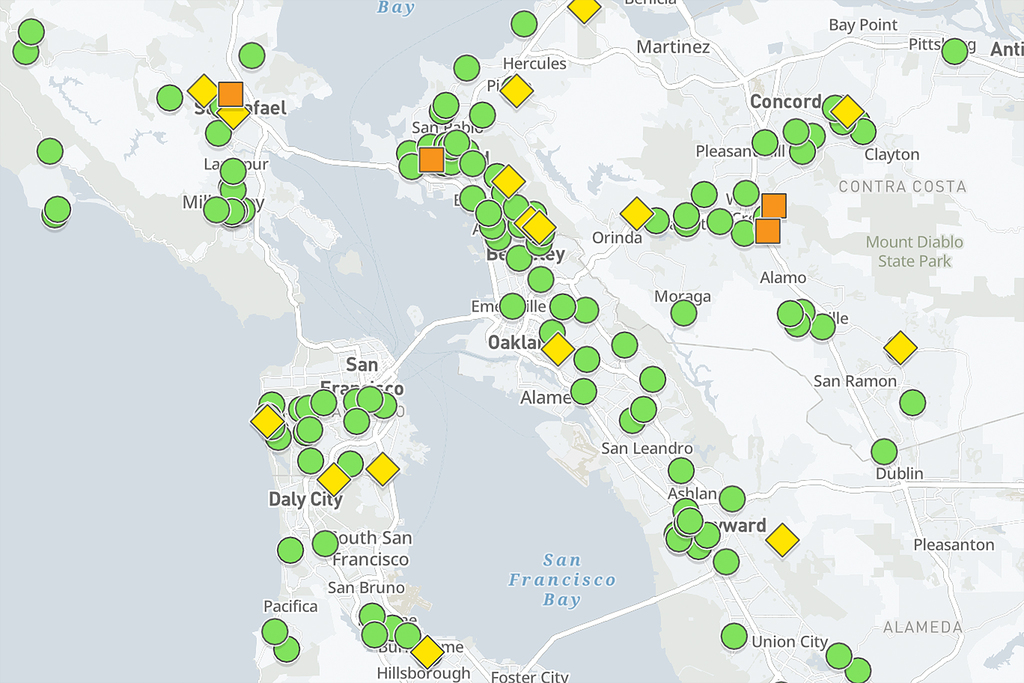
More than 5,500 PG&E customers remained without electricity Wednesday night, hours after the atmospheric river dumped record rain on the Bay Area.
Downtown San Francisco recorded 2.28 inches by 3 p.m., breaking the November 18 daily record of 2.24 inches set in 1918, the National Weather Service said.
The storm scrambled the morning commute. Flooding closed the Van Ness Muni station and all westbound lanes of Interstate 580 in the East Bay by 12:30 p.m. Southbound I-280 at Geneva Avenue filled with standing water. BART warned of systemwide delays.
SamTrans said multiple buses were rerouting or missing stops. Waymo paused service after vehicles stalled in flood zones. Supervisor Bilal Mahmood confirmed the halt came after the county’s Department of Emergency Management “immediately” responded to stalled cars in the Panhandle.
Record daily rainfall for Downtown San Francisco. As of 3 pm 2.28 inches of rain has fallen so far today (since midnight). The old record for this date was 2.24 inches back in 1918. The final numbers will be calculated at midnight with more rain forecast to fall this evening.
Power Outages Linger Into Evening
PG&E reported 18,000 customers in the dark at the peak around 10 a.m. By 9:45 p.m., 5,545 were still offline, the utility said. The largest cluster — 4,248 — sat in the East Bay.
One outage that began just after 1 p.m. knocked out thousands across downtown Oakland and near Lake Merritt. The company had at least 150 crews deployed. Spokesperson Tamar Sarkissian said restoration work would continue through the night. Thursday’s system was not expected to be as powerful.
#SJFD is responding to a flooding incident at W Santa Clara St and Stockton Ave near the SAP Center. Two cars disabled in water with one person inside each. One adult female extricated and transported with non life threatening injuries. Boat rescue in progress for 2nd individual. pic.twitter.com/3FmlnPeTgt
“What we're seeing is pretty much aligned with what our meteorologists were predicting, and we've been able to get our crews to the right areas,” Sarkissian said.
Flooding, Not Major Rivers, Was the Story
NWS meteorologist Roger Gass said the ground was not saturated enough for a flood watch. Urban and small-stream advisories covered Contra Costa, San Francisco, San Mateo and Santa Clara counties. “We don't expect any major main stem river flooding like with the Russian River, the Napa River and the Salinas River,” Gass said.
A reminder El Niño has not even reached peak strength yet. It will continue to strengthen through the end of the year before it begins to weaken in early 2027. Today’s storm certainly gave the Bay Area a good assessment of our pain points for future storms this season.
Low-lying areas with poor drainage took the brunt. San Francisco firefighters rescued two people from a flooded roadway where a vehicle collision occurred. Maintenance-hole covers floated in at least one neighborhood. A 15-foot sewage geyser erupted in the Ocean Beach area, bystander footage showed.
Wind Grounds Flights, Then Eases
A high-wind warning for the East Bay Hills and advisories for interior valleys and the coast expired at 1 p.m. Gusts up to 70 mph were recorded in the hills. SFO issued a morning ground stop for departures.
By 11:45 a.m. it was lifted. The FAA still logged average departure delays of 186 minutes. NWS meteorologist Ryan Walbrun said around 11:30 a.m. that the strongest winds — from San José down to the central coast — had peaked.
City Urges Residents to Prepare for More Rain
Mayor Daniel Lurie warned at a Wednesday press conference that the winter storm season was just starting. “If your street saw flooding, I would urge you to keep your car away from the area going forward, when rain is coming again,” he said. That evening, residents lined up in the Marina for free sandbags from the Department of Public Works.
🚨Heads up, Central Coast(Big Sur)! A Flash Flood Watch -> Wed AM–Thu AM for Plaskett & Timber burn areas. With 2–4" of rain near Big Sur, there is a HIGH risk of mud, rock & debris flows near Hwy 1. Have multiple ways to get alerts & stay safe! Now is the time to prepare. #CAwx pic.twitter.com/1oGJrDkG1f
“It's better to have the sandbags and not need them, than need the sandbags and not have them,” said Marina resident Patrick Thomasma, who collected ten. Another resident, Kobe Wang, planned to place bags at his garage and basement door after water pooled outside his house and flooded his roommate’s car.
PG&E, headquartered in Oakland, serves 5.2 million households across northern and central California and traces its roots to the San Francisco Gas Company, incorporated on August 31, 1852, which lit the city’s first gas street lamps on February 11, 1854.
🚨 Heads N Napa (Pickett Burn Area)! 🌧️A Flash Flood Watch runs Tue PM–Wed PM. With 2–3" of rain on tap, debris flow risk is HIGH—watch for mud, rock & loose debris near burn scars & Simmons Canyon. Have multiple ways to get alerts & stay safe! Now is the time to prepare. #CAwx pic.twitter.com/RLuTDE0rOX
The modern utility was established on October 10, 1905, through the merger of predecessor companies and by 1984 had become the nation’s largest electric utility business. It filed for Chapter 11 bankruptcy in 2019 after its equipment was found responsible for the 2018 Camp Fire, the deadliest wildfire in state history, and emerged from bankruptcy in 2020.
Coastal and Mountain Hazards Extend South
The NWS flagged a continued risk of waterspouts over the ocean east of San Francisco Wednesday. AccuWeather warned that travel delays, localized flooding and hazardous conditions would persist, especially along the coast and mountain passes. Seasonal high tides overlapping with storm risks during Thanksgiving week could bring another round of coastal wave damage.
Avoid the area: Alemany Blvd / Bayshore Blvd for a vehicle collision with a flooded roadway. SFFD units are on scene of a vehicle collision involving a flooded roadway. Two victims have been rescued and moved to a safe location. CHP on scene as well. Please avoid the area as… pic.twitter.com/P7YZzxOWLW
More on Bay Area
We've notified @SF_emergency about the stalled Waymos in the Panhandle, and they have immediately taken action. We have been informed that Waymo service has accordingly been paused today due to stalling in flood zones. We will continue to monitor and address conditions. https://t.co/HR4sgzLRRX
Keep reading
- Janicki Secures $600M Credit Facility to Expand Aerospace Manufacturing in Montana and Washington
- Bridgeport Man Sentenced to 14 Months for Nationwide Unclaimed Property Fraud
- 3.6% for Social Security, 2.6% for FERS, and a Bill Still Pending for VA (daybreakwire.com)
- Portland lightning strike damages homes and cuts power (newsarchyuk.com)

Janicki Secures $600M Credit Facility to Expand Aerospace Manufacturing in Montana and Washington
Janicki Industries has locked in a $600 million credit facility to build a massive new aerospace campus in...

Bridgeport Man Sentenced to 14 Months for Nationwide Unclaimed Property Fraud
Bridgeport resident Cirt Lindsay was sentenced Monday in federal court in Vermont to 14 months in prison for...

Revisiting Chiefs’ 2026 Draft: Trading Up for Delane and Early Returns
Kansas City traded up from the ninth overall pick to the sixth in April, sending a third- and...

Huntsville International Airport on Track for Fourth Record Year With 22 Added Weekly Departures
Huntsville International Airport is on track for a fourth year of record passenger traffic, adding 22 weekly departures...