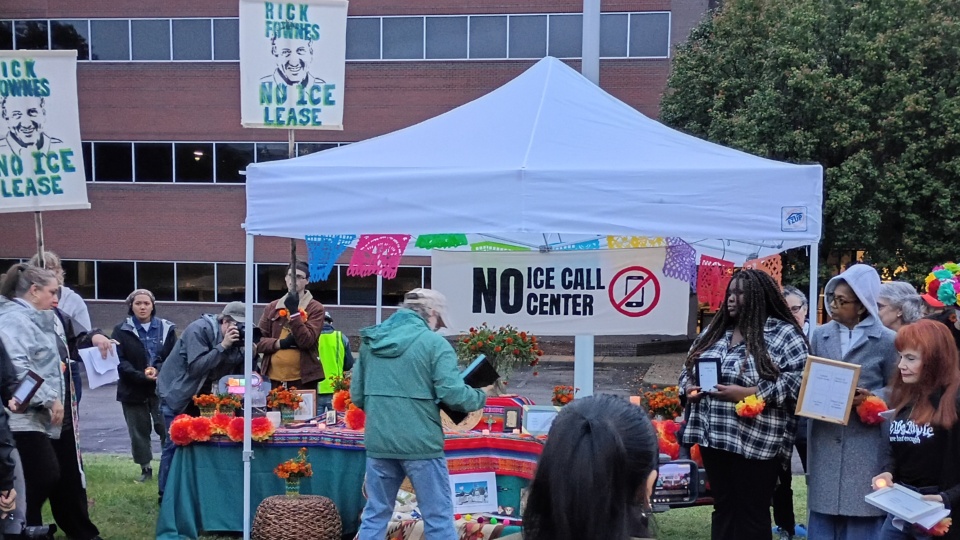
On a rainy Sunday afternoon in Nashville, the quiet Donelson neighborhood became the site of a pointed protest as activists gathered to oppose a proposed Immigration and Customs Enforcement (ICE) call center.
Dozens of demonstrators from groups including the Tennessee Immigrant and Refugee Rights Coalition and NOAH marched toward a three-story office building on Royal Parkway, aiming to block a facility that has sparked intense community pushback.
The stakes of this project are high, both for the local community and for federal immigration enforcement. If completed, the facility would operate 24/7, coordinating local law enforcement agencies under 287(g) agreements while directing field deportation operations and tracking unaccompanied immigrant children. According to ICE, the center is designed to handle between 6,000 and 7,000 calls every day, People’s World reported.
The project’s path has been anything but smooth. It was originally slated for a rural site in Adams, Tennessee, but shifted to Nashville after facing local resistance. Now, the focus has turned to the building’s owner, Rick Fownes and MAC Partners LLC, with protesters calling on the Massachusetts-based firm to cancel its lease agreement. To date, those calls have gone unanswered.
The controversy extends beyond the site location to the $63 million contract awarded to Koniag Government Services (KGS). While KGS is presented as an Alaska Native corporation—a status that carries specific federal contracting benefits under the Alaska Native Claims Settlement Act—research into the company’s leadership paints a different picture.
Despite claims that the firm is composed of Alutiiq people, an examination of its 13-member leadership staff reveals no Native representation. Instead, the team is comprised of white, African American, and Asian American executives, many of whom have backgrounds in the military-industrial complex.
For the activists in Donelson, the human cost is the central issue. During the demonstration, participants constructed an ofrenda—a traditional altar—in front of the proposed site. They placed photo frames on the altar, each bearing the name of a person who died while in ICE custody. The act reminded everyone of the policies the facility is intended to carry out.
“We are here to say that Nashville is not a place where this kind of operation is welcome,” one participant noted during the rally, as reported by People’s World. The gathering included songs and speeches, showing the deep-seated opposition to the facility’s presence in the city.
Worth a look
SEPTA Adds Express Trains for Steelers Game as Marathon Clogs Roads
Traffic congestion from the Philadelphia Marathon will complicate travel to Lincoln Financial Field this Sunday, prompting transit officials...
ICE Lodges Detainer for Guatemalan Charged With Kidnapping, Raping Oklahoma Teen; Suspect Released Under Obama Administration
U.S. Immigration and Customs Enforcement lodged a detainer asking Oklahoma officials not to release a Guatemalan man charged...

Lynn Businesswoman Cynthia Carco Dies; Services Nov. 24
Cynthia Yvonne Carco died Thursday; her Funeral Mass is scheduled for Tuesday, November 24, 2026, at 10:00 A.M....

Columbus Crew Face Messi, Inter Miami in Playoff Opener
“To be honest, you never want to play against one of the best in the world who can...