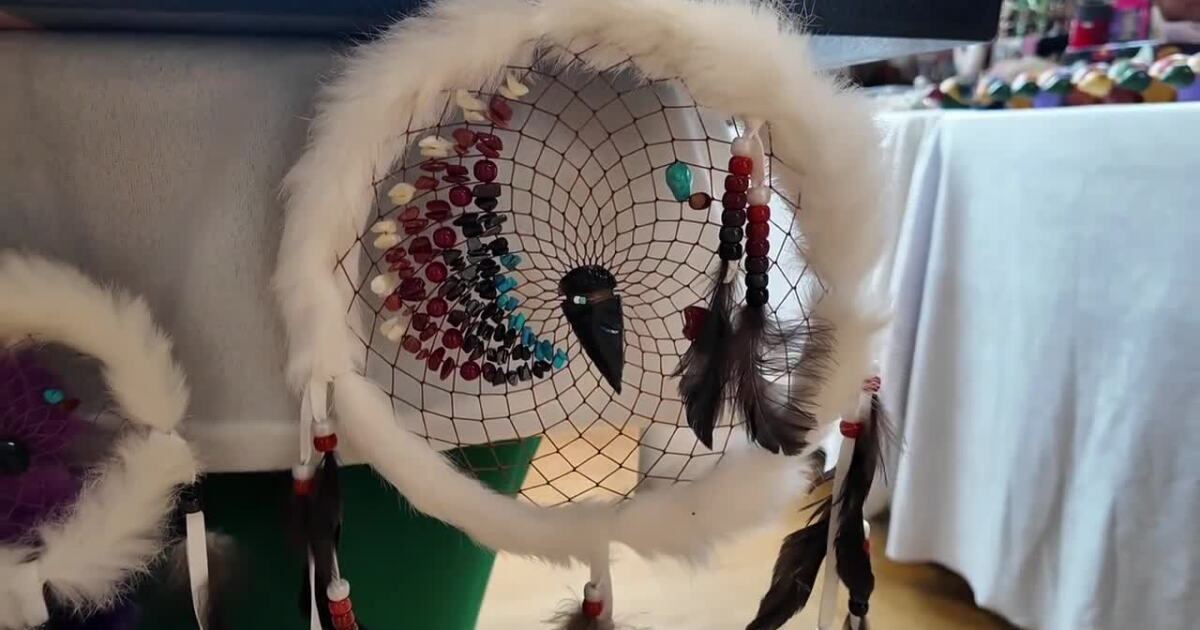
Native artists gathered at the Urban Indian Center of Salt Lake this weekend for the Rebalancing Culture Harvest Arts Market, sharing work rooted in stories, materials and lessons passed through generations.
Harry Bert, who is Navajo and Hopi, spends three days carving a single piece of cottonwood root. He chooses the root because of its relationship to water; in the dry terrain he describes, the tree’s roots reach for moisture beneath the ground. “We need water just to survive,” he said. His carvings incorporate details representing the four directions, the four seasons and the four ages of life, along with markings for the snow and rain that help corn grow.
Renee Webb Harrison creates small figures of Navajo men and women dressed in clothing, jewelry and scarves like those she sees elders wear. She began nearly a decade ago after adapting a magazine craft project that used clothespins for holiday characters. “I just put on the Navajo outfit on it and it looked great,” she said. Raised in boarding schools and the placement program, she said she did not learn much about Navajo culture as a child. After marrying and living on the Navajo reservation, her husband’s family helped her learn through their language and traditions. “I would like to know more,” she said, adding that being around Native people and spending time at the center has helped her.
Laquina Kaufman, originally from Arizona and now living in Taylorsville, showed ornaments made from white clay and horsehair with hand-painted designs. Her mother taught her to make art, and she is now teaching her children; her daughter makes some of the work displayed at their table.
“I just love the creation of all the design,” she said. “There’s always a story behind our design.”
Lois Sanchez took up jewelry making about five years ago after retirement, following earlier pursuits that included roping, riding motorcycles and hunting. She grew up in a family of eight children; her parents taught them different ways to support themselves, grow food and build things. “I like working with my hands,” she said. Among her pieces was jewelry featuring a horned toad, which she said can represent power and luck, and stones she values for their connection to nature.
Hopi artist Randy Tippu, 64, brought wooden feathers decorated with clouds, lightning and rain — images reflecting the importance of moisture to Hopi dry farmers.
He learned to paint with his father when he was about 5 or 6, and said he feels an obligation to keep creating and to encourage young artists, whether they are Hopi, Native American or anyone else who wants to make art. One lesson from his father has stayed with him: “Put happy things into it to make their home happy,” he said.
The market ran Saturday, Nov. 21 from 10 a.m. to 5 p.m. and Sunday, Nov. 22 from 10 a.m. to 4 p.m. at the Urban Indian Center of Salt Lake, 120 W 1300 S, Salt Lake City, UT 84115, with admission open to the community. Supported by the Cambia Health Foundation. For more information, contact Rad Cuch at (801) 707-1873.
Worth a look

Cognetti Names Eileen Cipriani Deputy Chief of Staff and District Director Effective January
U.S. Rep.-elect Paige Cognetti named Scranton Business Administrator Eileen Cipriani as deputy chief of staff and district director...

Vikings and 49ers Face off in Mexico City for Week 11 Matchup
The Vikings and 49ers kick off at 8:20 p.m. ET on Sunday at Estadio Banorte in Mexico City,...

Maine to Seat First Two Franco Americans in Congress as Rivals Jackson, LePage to Be Sworn
When Sen.-elect Troy Jackson and Rep.-elect Paul LePage are sworn in next January, Maine will for the first...

Anchorage Officer Shoots Armed Man During Domestic Violence Call
An Anchorage police officer shot and injured a man armed with a shotgun early Sunday during a domestic...