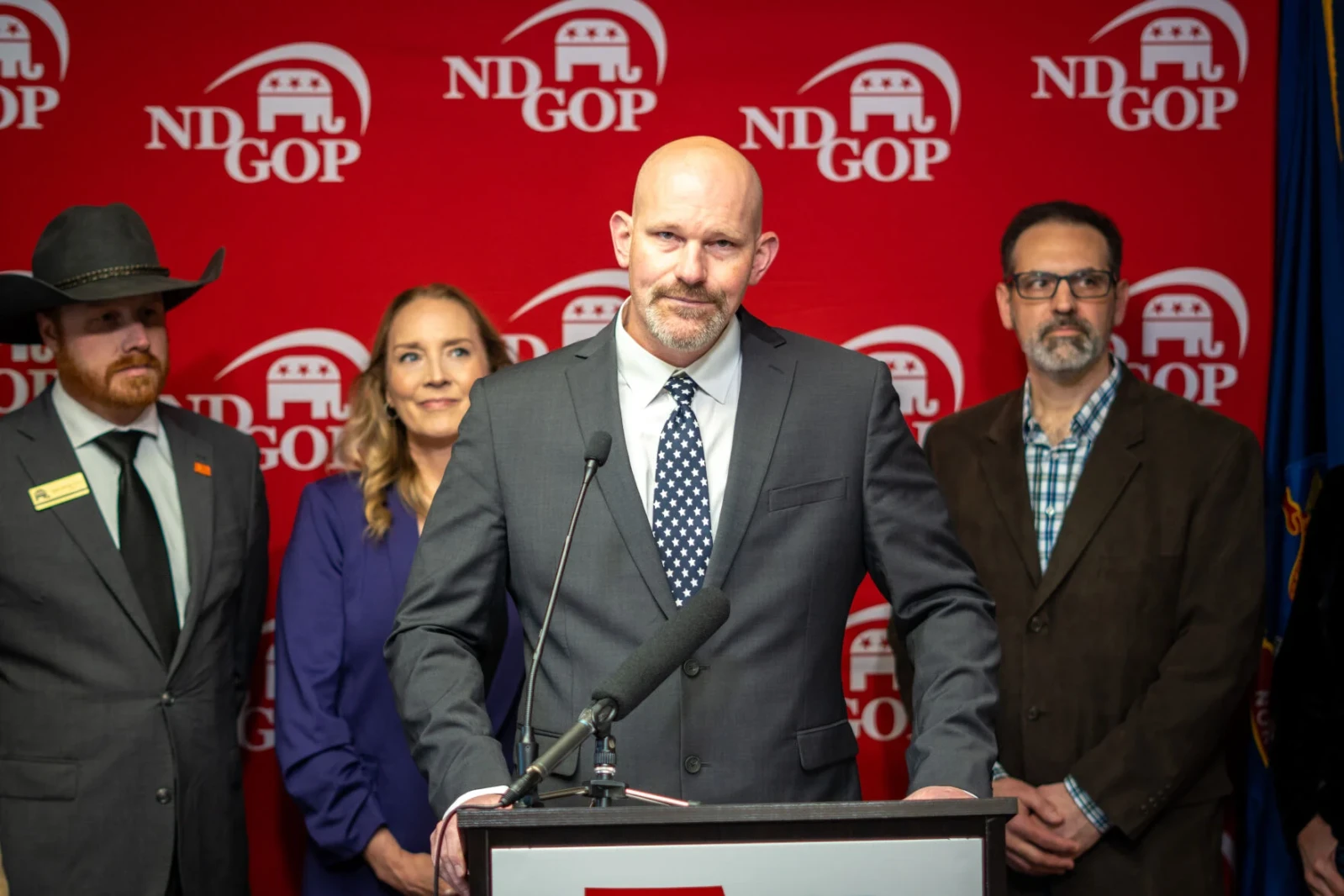
North Dakota Republicans filed a federal lawsuit Tuesday night challenging the state’s open primary system, citing a party-commissioned survey that found 11% of self-identified Democrats reported voting in GOP primaries for strategic reasons.
The North Dakota Republican Party, led by Chairman Matthew Simon, announced the suit without notifying its executive committee, according to several members who spoke to InForum.
“The interference was enough to change the outcome in several key Republican districts over the past two cycles,” Simon said. “Democrats are putting their priorities on the ballot under our name.”
The party also says nearly 46% of primary voters surveyed reported being contacted and encouraged to vote in the Republican primary rather than the Democratic-NPL primary, KVRR reported.
The lawsuit targets three provisions: the open primary structure, the requirement that parties nominate candidates through state-run primaries, and statutory mandates that certain nominees and officeholders serve on district party committees. North Dakota does not have partisan voter registration.
Legal precedent is mixed. White. White.
On open primaries, lower courts have split. A federal district court ruled for the Idaho Republican Party in 2011, finding Idaho’s open primary unconstitutional as applied to the GOP. The Idaho GOP presented evidence of crossover voting without proving malicious intent.
Conversely, the 9th Circuit rejected a similar challenge from the Democratic Party of Hawaii in 2017, ruling the party failed to show outside voters were determining nominations or moderating candidate positions. The Supreme Court declined review.
“The appellate court treated the severity of the burden as a factual question requiring evidence, rather than something automatically established by the existence of an open primary,” InForum reported.
The NDGOP’s survey of 306 voters aims to supply that evidence. Yet establishing crossover voting occurs is not the same as proving material impact on outcomes, a distinction central to the divergent Idaho and Hawaii rulings.
The suit also raises a structural question in a state without party registration: who decides if a voter is a Republican? The 9th Circuit observed that participating in a party’s primary may itself be a legitimate means of affiliation.
Earlier this year, the NDGOP passed a resolution removing the Republican brand from candidates who skipped the state convention. All statewide Republican candidates boycotted that convention. The party also let its communications director and office manager go due to funding shortfalls, InForum reported.
If the NDGOP prevails, only party-endorsed candidates could appear on the ballot as Republicans. That could incentivize traditional Republicans — who outnumber and out-fundraise the populist faction — to reclaim party machinery, InForum noted.
The North Dakota Attorney General’s office must defend current state law at taxpayer expense.
Worth a look

Minnesota Seeks 7th Win, Paul Bunyan’s Axe at Wisconsin Friday
Minnesota (6-5, 4-4 Big Ten) travels to Camp Randall Stadium on Friday for the 135th meeting with Wisconsin...

George Washington’s Anne Arundel Tavern Visits Detailed; Only Rising Sun Inn Survives
George Washington stopped at Widow Ramsey's Tavern in Millersville and Rawlings' Tavern in Harwood in 1773, and only...

Nebraska Faces Iowa After Toppling Ohio State
Nebraska faces Iowa on Friday in Iowa City with a chance to make its first real statement of...

Democrat Chuck Hubbard unseats 11-term Republican Virginia Foxx
"I have very little tolerance for people who tell me that they graduate with $200,000 of debt or...