
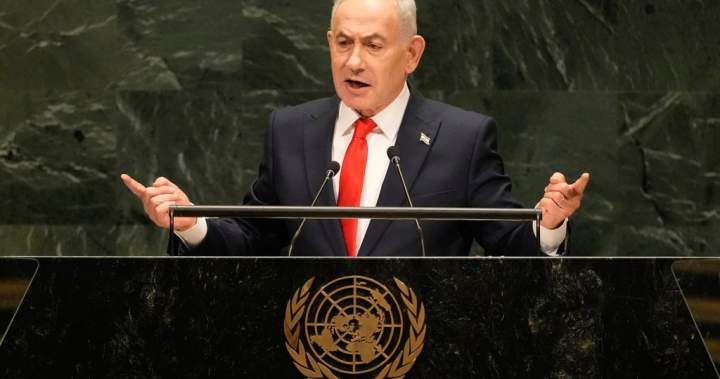
“My responsibility as a leader obligates me to put everything aside, including the principle of the largest party,” Israeli caretaker Prime Minister Benjamin Netanyahu said on Saturday, proposing a national unity government where his rival, Gadi Eisenkot, would serve first as prime minister.
Netanyahu announced the concession in a social media post, saying he would initially serve as an “alternate prime minister.” The move comes as Eisenkot, a former military chief tasked by President Isaac Herzog with forming a government by the December 6 deadline, has accused Netanyahu’s Likud party of stalling talks to force another election. Eisenkot swiftly responded by inviting Netanyahu to “genuine and accelerated negotiations.”
Neither bloc secures Knesset majority after October election
Following the inconclusive October 27 election, neither Netanyahu’s bloc, which won 53 seats, nor Eisenkot’s centrist alliance of four parties, with 48 seats, secured a majority in the 120-seat Knesset. Eisenkot has signed coalition deals with Yisrael Beiteinu and The Democrats, but still lacks the 61 seats needed to govern, Global News reported. He has until December 6 to form a government, with the possibility of a 14-day extension, SBS News confirmed.
Eisenkot accused Likud of refusing to compromise over the past two weeks. “Likud, for its part, was unwilling to compromise and, over two weeks, refused to put a single concrete proposal on the table,” he said in a statement on Friday. Netanyahu’s offer came later, on Saturday.
Eisenkot sets 24-hour deadline for Likud
In response to Netanyahu’s proposal, Eisenkot set a 24-hour deadline to assess Likud’s intentions. “If Likud is ready for genuine unity, I am ready to assess the seriousness of its intentions over the next 24 hours,” he said, inviting Netanyahu to “genuine and accelerated negotiations on basic guidelines and policy issues.”
Eisenkot had previously accused Likud of stalling for two weeks without offering concrete proposals, calling their conduct an effort to “run down the clock” and force another election.
Eisenkot’s Yashar party claimed to have put forth “significant compromise positions” in a detailed proposal sent to Netanyahu at his request last Sunday. Netanyahu’s Likud, however, accused Eisenkot of working to form a “dangerous left-wing government” while maintaining it remained open to unity talks.
Arab party leader’s statement clears path for coalition
The move could clear the path for his party to support an Eisenkot-led government, as condemning Hamas is one of Eisenkot’s conditions for cooperation. Eisenkot has made significant progress by signing coalition deals with The Democrats and Yisrael Beiteinu, but their combined 36 seats fall far short of the 61 needed for a majority in the 120-seat Knesset.
The deadlock leaves Eisenkot dependent on Arab-led parties, whose unprecedented 19 seats have positioned them as kingmakers. However, some of Eisenkot’s allies have voiced opposition to relying on their support. Netanyahu framed his proposal as necessary to address “the gravity of the existential danger,” while Yair Lapid, co-chair of the centrist Beyachad party, dismissed the offer as “yet another transparent con by a serial fraudster.”
Eisenkot depends on Arab party support to form government
The deadlock leaves Eisenkot dependent on the support of Arab-led parties. On Saturday, Mansour Abbas, leader of the Raam party, implicitly recognised Hamas as a “terror group” in an interview with Israel’s Channel 12 News, a move that could clear the path for his party to back an Eisenkot-led government. Eisenkot has made condemning Hamas a precondition for cooperation.
Netanyahu framed his proposal as necessary to address “the gravity of the existential danger,” while Eisenkot questioned its sincerity. “For about three weeks now, my team and I have been proposing and trying to conduct genuine, sincere and accelerated negotiations, but we are met with refusal and evasion,” he said.
Former Benny Gantz’s rival, Naftali Bennett, called Netanyahu’s decision the right one, but other opponents dismissed it as a transparent ruse. “Enough with the stunts and tricks,” said Yair Golan, head of the Democrats, on X.
Netanyahu and Eisenkot agreed to meet on Sunday morning, November 29, for talks. Both sides now face a critical decision: whether to forge a compromise or allow Israel to head toward another election, following a period of political fragmentation between 2019 and 2022 when there were five separate elections.
More on Yisrael Beiteinu
Keep reading
- Ahmed Al Ahmed Awarded Cross of Valour for Bondi Beach Heroism
- Estonia to Close All Road Border Crossings With Russia on Dec. 1 Over Hybrid Threats
- Netanyahu Offers to Rotate Premiership With Gadi Eisenkot (archyde.com)
- Netanyahu offers Eisenkot first turn as prime minister in unity government (newsarchyuk.com)

Ahmed Al Ahmed Awarded Cross of Valour for Bondi Beach Heroism
Ahmed Al Ahmed has become only the sixth person to receive Australia’s highest civilian bravery honour for disarming...

Estonia to Close All Road Border Crossings With Russia on Dec. 1 Over Hybrid Threats
Estonia will close all five road border crossings with Russia on Dec. 1 for an initial six months,...

Channel Sole Stocks Collapse, Prompting 87% Quota Cut
Channel sole stocks have collapsed, prompting scientific advisers to recommend an 87 percent quota cut for 2027 that...

Bandai Namco Unveils Gundam SEED FREEDOM Zero Trailer and Theme Songs
Bandai Namco Filmworks dropped the full theatrical trailer and a new key visual for Mobile Suit Gundam SEED...