
Kevin Puebla thought the headaches were a concussion from mixed martial arts training.
A month later, swelling appeared on his head, and the 21-year-old University of New Mexico student learned a childhood tumor had spent a decade growing back inside his cavernous sinus.
The teratoma sat in a cavity laced with veins near the base of his skull. Removing it usually means a craniotomy — opening the skull — but Puebla had already survived three of those before his first birthday.
A fourth carried unacceptable risk, so the Presbyterian team turned to transorbital neuroendoscopic surgery, or TONES, accessing the tumor through the space around his left eye instead. Puebla’s surgery was the first such procedure performed in New Mexico.
TONES was first proposed at a 2007 otolaryngology conference, but interest accelerated over the past nine years, said Dr. Michael Ortiz Torres, a Presbyterian neurosurgeon who operated on Puebla. The approach avoids retraction of the brain itself, trading a large skull opening for a keyhole route behind the orbital rim.
“This is a very complex location to do surgery. Teratoma is a complex and hard tumor to manage. And the endoscopic transorbital approach is a very complex, very new surgery,” Ortiz said. “I would suspect that if you asked that question to a hundred neurosurgeons, maybe one would say, ‘Let’s do it transorbital.'”
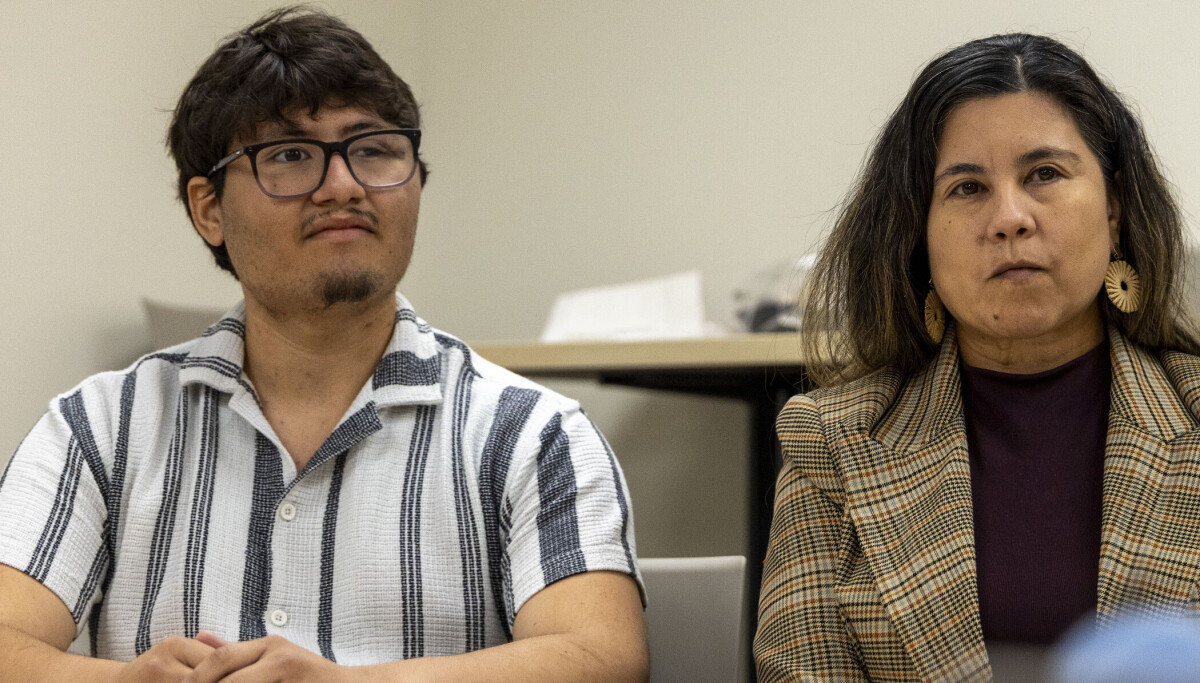
Dr. Juan Carlos Yanez-Siller, a Presbyterian otolaryngologist on the operating team, had spent years attending conferences on TONES and studying the technique on cadavers. He recognized Puebla as the rare candidate whose anatomy and history aligned with the procedure’s narrow indications.
“We knew the characteristics of the perfect case for this type of surgery,” and Puebla matched them, Yanez-Siller said.
Teratomas arise when germ cells — capable of forming neurons, skin, hair, or other tissues — migrate to the wrong location during development. They are typically benign but can compress critical structures as they enlarge. Puebla’s tumor had been growing silently for ten years before the headaches and visible swelling forced the issue in August.
Ortiz met several times with Puebla and his mother, Susanna Puebla. The scar tissue from three infant surgeries meant re-entering through the skull would significantly raise the odds of brain injury and complications, Ortiz told them. The prior operations “didn’t work like we wanted them to — probably not a good idea” to repeat, he said.
Yanez-Siller offered the transorbital alternative as a “minimally disruptive, minimally invasive approach.” The family appreciated the transparency.
“Right before they went into surgery, I was very scared as a mother, and they said, ‘We’re going to treat him like if he was our family.’ That was very impactful and just very down to earth.”
Susanna Puebla
Puebla, an aspiring biomedical engineer and former offensive guard on his high school football team, spent most of his life unaffected by his teratoma.
Related reading
SEPTA Adds Express Trains for Steelers Game as Marathon Clogs Roads
Traffic congestion from the Philadelphia Marathon will complicate travel to Lincoln Financial Field this Sunday, prompting transit officials...

ICE Lodges Detainer for Guatemalan Charged With Kidnapping, Raping Oklahoma Teen; Suspect Released Under Obama Administration
U.S. Immigration and Customs Enforcement lodged a detainer asking Oklahoma officials not to release a Guatemalan man charged...

Lynn Businesswoman Cynthia Carco Dies; Services Nov. 24
Cynthia Yvonne Carco died Thursday; her Funeral Mass is scheduled for Tuesday, November 24, 2026, at 10:00 A.M....

Columbus Crew Face Messi, Inter Miami in Playoff Opener
“To be honest, you never want to play against one of the best in the world who can...