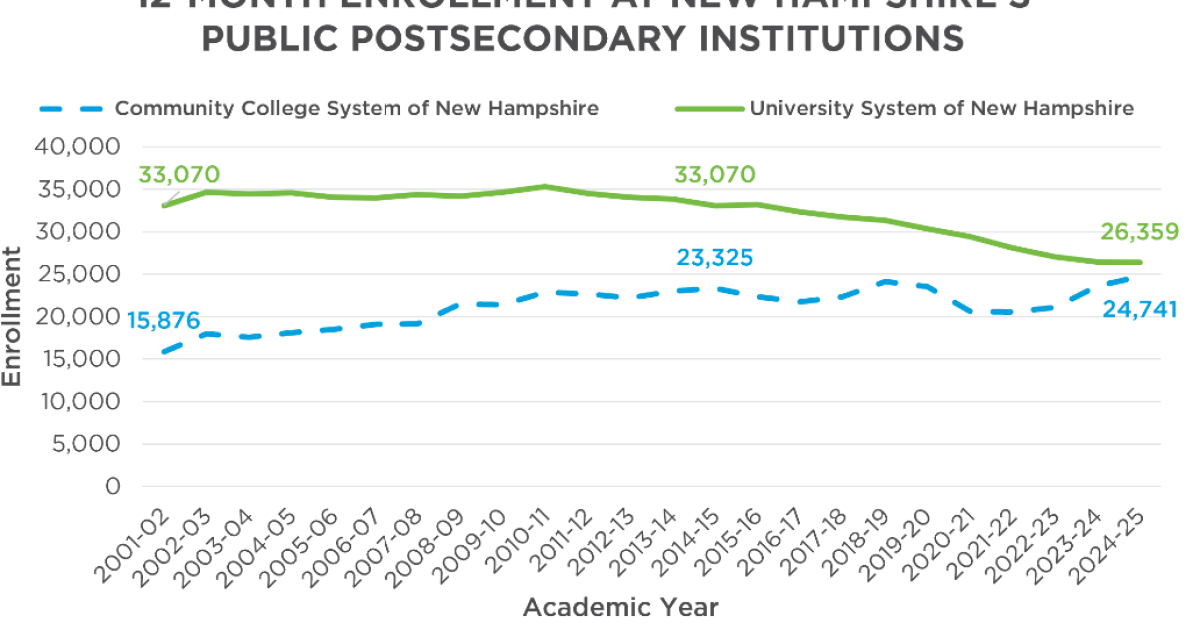
Fewer New Hampshire high school graduates are pursuing college degrees and those who do increasingly choose schools outside the state, the New Hampshire Fiscal Policy Institute said in an analysis released Tuesday.
The number of high school graduates fell about 5% between 2014 and 2024, but the number pursuing college dropped nearly three times that rate, NHPR reported. Three in five recent graduates who seek a four-year degree leave New Hampshire for college. Meanwhile, six of the state’s 10 fastest-growing occupations require a four-year college degree, the institute found, citing long-term employment projections from New Hampshire Employment Security.
New Hampshire is at the bottom for public funding of higher education, and legislators reduced state backing for the University System of New Hampshire by approximately $18 million across two years in the latest budget, NHPR reported.
The system implemented tuition hikes for this academic year, marking the first time in several years. After accounting for inflation, average tuition and fees have decreased over the past 25 years, while average room and board has climbed from roughly $9,000 in 2011 to $13,000 in 2023.
“These trends make declining enrollment not only a higher education issue, but also an overall workforce and economic development challenge,” the institute wrote in its report.
The University System announced in October that starting next school year it will waive tuition for in-state students who meet academic and income guidelines, though room and board is not covered. Gov. Kelly Ayotte has called for a similar waiver for Community College System students and said she supports a $20 million increase for the University System in the next state budget, according to reporting by the Union Leader.
The institute recommended making public colleges more affordable and expanding enrollment opportunities for high school graduates. It pointed to the University of New Hampshire’s success this fall, where enrollment rose nearly 5% after the school awarded a record $40 million in financial aid.
New Hampshire has the nation’s third-highest median age. K-12 public school enrollment dropped 25% between 2002 and 2025, shrinking the pipeline of potential college students, NHPR reported. Among New England states, New Hampshire saw the largest enrollment decline at its public colleges between 2002 and 2024.
“Higher education institutions are important to New Hampshire’s economy,” the report said. “In addition to creating jobs, these institutions help strengthen the workforce pipeline.”
Related reading
Louisiana Plans Six-Month Delay in Medicaid Work Requirement Enforcement
Louisiana will delay enforcing Medicaid work requirements for six months, protecting eligible people from losing coverage. The state...

Microsoft Employs Over 50 Military Veterans in Cheyenne
Microsoft employs over 50 military veterans, including Air Force veteran Herrod, among roughly 300 full-time workers in Cheyenne....

Four Sentenced in Makaha Shooting Death of Marcus Araneta
Four men sentenced in Makaha shooting death of 19-year-old Marcus Araneta. Styren Stevens, 20, Matthew Moon, 22, Olsen...

Broncos Week 12 Preview: Offense Struggles, Defense Holds Strong
Rookie quarterback Bo Nix completes 59.9% of passes for 1,955 yards with 12 touchdowns and five interceptions. The...