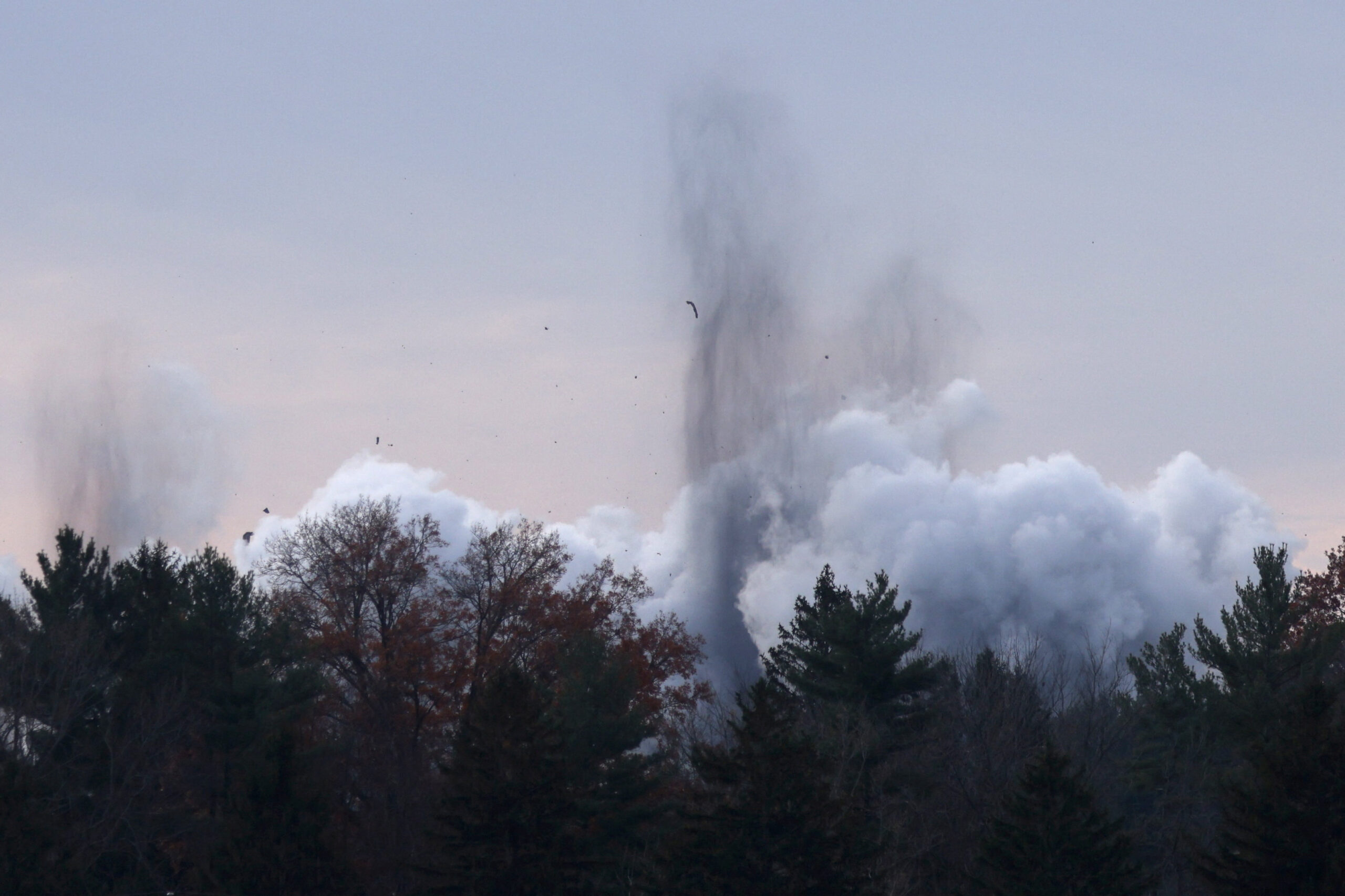
The U.S. Army detonated nearly five tons of unstable lead azide at the Iowa Army Ammunition Plant in Middletown on Wednesday, a day before Thanksgiving, after determining the material could explode uncontrollably as temperatures dropped.
The controlled blasts destroyed all 68 barrels stored in two bunkers, Maj. Gen. Eric Shirley, who led the operation, said in a briefing. Earthen barriers, foam and water were deployed to absorb the blast and suppress dust, the Army said. “The risk was reduced as close to zero as it’s absolutely humanly possible,” Shirley said. The Environmental Protection Agency’s air monitors detected no lead in the air around the plant, and FEMA issued an all-clear Wednesday afternoon, the Army reported. The Post said an alert sent to cellphones told residents it was safe to resume normal activities. Andrew Whelton, an environmental engineering professor at Purdue University who has helped communities recover from chemical disasters, called the EPA data promising but stressed that lab-tested samples are needed to determine health risks. “This should take days to weeks,” Whelton told The Post. “But what we may see is different guidance issued to different communities based on how far they are from the detonation area and whether or not they were upwind or downwind.”
Colin Wellenkamp, executive director of the Mississippi River Cities and Towns Initiative, said water treatment facilities along the Mississippi and Missouri rivers will test periodically for detectable spikes, The Post reported. Army officials said they learned in March that the lead azide — kept in drums with a water-and-ethanol stabilizer — had dangerously deteriorated as liquid evaporated and explosive crystals formed. But documents obtained by The Post show American Ordnance, the plant’s operating contractor, asked a disposal company in September 2025 to develop a plan to neutralize the same 68 drums — nearly six months before the Army’s stated discovery.
In February, the contractor told the company the government had decided to pursue another approach based on safety concerns. The Army hired MuniRem Environmental in March to develop a chemical treatment plan, then canceled the contract two months later after concluding that opening and treating the barrels risked an accidental explosion. MuniRem’s founder maintains chemical treatment remained viable. A federal appeals court this week allowed the detonation to proceed after residents and environmental groups raised concerns about potential health impacts and a lack of information, The Washington Post reported. The episode has renewed scrutiny of the military’s aging munitions infrastructure. An Army press release from 2014 said the service began researching alternatives to lead azide in 2004 because the Defense Department was concerned about a 40-year-old stockpile “deteriorating” at the same Iowa facility. The 68 barrels detonated Wednesday arrived from a Texas Army facility in 2009.
American Ordnance performed monthly visual inspections and each September opened barrels to check and replenish stabilizing fluid, according to a sworn declaration from an Army explosives specialist cited by The Washington Post.
“What did inspectors find in September 2025? Why was the contractor seeking to dispose of the 68 drums that month if the Army did not learn they were dangerous until March?” The Washington Post asked in its editorial.
“No private manufacturer could expect such questions to disappear after exposing surrounding communities to this sort of hazard. The military should not get a pass, either.”
Democrats have promised aggressive oversight when they take control of Congress, The Washington Post reported. Investigating what went wrong in Iowa — and whether similar dangers lurk elsewhere in the military’s aging munitions infrastructure — would be a worthwhile place to start, the paper said.
Residents and officials react to Iowa detonation
Burlington resident Tim Brandt watched the blasts from a roadside and told the Associated Press the explosion reminded him of noisemakers that crack on the ground. “It seemed like government put fear in a lot of people over nothing,” he said.
Donald Trump posted on social media that the Army did a “great job,” the Guardian said. Acting Secretary of the Army Adam Telle and the Republican governors of Iowa and Missouri also said the operation appeared successful and the explosion was well contained, according to the Guardian.
Plant history and aging infrastructure concerns
Democrats have promised aggressive oversight when they take control of Congress, and the Washington Post reported that investigating what went wrong in Iowa — and whether similar dangers lurk elsewhere in the military’s aging munitions infrastructure — would be a worthwhile place to start.
More on American Ordnance

Louisiana Plans Six-Month Delay in Medicaid Work Requirement Enforcement
Louisiana will delay enforcing Medicaid work requirements for six months, protecting eligible people from losing coverage. The state...

Microsoft Employs Over 50 Military Veterans in Cheyenne
Microsoft employs over 50 military veterans, including Air Force veteran Herrod, among roughly 300 full-time workers in Cheyenne....

Four Sentenced in Makaha Shooting Death of Marcus Araneta
Four men sentenced in Makaha shooting death of 19-year-old Marcus Araneta. Styren Stevens, 20, Matthew Moon, 22, Olsen...

Broncos Week 12 Preview: Offense Struggles, Defense Holds Strong
Rookie quarterback Bo Nix completes 59.9% of passes for 1,955 yards with 12 touchdowns and five interceptions. The...