
A Political Earthquake Rocks Los Angeles
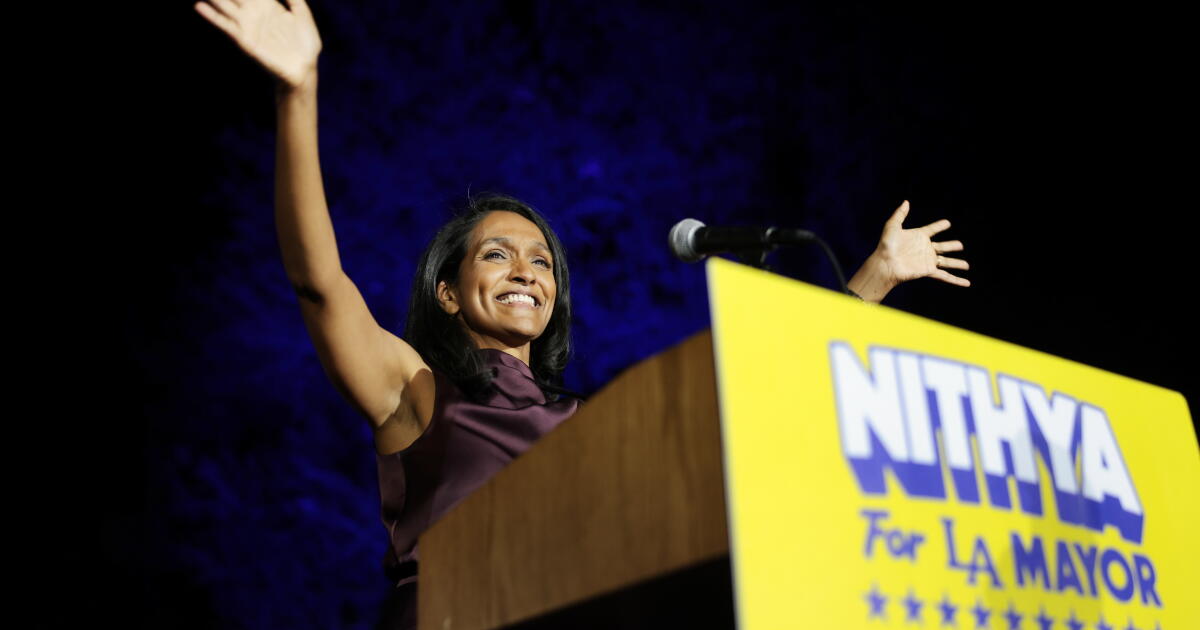
Nithya Raman has unseated incumbent Mayor Karen Bass in the Los Angeles mayoral race, the Los Angeles Times reported. The victory, confirmed on Thursday after a neck-and-neck race that saw mail-in ballots push Raman over the finish line, marks the first time a challenger has defeated an incumbent mayor in more than two decades and cements a historic shift in the nation’s second-largest city.
Raman’s win, which she declared in a video statement saying, “Los Angeles, I’m deeply honored to be your next mayor,” caps off a rapid political ascent from urban planner to city hall’s top office. Bass, a 73-year-old former congresswoman who made history as the city’s first Black woman mayor four years ago, conceded the race. “While this is not the outcome we hoped for, the people of Los Angeles have spoken,” Bass said in a statement, promising a “smooth and seamless transition.”
A New Coalition Built on Age
The race was defined by a generational and ideological clash. Raman, backed by the Democratic Socialists of America and a surge of younger voters, campaigned on a platform of fixing the “broken status quo” by tackling housing affordability and homelessness head-on. NBC News noted that she accused Bass of mismanaging the city’s homelessness crisis and blasted City Hall for what she characterized as a “reluctance to move forward with transformative policy change.” Bass, meanwhile, ran on a public safety message aimed at moderates, arguing her six-term congresswoman experience made her the steady hand needed to lead a complex city.
“I look at this race almost completely through a generational lens,” said Dan Schnur, a professor of politics at USC, Pepperdine and UC Berkeley, as quoted by the Los Angeles Times. “I think this is a new coalition built by Nithya Raman based on age.” Mike Trujillo, a Democratic consultant who supported Bass, echoed that sentiment, telling the Times, “This is not a geographic coalition or racial coalition, this is a when-you-were-born coalition.” The final tally reflected this divide, with Raman securing a decisive 52% of the vote compared to Bass’s 48%, powered by ballots that arrived after Election Day, a demographic known to skew younger and more progressive.
Indian-origin Nithya Raman Makes History, Wins Los Angeles Mayoral Race Born in Thrissur, Kerala, Nithya Raman has defeated incumbent Karen Bass to become Los Angeles’ first Indian-American and the first South Asian woman to lead the city. 🇮🇳🇺🇸 A Harvard and MIT graduate,… https://t.co/7DiUgeB1B0 pic.twitter.com/4Z67JgyFDU
The Outsider vs. The Entire City Council
Raman’s campaign was notable for what it lacked: support from her own colleagues on the City Council. Not a single one of them endorsed her bid for mayor, a fact her opponent, Bass, used to question her ability to govern. “Your colleagues have a very difficult time working with you,” Bass said during a mayoral debate. The three other democratic socialists on the council all endorsed Bass, a stark contrast to the national DSA’s enthusiastic support for Raman. This dynamic underscored Raman’s identity as a political outsider, a status she wore as a badge of honor.
“So the establishment doesn’t like Raman: so what?” Los Angeles Times columnist Gustavo Arellano wrote, arguing that Raman’s fractious relationship with the political class was precisely what frustrated voters craved. He pointed out that while the political class was largely absent from her election night party, their constituents were not. “Even though every city councilperson said they were standing with Karen Bass, not very many of the people they represent followed them to the polls,” Kurt Peterson, a leader of the hospitality union Unite Here Local 11 which endorsed Raman, told Politico.
This outsider status is not new for Raman. Her entry into politics in 2020 was itself an earthquake. When she won a seat on the LA City Council, it was the first time a sitting council member had been ousted in 17 years. Her campaign, endorsed by Bernie Sanders and the DSA, was built on an unprecedented grassroots effort. “We knocked on 80,000 doors, which as far as we know, is a record,” Raman told the Guardian at the time. “By the general election, we had 2,000 volunteers over all. We had 1,000 people just in our Slack.”
A Progressive, but Not an Ideologue
Raman’s victory means that the three largest cities in the U.S.—Los Angeles, New York, and Washington, D.C.—are now all led by democratic socialists. Her win has drawn inevitable comparisons to New York Mayor Zohran Mamdani, another progressive insurgent. However, Raman has been careful to distinguish her own brand of politics. In a Vanity Fair profile, she noted she favors the “Scandinavian model of social democracy,” signaling a belief in a regulated free-market economy rather than the more explicitly anti-capitalist vision of many in the DSA.
“Mamdani is one of the most popular politicians in America right now, and I’m very grateful to be compared to someone who is that skilled as a communicator and a leader,” Raman said. “But I am different. I am myself.” This independent streak is central to her political identity. She touts her willingness to break with allies, even on issues dear to the progressive base. She famously broke with the DSA on her belief that LA’s mansion tax needed reform, calling it an “extremely unpopular sentiment.” A Hollywood supporter told Vanity Fair that Raman “isn’t ideological. She’s a wonk.”
Her relationship with her local DSA chapter has been complicated. The local chapter did not endorse her during the primary after she entered the race at the last minute, having previously endorsed Bass. After she advanced to the runoff, they gave her an “enthusiastic” endorsement but noted their “ups and downs,” citing her inconsistent position on Palestine. The endorsement was nearly rescinded by a national DSA committee over her stance on Israel but was upheld in a 14-13 vote. Despite the drama, the local chapter celebrated her victory with a simple, triumphant photo captioned: “YUP, that’s our mayor!!!”
Democratic socialist Nithya Raman is projected to become Los Angeles’ next mayor Nithya Raman defeated incumbent Karen Bass, according to Decision Desk HQ and other outlets, in a result that marks a major leftward shift for the nation’s second-largest city. Raman, a 45-year-old… https://t.co/rIJWEEgWV5 pic.twitter.com/a8OdPRPYHM
Raman’s profile is also shaped by her unique ties to Hollywood. While older celebrities like Jane Fonda and Samuel L. Jackson endorsed Bass, Raman secured support from younger figures like Mindy Kaling, Adam Scott, and Jaboukie Young-White. Her husband, Vali Chandrasekaran, is a longtime TV writer, and Raman herself served as the entertainment director for Time’s Up during the #MeToo era, giving her deep connections to the progressive wing of the entertainment industry. She also drew attention from a prominent Republican, former California governor Arnold Schwarzenegger, with whom she had a “widely publicized private meeting.”
A Mandate to Build and Rebuild
As mayor, Raman’s agenda will be immediately shaped by the immense challenge of preparing Los Angeles for the 2028 Summer Olympics, a complex undertaking that will test the city’s infrastructure, transportation, and security systems. But her core focus will be on the issues that defined her campaign: housing and homelessness. As an urban planner, she has long been an advocate for building more homes at all income levels, a stance that earned her an endorsement from the pro-housing group Yimby Action. Her platform calls for tripling annual housing construction in the city, a direct response to its affordability crisis.
Her commitment to this cause predates her political career. In 2017, she co-founded the SELAH Neighborhood Homeless Coalition, a volunteer organization in northeast LA that still boasts 800 members. The group focuses on outreach and advocacy, recognizing “unhoused individuals as fellow members of our community worthy of the same dignity, respect and representation afforded to any housed person.” This hands-on experience with homelessness, coupled with her urban planning expertise, forms the foundation of her mayoral platform and her appeal to voters weary of inaction.
The politics of Los Angeles have changed permanently. With a mandate from a new generation of voters and a reputation for bucking the establishment, Nithya Raman steps into the mayor’s office at a critical moment for the city. Her success will be measured not just by the grand projects she undertakes for the Olympics, but by the fundamental question she built her campaign on: can she finally make a city that works?
Worth a look
Alabama’s Rare Day Trip to Baton Rouge for Rivalry Game
Alabama travels to Baton Rouge for a rare 2:30 p.m. kickoff against LSU on Saturday, November 7, in...

New Indiana Marker Recognizes Slipher Brothers for Research
Frankfort, Indiana, now officially honors two of its own who helped us see the universe. A new Indiana...

Wichita Wind Surge Hires Assistant for Field Operations
Wichita Wind Surge Seek Assistant to Keep the Diamond in Perfect Condition The Wichita Wind Surge are looking...

LIV Golf shifts from restructuring to liquidation after failed deal
The Death of LIV Golf Was a Foregone Conclusion The plan for LIV 2.0 is dead. The loud,...